

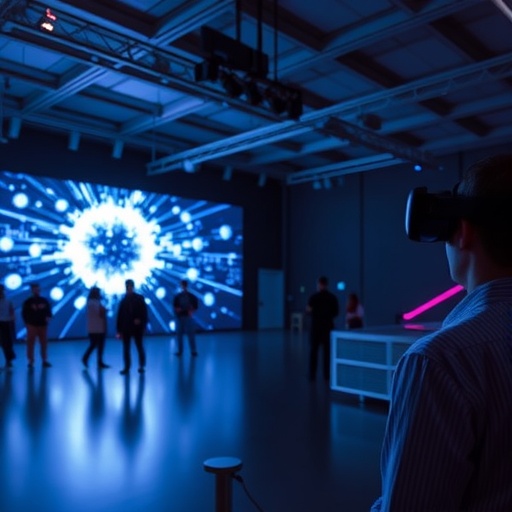
In a groundbreaking advancement for particle physics research, a team led by physicists Yu-Mei Zhang and Zheng-Yun You has unveiled an immersive virtual reality (VR) platform designed to revolutionize the exploration and analysis of complex detector geometries and event data within the Jiangmen Underground Neutrino Observatory (JUNO) experiment. This novel VR framework leverages cutting-edge technology to transcend the constraints of traditional 3D visualization methods, providing physicists with an unprecedented environment for detailed examination and simulation of particle interactions.
Traditional visualization tools often falter in portraying intricate detector architectures and dynamic particle events with the level of interactivity and precision necessary for frontier physics inquiries. Addressing this gap, the newly developed system utilizes the Unity engine—a powerful, cross-platform game development platform—to create an immersive virtual space that faithfully replicates the intricate geometric structures of the JUNO detector. This immersive virtual rendering maintains strict alignment with detector geometry descriptions derived from offline software, thereby preserving the scientific rigor and accuracy that high-energy physics demands.
The heart of this innovation is a spatially interactive user interface, accessible through the state-of-the-art Meta Quest 3 head-mounted display and operated via handheld controllers. This setup empowers researchers to navigate within the detector environment freely, manipulate detector sub-components, and control the temporal progression of physics events in a manner akin to being physically present inside the experimental apparatus. Such fidelity of interaction greatly enhances the user’s ability to discern spatial relationships and temporal correlations within multifaceted datasets.
One of the most impressive technical feats of the VR framework lies in its precise visualization of Photomultiplier Tubes (PMTs), key sensor units within the JUNO detector. With tens of thousands of PMTs represented in high geometric fidelity, the system color-codes hit multiplicity using a nuanced gradient from light to dark blue. This chromatic encoding offers instant visual cues regarding the intensity and distribution of photon hits, enabling rapid pattern recognition and more intuitive analysis of particle interactions.
Beyond static visualization, the system incorporates a robust particle system algorithm to dynamically illustrate photon propagation paths. This feature is invaluable for studying the stochastic nature of photon travel and energy deposition patterns within the detector volume. By simulating these paths in real time, the VR interface affords researchers an interactive platform for testing hypotheses and refining event reconstruction algorithms with a level of granularity difficult to achieve through conventional software.
The immersive VR approach shines particularly in the representation of complex physics events such as Inverse Beta Decay (IBD) signals. Highlighting the characteristic temporal delay of approximately 170 microseconds between positron and neutron signals, the system provides a visually intuitive animation of this nuanced interplay. This temporal visualization aids in disentangling signal characteristics critical to neutrino detection, as well as enhancing understanding of the underlying physical processes.
For high-energy cosmic muon events, the VR platform reproduces detailed particle trajectories through the detector volume, coupled with the corresponding energy deposition processes. Researchers can observe the precise spatial progression of muons and their interactions within the detector medium. These immersive reconstructions facilitate a deeper analysis of background events and detector responses, which are essential for the accurate identification of neutrino signals buried amidst cosmic noise.
Time control within the VR environment allows users to replay and inspect event evolutions with nanosecond precision. This granular temporal navigation provides a powerful tool for comprehensively analyzing transient phenomena, enabling the scientific community to unravel subtle details that might otherwise be overlooked. By advancing temporal manipulation capabilities, the platform supports a new paradigm of event analysis in neutrino physics.
The team’s application of VR technology is not confined merely to visualization but extends to optimizing simulation and reconstruction algorithms. By immersing researchers in a virtual representation of the detector that is both accurate and manipulable, the platform acts as a testbed for refining computational models, improving the fidelity of simulation outputs, and ultimately enhancing the precision of physics analyses.
Looking towards the future, the immersive VR environment developed for JUNO is poised to facilitate groundbreaking discoveries in neutrino physics. Researchers anticipate leveraging the platform for the meticulous scrutiny of neutrino signal events and the pursuit of rare event signatures. This approach will aid in identifying subtle patterns and anomalies within complex, high-dimensional datasets that conventional analysis might fail to detect.
Professor Zheng-Yun You from Sun Yat-sen University emphasizes the transformative impact of this technology: “VR technology provides physicists with an analysis platform that simulates the experience of being inside the detector. Through the VR interface, we can reconstruct an immersive view of the event in three-dimensional space, allowing us to freely explore the data, observe details from multiple perspectives, and identify potential patterns and anomalies.” This statement encapsulates the paradigm shift ushered in by the platform, where virtual immersion becomes integral to experimental physics.
The implications of this VR framework extend beyond the JUNO experiment itself. Its success demonstrates the potential for broad application across large-scale scientific facilities where the complexity of data and experimental arrangements often challenges conventional visualization and analysis tools. Adopting immersive VR technology could redefine the standard modes of interaction with high-dimensional scientific data in various fields.
By integrating advanced VR with precise offline software data, the platform ensures that complex detector geometries and intricate event details are captured with scientific accuracy and presented in an accessible, interactive format. This synthesis represents a critical step in bridging the gap between data acquisition and human interpretability—an essential advance as experimental setups grow more sophisticated and datasets more voluminous.
In summary, this innovative Unity-based VR visualization tool exemplifies how immersive technology can empower physicists to explore, analyze, and interpret particle physics data with a new depth of understanding. By merging high-precision detector information with dynamic, interactive representations, this platform not only enhances current research capabilities but also paves the way for future scientific breakthroughs in neutrino physics and beyond.
Subject of Research: Not applicable
Article Title: Unity-based virtual reality for detector and event visualization in JUNO experiment
News Publication Date: 5-Feb-2026
Web References: DOI link – http://dx.doi.org/10.1007/s41365-026-01900-x
Image Credits: Zhengyun You
Keywords
Nuclear physics, Particle accelerators


