

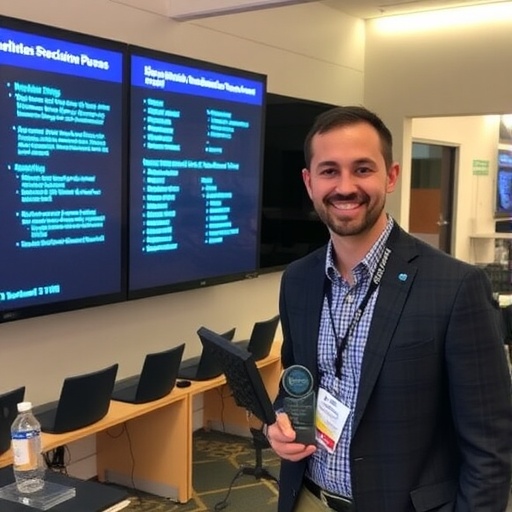
In a significant accolade underscoring the profound impact of emerging technologies, Binghui Wang, an Assistant Professor of Computer Science at Illinois Institute of Technology, has been honored with the 2025 Distinguished Junior Research & Development Award by the Institute of Electrical and Electronics Engineers (IEEE) Chicago Section. This prestigious award, presented annually to an outstanding IEEE member with less than a decade of professional experience, highlights Wang’s remarkable contributions to the fields of artificial intelligence and cybersecurity. His work, which advances the frontier of trustworthy AI systems, represents a critical stride in safeguarding the increasingly complex and ubiquitous deployment of machine learning technologies.
Wang’s recognition by IEEE Chicago emphasizes his substantial progress in research and development, particularly in AI security and trustworthy machine learning frameworks. The award committee distinguished Wang’s innovative contributions, citing a prolific publication record exceeding 114 research papers, which showcase pioneering methodologies addressing the vulnerabilities and robustness of contemporary AI systems. His groundbreaking research attracted further attention with his receipt of the National Science Foundation’s CAREER Award, a testament to his commitment to cultivating integration of theoretical rigor with applied science.
At the core of Wang’s research agenda lies the imperative to engineer AI systems that are not only performant but provably secure. This vision is essential in the era of large-scale models whose deployment in real-world contexts raises unprecedented challenges. Wang critically examines and mitigates emergent risks such as backdoor attacks—covert manipulations that can surreptitiously alter model behavior—and data leakage, which threatens privacy and intellectual property. His approach deftly balances mathematical guarantees with empirical validation to ensure that AI models behave reliably under adversarial conditions.
The complexity of modern AI architectures demands robust defense mechanisms that preserve privacy without compromising utility. Wang’s research pushes beyond conventional protective measures, innovating frameworks for privacy-preserving machine learning that safeguard sensitive information during training and inference phases. These efforts foresee applications in domains where data confidentiality is paramount, including healthcare, finance, and national security, thereby contributing to the foundation of trustworthy AI governance.
Wang’s scholarly endeavors integrate concepts from cryptography, formal verification, and system design, enabling the development of AI platforms resistant to sophisticated cyber threats. By bridging the gap between theoretical computer science and practical engineering, his work exemplifies a holistic approach to AI security. This research paradigm resonates strongly with the pressing need to instill confidence in AI deployments, especially as AI systems are increasingly embedded in critical infrastructure and high-stakes decision-making processes.
The IEEE Chicago Section’s decision to honor Wang resonates amidst a growing acknowledgment of the significance of cybersecurity in the AI landscape. His advances are instrumental in preempting and counteracting adversarial exploits that could compromise system integrity or lead to erroneous, potentially harmful outputs. Notably, Wang addresses the challenge of ensuring reliable model behavior across diverse and evolving operational environments, a cornerstone in achieving adaptive and trustworthy AI.
Beyond his technical contributions, Wang’s role as a mentor and collaborator amplifies his impact. His guidance shapes the next generation of researchers and practitioners, fostering a culture of innovation and responsibility. The synergistic efforts between Wang, his students, and collaborators encapsulate a vibrant academic ecosystem dedicated to confronting today’s AI security dilemmas with cutting-edge solutions.
Wang’s award coincides with the IEEE Chicago Section’s broader commitment to recognizing excellence across burgeoning fields such as quantum computing and STEM education partnerships. The 2025 awards dinner, where Wang received this distinction, celebrated a cohort of ten leaders who demonstrate exceptional expertise and leadership in their respective domains. This context situates Wang’s achievements within a dynamic community advancing both foundational research and public engagement.
His research ambition extends into the creation of deployable AI systems with rigorous, provable guarantees that withstand both theoretical scrutiny and practical adversities. This pursuit is crucial for critical applications where AI decisions must be transparent, predictable, and secure. Wang’s work pushes the scientific boundary not only in detecting and mitigating threats but also in fostering architectures conducive to long-term reliability and trust.
The recognition Wang has garnered reflects not only his technical prowess but also a deep commitment to addressing societal challenges posed by the rapid integration of AI into various sectors. This dual focus on innovation and ethical responsibility represents a defining characteristic of his career trajectory, eventually contributing to the shaping of global standards in AI safety and cybersecurity.
Wang’s forward-looking research roadmap envisages expanding the understanding of complex threat models and devising adaptive countermeasures that evolve alongside adversarial strategies. This dynamic, anticipatory approach is essential to securing AI ecosystems against future vulnerabilities, ensuring that technological progress continues within a framework of resilience and accountability.
Ultimately, the IEEE Chicago Section’s Distinguished Junior R&D Award bestowed on Binghui Wang epitomizes the impact that dedicated scientific inquiry can have on both technology and society. His work in trustworthy AI and cybersecurity not only advances computer science but also lays the groundwork for safer, more dependable AI applications that are increasingly integral to modern life. Wang’s recognition promises to inspire continued innovation and collaboration in these critical research areas, fueling the next wave of transformative technologies.
Subject of Research:
Artificial intelligence security, trustworthy machine learning, AI system robustness and privacy-preserving frameworks in cybersecurity contexts.
Article Title:
Illinois Tech’s Binghui Wang Earns 2025 IEEE Chicago Distinguished Junior R&D Award for Pioneering Work in AI Security
News Publication Date:
March 24, 2026
Web References:
- Illinois Tech Directory – Binghui Wang: https://www.iit.edu/directory/people/binghui-wang
- IEEE Chicago Section: https://ieeechicago.org/
- NSF CAREER Award Announcement: https://www.iit.edu/news/tackling-machine-learning-vulnerabilities-nsf-career-award
Image Credits:
Illinois Institute of Technology
Keywords
Artificial intelligence, machine learning, cybersecurity, trustworthy AI, AI security, backdoor attacks, data leakage, privacy-preserving machine learning, AI robustness, IEEE Chicago Section, NSF CAREER Award.


