

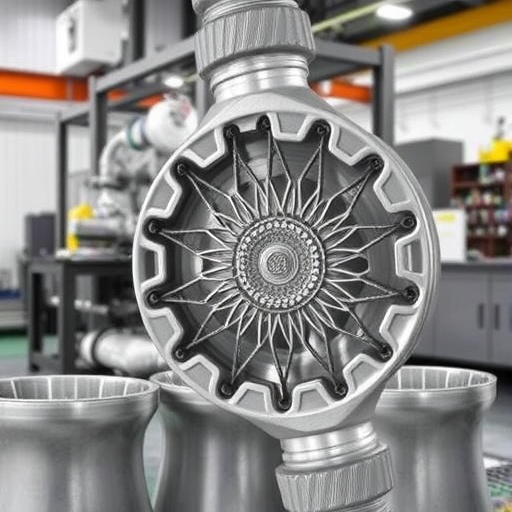
In a groundbreaking leap that could redefine the global manufacturing landscape, researchers have unveiled a revolutionary hydrogen-based technology that enables transforming raw ore directly into near-net-shape stainless steel parts. This innovative process promises to significantly streamline production, enhance sustainability, and reduce the environmental impact traditionally associated with stainless steel manufacturing. The development heralds a new era where manufacturing efficiency meets green technology, positioning hydrogen as a pivotal agent beyond its conventional fuel applications.
Traditional stainless steel manufacturing involves multiple stages, starting from ore extraction, smelting, refining, alloying, and finally shaping parts through myriad mechanical processes. Each stage, while essential, demands substantial energy, emits considerable carbon dioxide, and consumes large volumes of water and other resources. The presented hydrogen-based ore-to-part technology radically condenses these stages, employing hydrogen’s reducing capabilities to process ore and simultaneously shape the steel in near-net geometries, effectively bypassing several energy-intensive intermediate steps.
The essence of this technique lies in leveraging hydrogen’s potent chemical reactivity to serve dual roles: reducing the metal oxides directly from iron ore and facilitating in-situ sintering into near-final shapes. This dual function offers an unprecedented advantage. By integrating reduction and shaping, not only is energy usage curtailed, but the process also significantly minimizes material waste customarily generated through machining and finishing operations, which plague conventional subtractive manufacturing.
From a technical standpoint, the process hinges on finely tuned thermal and chemical conditions where hydrogen gas interacts with iron ore at precise temperatures and pressures conducive to reduction without over-sintering. The ore, primarily composed of iron oxides, undergoes chemical transformation where hydrogen strips oxygen, reducing the mineral to metallic iron. Simultaneously, under controlled sintering environments, these reduced particles coalesce and bond sufficiently maintain structural integrity, forming a near-net-shape component ready for minimal post-processing.
What sets this research apart is the focus on achieving near-net-shape manufacturing. This term describes the production of parts in geometries close to final specifications, drastically reducing the need for elaborate material removal and mechanical finishing. Near-net-shape approaches have existed primarily in powder metallurgy and additive manufacturing realms, but applying this concept directly to ore-to-metal transformation with hydrogen is revolutionary, circumventing traditional smelting and casting entirely.
Environmental sustainability is central to this innovation. Conventional smelting and steelmaking rely heavily on carbon-based reducing agents such as coke or coal, which contribute significantly to greenhouse gas emissions. By substitively replacing carbon reducing agents with hydrogen, the process drastically cuts CO2 emissions. The only by-product of the hydrogen reaction with iron oxides is water vapor, signaling a clean and eco-friendly metallurgy pathway. This represents a vital stride for the steel industry, which accounts for a substantial fraction of global carbon emissions.
Beyond environmental benefits, the hydrogen-based ore-to-part manufacturing also bears economic advantages. The process reduces the operational complexity of steel production facilities by eliminating intermediate steps and associated equipment. Furthermore, the dependency on coal and coke imports subsides, mitigating supply chain vulnerabilities and costs. Industrial adoption of this process could herald enhanced resource efficiency and cost-effectiveness alongside environmental responsibility.
Maintaining the high-quality characteristics of stainless steel within this novel process was a key challenge. Stainless steel’s corrosion resistance stems from specific alloying elements like chromium, nickel, and molybdenum, whose uniform incorporation and controlled microstructure are critical. The research team succeeded in engineering the hydrogen-based reduction and sintering conditions to accommodate these alloying elements homogeneously, preserving the mechanical strength and corrosion resistance standards expected in stainless steel applications.
The potential applications for this technology are vast, spanning sectors from automotive and aerospace to medical devices and infrastructure, where stainless steel’s durability and resistance are indispensable. By enabling flexible yet precise metal part fabrication directly from ore, manufacturers could realize customized designs without sacrificing performance or incurring the environmental toll of traditional steel production. The scalability of the process further envisions decentralized manufacturing hubs, reducing logistical footprints.
A critical aspect underpinning this technology’s viability is the integration of advanced process monitoring and control systems. Precision in temperature regulation, hydrogen flow rates, and timing are vital for ensuring consistent reduction, alloying, and sintering outcomes. Advances in thermal sensors, real-time spectroscopic analysis, and AI-powered process analytics collectively contribute to maintaining quality control and optimizing system efficiency, reinforcing the industrial readiness of the method.
This research also aligns well with the increasing global push for hydrogen economy frameworks. By extending hydrogen’s utility into metallurgical manufacturing, the technology amplifies hydrogen demand and storage infrastructures, promoting further investment and innovation in hydrogen production and distribution. The synergy between green hydrogen generation from renewable energy sources and its consumption in sustainable metal manufacturing solidifies a closed-loop eco-industrial paradigm.
While challenges remain in transitioning this technology from laboratory scale to widespread industrial implementation, initial pilot projects demonstrate promising throughput levels and part fidelity. Continued research aims at refining reaction kinetics, maximizing hydrogen utilization efficiency, and exploring the integration of other alloy systems beyond stainless steel to broaden the technology’s scope. Collaboration with industry partners is underway to accelerate commercialization pathways.
The hydrogen-based ore-to-part manufacturing marks a conceptual and practical shift in materials engineering, underscoring the transformative potential of combining chemical innovation with manufacturing science. It exemplifies the kind of systemic innovation essential for meeting the dual imperatives of industrial performance and environmental stewardship in the 21st century. Success here could inspire parallel efforts in other critical metals, catalyzing a broader revolution in sustainable manufacturing.
As the technology matures, it may redefine not only stainless steel production but also reshape how raw material resources are leveraged worldwide. Envisioning factories where unprocessed ore feeds directly into high-performance parts with minimal carbon footprint introduces a powerful vision for global manufacturing evolution. The fusion of hydrogen’s promise with modern metallurgy could indeed be the keystone in unlocking future green industrial revolutions.
Ultimately, this research signals a hopeful trajectory toward reconciling the steel industry’s immense demands with planetary health imperatives. Through harnessing hydrogen’s unique chemical properties and cutting-edge process innovations, the pathway from ore to functional part is becoming shorter, cleaner, and more efficient. Such developments reinforce how scientific ingenuity coupled with environmental consciousness can drive technologies that balance human progress and ecological responsibility.
The implications of this work extend beyond technical merits, offering compelling narratives for policy makers, industrial leaders, and environmental advocates. Integrating hydrogen-based ore-to-part manufacturing within strategic industrial frameworks could accelerate decarbonization goals, stimulate economic revitalization, and influence global supply chain resilience. It positions steel production at the forefront of sustainable innovation, helping societies align with ambitious climate targets.
As industries and governments worldwide grapple with decarbonization challenges, the hydrogen-enabled ore-to-part stainless steel manufacturing provides a beacon of transformative potential. It encapsulates a vision where advanced chemistry, materials science, and manufacturing converge to create solutions that are not only viable but imperative for sustainable industrial futures. The global manufacturing sector may soon witness the dawn of a truly green steel era.
Subject of Research:
Hydrogen-based ore-to-part manufacturing technology for near-net-shape stainless steel production.
Article Title:
Hydrogen-based ore-to-part manufacturing of near-net-shape stainless steel.
Article References:
Yang, M., Kannan, R., Keshavarz, M.K. et al. Hydrogen-based ore-to-part manufacturing of near-net-shape stainless steel. npj Adv. Manuf. 3, 9 (2026). https://doi.org/10.1038/s44334-026-00069-w
Image Credits: AI Generated


