

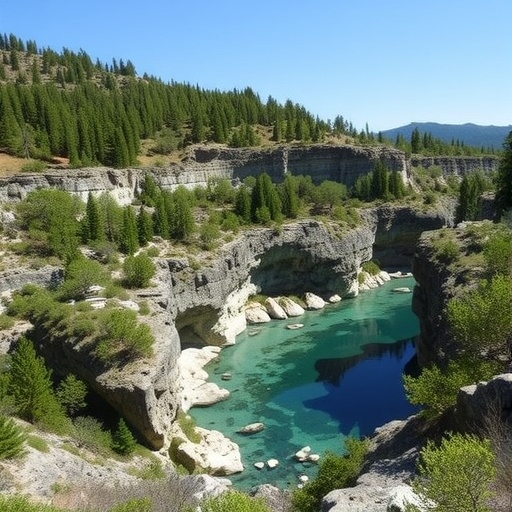
In the intricate landscapes of Southwestern China, the enigmatic world of karst groundwater systems is gradually unfolding its secrets through the lens of hydrochemical and multi-isotopic analyses. A recent groundbreaking study by Yu, J., Yang, S., Xie, Z., and colleagues published in Environmental Earth Sciences has set a new benchmark in understanding the genesis and dynamic behavior of these complex subterranean water networks. The ramifications of their findings offer not only a fresh perspective on groundwater evolution but also hold critical implications for water resource management in karst regions globally.
Karst groundwater systems, characterized by their unique geological formations including caves, sinkholes, and underground rivers, have long posed challenges for hydrologists due to their heterogeneous and anisotropic nature. The study in question delves deep into the hydrochemical signatures of these waters, employing an array of isotopic tracers that reveal both the origin and transformation processes of the karst waters. By integrating these chemical clues with isotopic data, the researchers mapped a robust genesis model that delineates the recharge sources, flow paths, and interaction mechanisms within the karst aquifer.
One of the pivotal aspects of this research is the application of multi-isotopic markers, including stable isotopes of oxygen and hydrogen, as well as radiogenic isotopes that provide time scales for water residence and renewal rates. These sophisticated analytical tools enable a nuanced understanding of how groundwater in karst regions interacts with surface water and the surrounding geology. The study demonstrates that isotopic compositions vary significantly across the region, influenced by factors such as altitude, temperature, and precipitation patterns, which are crucial in tracing the water recharge and subsequent modifications it undergoes underground.
In addition to delineating recharge sources, the hydrochemical profiles compiled reveal complex interactions between groundwater and the carbonate rocks constituting the karst system. The dissolution of carbonate minerals, along with secondary geochemical processes like cation exchange and redox reactions, imprints distinct chemical signatures on the groundwater. The researchers observed spatial heterogeneity in these chemical parameters, highlighting zones of intense water-rock interaction that play a key role in shaping water quality and aquifer sustainability.
The research further explores the temporal dynamics of the karst system, suggesting that groundwater flow is highly variable and influenced by seasonal changes, tectonic activity, and anthropogenic factors. By integrating isotopic dating techniques, the team demonstrates how water ages within different compartments of the karst aquifer vary, indicating complex residence times that challenge conventional hydrogeological models. Such insights are invaluable for predicting the response of karst groundwater to climatic fluctuations and human interventions.
This comprehensive approach combining hydrochemistry and isotopic geochemistry provides a holistic framework for assessing karst aquifers, which are notoriously difficult to characterize using traditional methods alone. The study’s methodology could be a blueprint for similar investigations worldwide, enabling scientists and policymakers to devise more effective conservation and management strategies for these vital water resources.
Importantly, the study casts new light on the intricate connectivity between surface processes and subterranean water systems. It underlines how surface water infiltration, influenced by variable climatic conditions, feeds into the karst aquifers, altering their chemistry and isotopic fingerprints. This interplay is essential in understanding contaminant transport pathways and potential vulnerabilities of karst groundwater to pollution.
The implications of this research extend beyond hydrogeology, touching upon ecological and socio-economic dimensions in Southwestern China. Karst groundwater supports a variety of ecosystems and supplies drinking water to millions. Understanding its genesis and evolution enables better risk assessment and ensures sustainable utilization, particularly in regions facing increasing water scarcity and environmental pressures.
Moreover, the study’s findings emphasize the sensitivity of karst systems to changes in environmental parameters. The isotopic evidence suggests that shifts in precipitation regimes and temperature, possibly driven by climate change, could markedly influence groundwater recharge and quality. This raises urgent calls for integrating climate resilience into water resource planning in karist areas.
Another crucial contribution comes from the refined conceptual model of groundwater flow in karst terrain proposed by the authors. By synthesizing their multi-disciplinary data, the team presents a dynamic model that captures the spatial-temporal heterogeneity and complex hydrochemical processes. This model challenges some established paradigms in karst hydrogeology, advocating for more nuanced and adaptable approaches to aquifer characterization.
The study also highlights the technological advancements in isotope geochemistry that have made such granular analyses feasible. The precision and resolution offered by state-of-the-art instruments enable the discrimination of subtle variations in isotopic ratios, opening new frontiers in groundwater research. These advancements are pivotal in uncovering processes that were previously hidden or misunderstood.
Furthermore, the integration of isotope data with hydrochemical measurements exemplifies the power of interdisciplinary research in Earth sciences. By bridging geochemistry, geology, and hydrology, the research team provides a compelling case for collaborative approaches in tackling complex environmental problems.
Beyond its academic significance, this research holds tangible benefits for local communities. Water managers can leverage these insights to design more efficient and sustainable groundwater extraction schemes, minimizing overexploitation and preserving aquifer health. It also informs pollution control measures by identifying vulnerable zones and pathways within the karst groundwater system.
In sum, this study represents a milestone in karst hydrogeology, demonstrating how multifaceted scientific techniques can unravel the complexities of groundwater systems. Its revelations pave the way for more sustainable water management practices in karst regions not only in Southwestern China but across the globe, where similar challenges prevail.
As pressures on freshwater resources mount worldwide, studies like this remind us of the critical need to deepen our understanding of natural water systems. The interplay of geology, chemistry, and hydrology in shaping groundwater resources is a testament to the delicate balance sustaining life and ecosystems. Through innovative science and collaborative efforts, protecting these vital resources becomes an achievable goal.
The research by Yu and colleagues ultimately exemplifies the transformative power of scientific inquiry in decoding nature’s complexities. Their integration of hydrochemical and isotopic tools offers a potent analytic framework for future explorations. As karst systems become ever more significant in the context of global water security, such pioneering work will remain indispensable.
Subject of Research: Genesis and hydrochemical characterization of the karst groundwater system in Southwestern China using multi-isotopic analysis.
Article Title: Hydrochemical and multi-isotopic insights into the genesis model of the karst groundwater system (Southwestern China).
Article References:
Yu, J., Yang, S., Xie, Z. et al. Hydrochemical and multi-isotopic insights into the genesis model of the karst groundwater system (Southwestern China). Environ Earth Sci 84, 702 (2025). https://doi.org/10.1007/s12665-025-12723-1
Image Credits: AI Generated


