

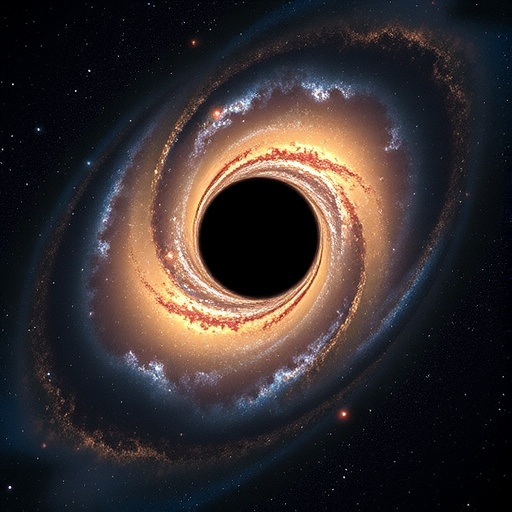
In a groundbreaking astronomical discovery, researchers have unveiled that the intense radiation emitted by active supermassive black holes—commonly situated at the cores of galaxies—can influence star formation not only within their host galaxies but also extend this impact to others located millions of light-years away. This paradigm-shifting finding emerges from a detailed study led by Yongda Zhu, a postdoctoral researcher at the University of Arizona’s Department of Astronomy and Steward Observatory, published in The Astrophysical Journal Letters.
The traditional cosmological view has held that galaxies, separated by vast cosmic distances, evolve largely independently. Zhu’s team challenges this notion by presenting compelling evidence that an extraordinarily active, supermassive black hole in one galaxy can exert a gravitational and radiative influence on neighboring galaxies, suggesting that galaxy evolution operates not in isolation but as a complex, interconnected cosmic ecosystem.
Supermassive black holes, often gothic cosmic enigmas, possess masses that range from millions to billions of solar masses. Their invisibility stems from the fact that black holes themselves emit no light; however, when they actively accrete surrounding matter, they transform into quasars. These quasars shine brighter than entire galaxies due to immense energy release from hot, infalling gas swirling in an accretion disk close to their event horizon, outshining their host galaxies by hundreds of trillions of times the luminosity of our sun.
An early puzzle that seeded this research was the unexpected observational result from the James Webb Space Telescope (JWST), which revealed a surprisingly sparse population of galaxies around some of the universe’s most luminous quasars during its formative billion years. This discovery ran counter to conventional wisdom, which predicts that massive galaxies cluster densely. Zhu and his team hypothesized that star formation in some galaxies near quasars might be suppressed, rendering these galaxies faint and challenging to detect.
To investigate, the team focused on quasar J0100+2802, an extraordinary cosmic beacon powered by a supermassive black hole with an estimated mass approximately 12 billion times that of the sun, seen as it existed more than 13 billion years ago. Utilizing the JWST’s unmatched infrared sensitivity, they observed the emission of doubly ionized oxygen (O III), a tracer of very recent star formation activity, in galaxies surrounding this quasar.
The data provided a striking revelation: galaxies within roughly a million-light-year radius exhibited significantly diminished O III emission relative to their ultraviolet light, signaling a suppression of the recent burst of star formation. The intense radiation emanating from the quasar appears to heat and dissociate molecular hydrogen clouds—the reservoirs of star-forming gas—effectively quenching their ability to collapse and birth new stars.
This insight illuminates the role played by quasar radiation as a formidable regulator of star formation across intergalactic scales. Previously, such feedback effects were primarily attributed to local environments within host galaxies alone. Now, the evidence suggests that the colossal radiation fields influence star-forming conditions well beyond their immediate galactic neighborhoods, shaping the evolution of myriad galaxies in their vicinity.
The implications of this discovery for cosmic evolution are profound. By acting as powerful cosmic predators, supermassive black holes do not merely consume matter but influence the stellar birthrates of galaxies in their proximate environment, orchestrating a large-scale modulation of galactic growth. This intergalactic regulatory mechanism offers a new lens through which scientists can understand the coevolution of galaxies and their central black holes.
Technically, the breakthrough was enabled by JWST’s extraordinary capability to capture faint infrared signatures emanating from the universe’s earliest epochs, overcoming the challenges posed by cosmic expansion stretching light wavelengths. Such faint signals would have been unobservable using previous generation telescopes, highlighting JWST’s pivotal role in unveiling high-redshift phenomena.
The study raises intriguing questions about our own Milky Way’s history. While currently dormant, the supermassive black hole at the center of our galaxy may once have been a vibrant quasar with properties similar to J0100+2802. If so, similar feedback processes could have influenced star formation within the Milky Way and its neighboring galaxies, leaving an indelible imprint on the local cosmic landscape.
Looking ahead, Zhu and colleagues aim to extend their observations to other quasar fields to assess how prevalent this suppression effect might be and to dissect additional mechanisms potentially influencing galactic evolution in the early universe. This pursuit promises to deepen our grasp of the cosmic tapestry and clarify the intricate interplay between black holes and galaxy formation.
In essence, this discovery rewrites the cosmic narrative, revealing that the lives of galaxies are not solitary journeys but part of a grand ecological symphony orchestrated by supermassive black holes. These cosmic behemoths, through their radiant ferocity, apparently sculpt the star formation histories of vast galactic neighborhoods, heralding a new understanding of how structure and complexity emerged in the early cosmos.
Such revelations underscore the dynamic and interconnected nature of the universe and highlight the transformative power of next-generation astronomical observatories. As more data emerges from JWST and upcoming missions, astrophysicists are poised to uncover further secrets about the formative eras of galaxies and their monstrous black hole hearts.
Subject of Research:
Not applicable
Article Title:
Quasar Radiative Feedback May Suppress Galaxy Growth on Intergalactic Scales at z = 6.3
News Publication Date:
3-Dec-2025
Web References:
https://doi.org/10.3847/2041-8213/ae1f8e
https://jwst.arizona.edu/
https://astro.arizona.edu/
References:
Yongda Zhu et al., “Quasar Radiative Feedback May Suppress Galaxy Growth on Intergalactic Scales at z = 6.3,” The Astrophysical Journal Letters, 2025.
Image Credits:
NASA, ESA, Joseph Olmsted (STScI)
Keywords
Supermassive black holes, quasars, galaxy evolution, James Webb Space Telescope, star formation suppression, intergalactic feedback, early universe, cosmic ecology, O III emission, molecular hydrogen, cosmic radiation, galactic growth


