

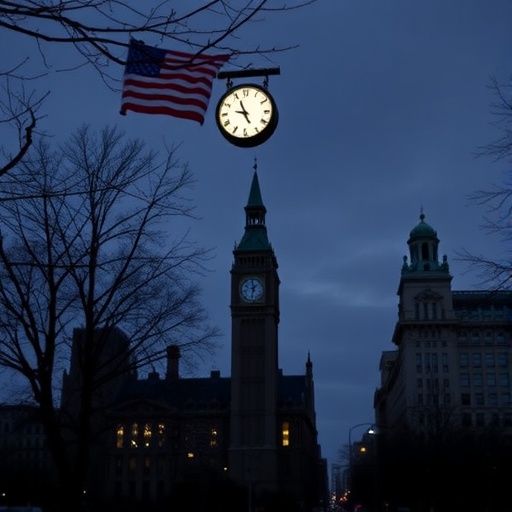
A comprehensive new study has shed light on the psychological impacts of the biannual clock changes associated with Daylight Saving Time (DST) and Standard Time (ST) in the United States, revealing that these temporal shifts trigger notable negative sentiments among the population. Published on March 4, 2026, in the open-access journal PLOS One, this research leverages social media sentiment analysis to quantify public mood fluctuations around these pivotal periods. The investigation reveals a striking disparity: while both time changes evoke adverse reactions, the transition back to Standard Time in the early fall provokes a more sustained and deeper depressive response compared to the spring shift to Daylight Saving Time.
The origins of Daylight Saving Time date back over a century, instituted in 1918 during World War I to conserve energy by capitalizing on extended evening daylight hours. Although the rationale was rooted in economic efficiency and resource management, modern scrutiny has questioned the enduring practical benefits of adjusting clocks twice yearly. Increasingly, DST has become a contentious topic, drawing attention not only for its questionable effect on energy savings but also for the broader social, economic, and health repercussions it entails.
In this latest research endeavor, led by Ben Ellman, an independent researcher based in Illinois, alongside Michael Smith from Purdue University’s College of Agriculture and their colleagues, the study taps into the vast troves of public expression aggregated from social media platforms, predominantly X (formerly Twitter). By analyzing millions of posts made within a critical 20-day window bracketing the clock shifts from 2019 to 2023, the authors meticulously applied sentiment analysis techniques using the Quid Social Media Listening platform. This approach enabled them to capture real-time, organic emotional responses to the time changes at scale, offering a novel lens into public mood dynamics.
The findings articulate a clear negative sentiment spike correlating with both the spring and fall clock changes. However, the downturn in affective tone observed following the switch to Standard Time in late autumn was notably more pronounced and persistent. This suggests that while the loss of an hour in spring causes an immediate dip in mood, people tend to rebound relatively quickly, adapting within days. In contrast, the shift back to Standard Time, which effectively results in earlier sunsets and longer evenings, appears to exert a more enduring depressive impact on communal sentiment.
Several factors may contribute to this asymmetry. The fall time change coincides with diminishing daylight and often with inclement weather conditions, both of which are known contributors to Seasonal Affective Disorder (SAD) and general mood decline. Furthermore, the disruption to circadian rhythms that occurs with both clock changes affects sleep patterns and biological functioning, but the compounded effect of reduced evening light in fall could exacerbate these negative physiological and psychological outcomes.
Importantly, the authors caution that the emotional response to temporal adjustments is a multifaceted behavioral phenomenon. While their analysis robustly captures population-level sentiment trends, it does not disentangle the potential moderating effects of age, socioeconomic status, geographic latitude, or individual chronotypes—factors which might influence susceptibility to the mood alterations linked to time shifts. Future research, they argue, should strive to explore these nuances to better understand who is most vulnerable and under what conditions.
The research also underscores a persistent public discontent toward the practice of altering clocks seasonally. Despite occasional policy debates and legislative proposals aimed at abolishing biannual time changes—either by adopting permanent Standard Time or permanent Daylight Saving Time—the social media data reflects a general aversion to the disruptions caused by these mandated temporal jumps. However, the study stops short of conclusively recommending one permanent time regimen over another, highlighting that preference for ST or DST remains unmeasured in this sentiment landscape.
Technically, the methodology employed harnessed advanced natural language processing algorithms capable of parsing contextual sentiment from a vast array of social media text data. This computational approach to behavioral analysis enables researchers to overcome traditional survey limitations, such as recall bias or sample size constraints, thereby delivering near real-time insights into collective psychological states with unprecedented granularity and scope.
The significance of these findings extends beyond academic interest; they carry practical implications for public health policy, workplace productivity, and societal wellbeing. Given the elevated risk of depressive symptoms associated with the fall clock change, stakeholders in health and labor sectors might develop targeted interventions to mitigate these effects. Moreover, this evidence base adds weight to ongoing discussions about the potential discontinuation of clock switching as a public policy.
In summation, Ellman, Smith, and their collaborators provide compelling social media-based evidence that the biannual time changes are not merely inconvenient but bear measurable psychological costs, with the autumnal reversion to Standard Time manifesting in a particularly intense and lasting negative sentiment. This study paves the way for further interdisciplinary investigations into how temporal structures governed by human policy impact mental health and societal rhythms, emphasizing the value of digital social data as a window into collective human experience.
As the debate over the future of Daylight Saving Time continues to gain momentum worldwide, insights gleaned from this research could inform more empathetic and scientifically grounded decisions. The nuanced understanding of public mood responses to time changes may well influence how governments balance historical tradition, energy policy, and mental health considerations in crafting future temporal frameworks.
Source: Ellman B, Smith ML, Reeling C, Widmar NJO (2026) Social media analysis reflects the negative sentiments experienced at both time changes with somewhat more depressive impact in early fall. PLOS One 21(3): e0342789. DOI: 10.1371/journal.pone.0342789.
Subject of Research: People
Article Title: Social media analysis reflects the negative sentiments experienced at both time changes with somewhat more depressive impact in early fall
News Publication Date: 4-Mar-2026
Web References: http://dx.doi.org/10.1371/journal.pone.0342789
References: Ellman B, Smith ML, Reeling C, Widmar NJO (2026) Social media analysis reflects the negative sentiments experienced at both time changes with somewhat more depressive impact in early fall. PLOS One 21(3): e0342789.
Image Credits: Ellman et al., 2026, PLOS One, CC-BY 4.0
Keywords: Daylight Saving Time, Standard Time, social media sentiment analysis, mental health, circadian rhythm, seasonal affective disorder, time change impact, public health policy, natural language processing, behavioral research


