

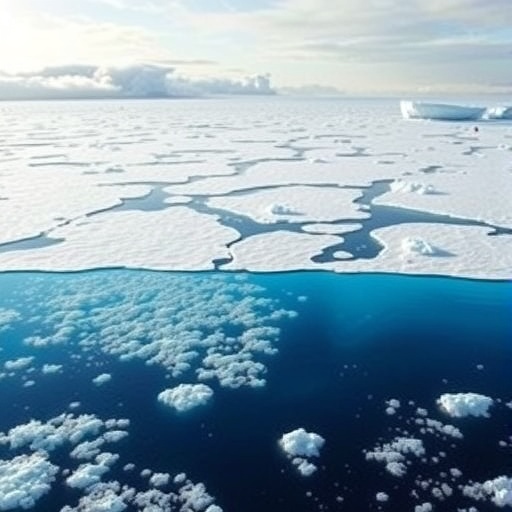
In the dim, frigid expanses of the deep ocean, a phenomenon akin to snowfall silently unfolds—a cascade of particulate matter known as “marine snow.” This marine detritus comprises the composite remnants of biological matter, including dead organisms, fecal pellets, and organic debris that drift from the surface to the abyssal depths. Integral to oceanic biogeochemical cycles, marine snow serves as a critical vector for carbon flux, facilitating the transport and sequestration of atmospheric carbon dioxide into the ocean’s interior. Yet, groundbreaking research by MIT scientists and collaborators reveals a formidable inhibitor lurking within this process: microscale bacterial activity that may dramatically constrain the sinking depths of these carbon-laden particles.
Marine snow’s propensity to sink is significantly influenced by the mineral composition embedded within its structure, particularly calcium carbonate (CaCO3). This mineral, abundant in the shells and exoskeletons of phytoplankton and marine invertebrates, functions as a ballast, imparting density to the composite aggregates. Traditionally, scientific consensus, grounded in thermodynamic principles, has maintained that calcium carbonate remains stable and insoluble within the ocean’s upper layers—generally above 1,000 meters depth—due to the prevailing temperature, pressure, and pH milieu. Such stability predicates the efficient descent of marine snow to abyssal zones where carbon may be sequestered for millennia.
Contrary to these expectations, empirical oceanographic measurements frequently document the dissolution of calcium carbonate within shallow ocean strata, posing a conundrum for researchers. The MIT-led study elucidates this paradox by uncovering the potent role of bacterial consortia that colonize marine snow particles. These microbial hitchhikers, through metabolic consumption of organic substrates, excrete acidic byproducts that locally reduce pH microenvironments on particle surfaces, thereby fostering the dissolution of otherwise stable calcium carbonate. This microbial mediation occurs on a microscale that traditional macroscale ocean chemistry models fail to capture, highlighting an intricate layer of complexity in marine carbon cycling.
To interrogate the dynamics of microbial influence on calcite dissolution, the research team engineered a series of controlled laboratory experiments employing synthetic marine snow analogs. These lab-simulated particles were crafted with precise variable concentrations of calcium carbonate and colonized with bacterial strains representative of natural ocean communities. Utilizing innovative microfluidic devices, the team perfused these particles with seawater at modulated flow rates that simulated differing sinking velocities. This approach allowed precise quantification of calcium carbonate dissolution rates in response to bacterial metabolic activity and hydrodynamic conditions.
Findings revealed a nuanced, non-linear relationship between sinking speed, bacterial respiration, and mineral dissolution. At slow sinking velocities, reduced oxygen influx creates hypoxic particle environs, limiting bacterial activity and subsequent acid production. Conversely, rapid sinking facilitates sufficient oxygenation but enhances surrounding fluid exchange, diluting acidic metabolites and attenuating their corrosive effect on calcium carbonate. Intriguingly, an intermediate sinking velocity emerges as a “sweet spot” wherein bacterial metabolic acidification is maximized, driving robust calcite dissolution and thereby eroding the particle’s ballast.
This microbe-mediated degradation undermines marine snow’s weight and sinking efficiency, causing particles to linger in shallower waters longer. Prolonged residence time elevates the probability that organic carbon within these particles will be respired by bacteria, converting previously sequestered carbon back into aqueous or atmospheric CO2. These findings challenge existing paradigms of the ocean’s biological pump efficacy and indicate that microbial biogeochemical processes exert substantial control over ocean carbon sinks, potentially impinging on the ocean’s capacity to mitigate anthropogenic CO2 emissions.
Lead investigator Andrew Babbin underscores the implications of these microscale interactions for global carbon cycle models: “Our research reveals that carbon sequestration through marine snow sedimentation is not solely dictated by physical and chemical oceanographic conditions on a large scale but is profoundly influenced by microbial ecology at the particle level. Integrating these biological feedback mechanisms is essential for accurate climate projections and geoengineering strategies aimed at CO2 drawdown.”
The study also carries profound ramifications for climate intervention proposals that seek to enhance the ocean’s biological carbon pump. Bioengineering or biogeochemical manipulations designed to accelerate carbon export must account for microbial consortia’s capacity to degrade mineral ballast and thus thwart particle sedimentation. In this context, Benedict Borer—a key author—emphasizes, “Engineering solutions to atmospheric CO2 accumulation must reckon with these natural microbial feedbacks that modulate carbon transport and utilization in unexpected ways.”
Beyond lab experiments, the researchers corroborate their findings with oceanographic observations of dissolved calcium carbonate in surface waters globally, affirming the pervasive role of microbial metabolic processes. This discovery encourages a reevaluation of oceanic carbon sequestration models that have historically underestimated microbial degradation pathways and their climatic consequences.
This pioneering investigation leveraged interdisciplinary expertise spanning marine biology, geochemistry, and microfluidic engineering, supported by grants from the Simons Foundation, National Science Foundation, and MIT’s Climate Project. Simulated marine snow and advanced microfluidic assays provided unprecedented resolution of microscale biogeochemical interactions, illuminating a previously unappreciated dimension of carbon cycling in the marine environment.
Looking forward, the team necessitates extended field studies to quantify these microbial effects across varied oceanic regimes, integrating molecular microbial ecology with in situ biogeochemical measurements. Such holistic approaches will refine predictive models of the ocean carbon sink’s response under changing climatic conditions and inform sustainable stewardship of marine ecosystems.
In sum, the intricate dance between microscopic bacteria and microscopic mineral particles reveals a profound interactive mechanism regulating carbon flux in the ocean. These insights not only fill gaps in our scientific understanding but also compel a cautious, biology-informed approach to ocean-based climate solutions, emphasizing that nature’s complexities defy simplistic technological fixes.
Subject of Research: Microbial impacts on calcium carbonate dissolution in sinking marine particles and implications for ocean carbon sequestration.
Article Title: “Microbially-enhanced dissolution of calcite in sinking marine particles.”
Web References: 10.1073/pnas.2510025123
Keywords
Oceanography, Marine snow, Carbon sequestration, Calcium carbonate, Biological pump, Microbial ecology, Biogeochemistry, Microfluidics, Climate change, Carbon cycle, Bacteria, Ocean chemistry


