

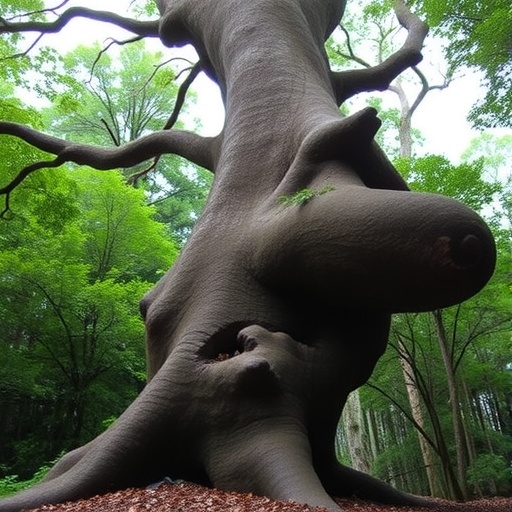
In the remote temperate rainforests of Chile’s Coast Range, ancient alerce trees—Fitzroya cupressoides—stand as silent sentinels of time, some living for millennia and attaining monumental girths rivaling shipping containers. These majestic conifers are not only ecologically significant as carbon sinks but are now revealed to be hosts to remarkably diverse communities of soil fungi, a discovery that fundamentally deepens our understanding of forest ecosystem complexity and resilience. Recent research published in the journal Biodiversity and Conservation sheds light on the mycorrhizal fungal diversity beneath these giants, unveiling a subterranean world that contributes critically to forest health and climate regulation.
The research highlights how the oldest and largest alerce trees harbor fungal communities beneath their roots that are more than twice as diverse as those found under smaller, younger trees of the same species. This increased fungal richness includes an impressive array of species, many of which are likely new to science, underscoring the alerce’s role as a keystone species for maintaining biodiversity below ground. Mycorrhizal fungi form symbiotic associations with tree roots, extending their ability to access water and essential nutrients, which aid the trees in coping with environmental stressors such as drought and pathogenic attacks.
Mycorrhizal networks do not merely support individual trees but facilitate nutrient cycling and carbon sequestration at ecosystem scales. Arbuscular mycorrhizal fungi, the type observed associated with alerce roots, play an outsized role globally by facilitating the transfer of approximately one billion tons of carbon into terrestrial soils each year. Such vast carbon fluxes underscore why these fungal communities are integral to mitigating climate change. Protecting these underground networks is tantamount to preserving the integrity of forest ecosystems and their capacity to act as natural climate buffers.
The team led by Drs. Camille Truong and Adriana Corrales, from institutions including Royal Botanic Gardens Victoria and the Society for the Protection of Underground Networks (SPUN), conducted their studies during an expedition to Alerce Costero National Park. Detailed soil sampling beneath 31 individual trees ranging from saplings to a staggering tree over 2,400 years old revealed correlational patterns between tree size and fungal biodiversity. DNA metabarcoding techniques enabled scientists to identify hundreds of different fungal taxa, highlighting the powerful application of molecular tools to unravel cryptic biodiversity.
Beyond the sheer numbers, the study argues that the loss of large-diameter, millennial trees results in disproportionate negative cascading impacts on entire fungal communities. These fungi have developed over centuries, intricately linking multiple plants within the forest through their root systems. If a single monumental tree is felled, the subterranean biodiversity it fostered becomes imperiled, threatening the overall forest ecosystem’s resilience. This research therefore represents a critical call to action to conserve these ancient arboreal giants—not just for their carbon storage but for the biological networks they sustain.
The alerce are among the longest-lived tree species on Earth, second only to North America’s bristlecone pines. Their ecological longevity is coupled with remarkable ecological roles, but their populations have been significantly reduced by centuries of logging, fire, and changing land use. The loss of the oldest trees, such as the “Alerce Abuelo,” which was felled in 1976 despite its estimated 3,622 years of age, marks a tragic depletion of natural heritage.
Their current status is precarious; listed as threatened by the International Union for Conservation of Nature (IUCN), alerce forests continue to face pressures from development, climate change, and proposed infrastructure projects that exacerbate risks of fire, invasive species, and habitat fragmentation. Understanding what lies beneath the soil, hidden from view, but essential for forest health, adds a powerful argument for stringent protection policies that shield these ecological behemoths and their subterranean partners.
The study’s molecular genetic analyses underscore the importance of DNA-based technologies in modern ecology, illuminating species that have heretofore remained unknown or invisible by morphological surveys alone. By linking fungal richness directly to tree biomass and age, the researchers provide quantitative evidence that mature trees disproportionately contribute to soil microbial ecosystem services. Such findings could reshape forest management strategies globally, emphasizing the protection of mature trees over uniform harvesting practices.
Furthermore, the research establishes mycorrhizal fungi as vital agents in maintaining forest ecosystem functions beyond nutrient acquisition. They serve as biological conduits integrating plant communities, influencing belowground carbon storage, and buffering forests against environmental fluctuations. With these insights, conservation efforts can adopt a holistic perspective that includes subterranean biodiversity as an ecosystem asset to be preserved alongside the more visible flora and fauna.
SPUN, a pioneering non-profit initiative dedicated to mapping and conserving global mycorrhizal fungal networks, played a central role in this research. Founded by evolutionary biologist Dr. Toby Kiers, who recently received the prestigious Tyler Prize for her groundbreaking work on underground fungal networks, SPUN represents a forward-thinking approach to integrating soil microbiomes into conservation science. Their collaborations with Chilean universities and international fungal foundations have opened new frontiers in ecological research.
Ultimately, this work reframes ancient alerce trees not only as living monuments of time but as dynamic hubs within a vast, complex web of underground life. The profound diversity of fungi they shelter signals a resilience developed over thousands of years—resilience that modern humanity must strive to protect amid accelerating environmental change. The study, titled “Large-diameter trees disproportionately contribute to soil fungal diversity in a coniferous forest with one of oldest living trees on Earth,” calls for a paradigm shift, where subterranean biodiversity is recognized as a pillar of forest conservation and climate change mitigation.
As the world grapples with ecological degradation and climate crises, discoveries like these offer hope by revealing the hidden architectures of life that sustain planetary health. By protecting these time-honored giants, humanity safeguards not just rare trees but entire ecosystems of microbes that collectively sustain forest vitality and the global carbon cycle. This research vividly illustrates that forest conservation is as much about what lies underground as what towers above.
Subject of Research: Soil fungal diversity associated with large-diameter alerce trees in temperate coniferous forests.
Article Title: Large-diameter trees disproportionately contribute to soil fungal diversity in a coniferous forest with one of oldest living trees on Earth.
News Publication Date: March 3, 2026
Web References:
- Biodiversity and Conservation journal article
- Society for the Protection of Underground Networks (SPUN)
- Tyler Prize Laureate Toby Kiers
References: DOI 10.1007/s10531-026-03277-0
Image Credits: Tomás Munita / SPUN
Keywords: alerce, Fitzroya cupressoides, mycorrhizal fungi, soil biodiversity, ancient trees, temperate rainforest, fungal diversity, carbon sequestration, forest resilience, molecular ecology, conservation biology, underground networks


