

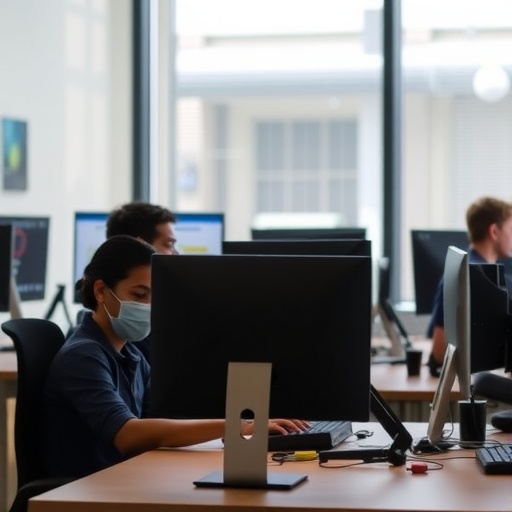
In the modern workplace, the omnipresence of smartphones has fundamentally altered social dynamics, particularly during breaks when employees traditionally engage in social interaction. A recent doctoral thesis from the University of Gothenburg provides new, in-depth insights into how the phenomenon known as “phubbing” — the act of snubbing others in favor of one’s mobile phone — influences the psychosocial work environment. This groundbreaking research not only confirms the socially disruptive potential of smartphone use but also pioneers understanding of its nuanced effects on workplace relationships and overall job engagement.
Phubbing, a portmanteau of “phone” and “snubbing,” describes the prioritization of mobile phone usage over face-to-face social interaction. While the deteriorating effects of mobile phone use on interpersonal relationships have been explored in social contexts, little empirical attention has previously been devoted to its impact within the workplace. Psychologist Per Martinsson’s research seeks to fill this critical gap by systematically investigating how mobile phone scrolling during breaks substitutes for or disrupts colleague interaction and how this behavior correlates with perceptions of the work environment.
The research methodology encompasses qualitative and quantitative approaches, including twenty-five detailed interviews with electricians and healthcare professionals, enriched by thematic analysis to extract prominent social themes. Complementary to these interviews, two large-scale survey studies were conducted with a combined sample of approximately 1,700 working adults. This mixed-methods approach allowed for a robust examination of both subjective experiences and broader trends across professions and working populations, yielding rich, multidimensional data.
One of the central findings from the interviews indicates that mobile phones frequently act as social barriers, creating invisible walls that fragment traditional communal spaces during breaks. Interviewees described how phones serve as tools for social withdrawal, latently signaling a desire for personal recovery or avoidance of social demands. This realization underscores the double-edged nature of mobile devices in the workplace — simultaneously offering respite but at the risk of social isolation.
From a psychosocial perspective, survey results revealed a strong association between perceived coworker phubbing and poorer evaluations of the work environment. Specifically, perceptions of diminished emotional and practical support, weakened trust among colleagues, eroded senses of community, and lower levels of engagement in both work tasks and organizational goals were prevalent among respondents who reported higher levels of phubbing by their peers. This comprehensive impact highlights the subtle yet profound ways in which smartphone behaviors shape workplace dynamics and collective morale.
Interestingly, the frequency of an individual’s own smartphone use did not exhibit the same negative associations with the psychosocial work environment, suggesting that it is not merely the behavior itself but the social context and perception by others that matter most. This distinction illuminates the complex interplay between individual behaviors and group norms, emphasizing that smartphone use becomes problematic when it signals disengagement or exclusion to others.
Notwithstanding these correlations, longitudinal analysis over a one-year period found no definitive evidence that phubbing behavior actively drives a decline in the psychosocial work environment. This temporal nuance calls for further empirical exploration to untangle causal relationships and to understand whether phubbing is a symptom or a catalyst of deteriorating workplace culture. Such distinctions are critical for designing effective workplace policies and interventions.
Another fascinating facet of the study pertains to generational differences in smartphone use and attitudes toward phubbing. Younger employees tend to use their phones more frequently during breaks and exhibit greater tolerance for phone use among colleagues. This generational divide signals evolving professional norms and challenges employers to foster environments sensitive to diverse expectations, where nuanced social etiquette governs digital habits during downtime.
Moreover, the research acknowledges that mobile phones are not inherently detrimental to social interaction. Interview participants reported instances where phones operated as extensions of social engagement, facilitating shared activities such as browsing pictures, watching videos, or collaboratively seeking information. This duality suggests that context-specific smartphone use can enrich rather than hinder workplace social bonds, pointing to the importance of discerning appropriate norms around mobile device use.
Per Martinsson emphasizes that promoting healthy digital etiquette in workplaces should stem from reflective dialogue rather than rigid regulations. Encouraging employees to articulate expectations and negotiate acceptable smartphone use collaboratively can nurture a more inclusive and supportive work culture. Such an approach respects individual autonomy while fostering mutual understanding and trust.
The implications of this research extend beyond individual interactions, highlighting the critical role of the psychosocial environment in influencing employee well-being, productivity, and organizational cohesion. As mobile technologies become ever more embedded in daily routines, understanding their subtle psychological and social ramifications becomes imperative for managers, policymakers, and workers alike.
This new knowledge challenges workplaces to rethink break-time dynamics in an era where digital distractions are pervasive. It raises pivotal questions about how organizations can balance the benefits of digital connectivity with the essential human need for genuine social connection. Addressing these challenges requires a culturally sensitive strategy attuned to the evolving digital landscape and workforce diversity.
Ultimately, this pioneering research not only advances academic comprehension of phubbing in professional settings but also provides a practical framework for fostering healthier, more engaged, and socially harmonious workplaces in the digital age. Its findings invite continued investigation and ongoing conversation about the role of mobile devices as both tools for connection and potential barriers to human interaction.
Subject of Research: The impact of coworker smartphone use during work breaks (phubbing) on the psychosocial work environment.
Article Title: Coworker Phubbing: Smartphone Use during Work Breaks and Its Effects on Workplace Social Dynamics.
News Publication Date: Information not provided; thesis defense scheduled for 13 March 2026.
Web References: None provided.
References: Doctoral thesis by Per Martinsson, University of Gothenburg (title: Coworker phubbing: Smartphone use during work breaks and the psychosocial work environment).
Image Credits: None provided.
Keywords: phubbing, smartphone use, workplace social interaction, psychosocial work environment, coworker relationships, digital etiquette, social withdrawal, employee engagement, workplace norms, generational differences.


