

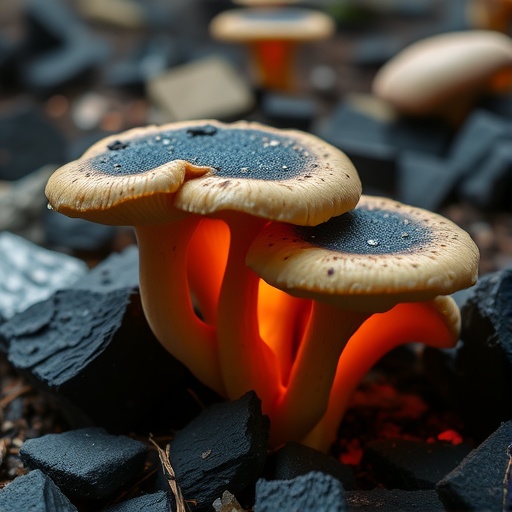
In the aftermath of devastating wildfires, the natural world undergoes profound transformations. While many organisms perish or escape the blaze, certain fungi not only survive but flourish amid the charred remnants. A groundbreaking study led by researchers at the University of California, Riverside, reveals the intricate genetic mechanisms that enable these tenacious fungi to dominate post-fire landscapes, unearthing evolutionary strategies previously unknown in the microbiological world.
Wildfires typically trigger massive ecological upheaval by rapidly consuming vegetation, animals, and microbes. However, some fungi demonstrate remarkable resilience, invigorated by the desolation and nutrient richness that follows. The new research, recently published in the prestigious Proceedings of the National Academy of Sciences, focuses on pyrophilous fungi—species that thrive specifically after fire events, despite often being inconspicuous in pre-fire soils. This investigation blends fieldwork across multiple burn sites in California with advanced genomic sequencing to uncover how these fungi adapt so readily to fire-scarred environments.
Sydney Glassman, associate professor of microbiology and plant pathology at UC Riverside and the study’s lead author, reports that by analyzing fungal genomes, her team identified three primary genetic strategies these fungi employ to utilize charcoal and survive thermal stress. Notably, these strategies include gene duplication, sexual gene recombination, and horizontal gene transfer—modes of genetic innovation that underpin the fungi’s capacity to capitalize on charred organic matter left by wildfires.
Gene duplication acts as a biological “copy-and-paste” mechanism, allowing fungi to amplify specific genes critical for producing enzymes that decompose charcoal residues—a carbon-rich but chemically complex substrate. The genus Aspergillus, familiar as the common green mold growing on bread, exemplifies this method through asexual reproduction. By increasing the number of charcoal-degrading gene copies, Aspergillus synthesizes larger quantities of cellulolytic and ligninolytic enzymes, enhancing its ability to metabolize fire-affected biomass.
Contrastingly, many Basidiomycota fungi, encompassing traditional mushroom-forming species, rely on sexual reproduction to generate genetic diversity. Through meiotic recombination during mating, these fungi shuffle gene variants to rapidly evolve traits that optimize charcoal metabolism. This sexual strategy enables the swift emergence of enzyme variants capable of breaking down the complex, recalcitrant compounds abundant in post-fire environments, demonstrating a dynamic evolutionary response to ecological niches created by fire.
Perhaps the most astonishing discovery made by the team is the horizontal acquisition of key metabolic genes by the fungus Coniochaeta hoffmannii from bacterial sources. Horizontal gene transfer, the movement of genetic material between unrelated organisms—common among bacteria but exceedingly rare across kingdoms—furnishes C. hoffmannii with novel enzymatic capabilities. This cross-kingdom genetic borrowing equips the fungus with specialized molecular tools for burning through charcoal, highlighting an extraordinary evolutionary shortcut rarely observed in eukaryotic life.
This research also clarifies how certain fungi withstand the fire itself. Some produce sclerotia, highly heat-resistant, dormant structures that persist underground for prolonged periods, effectively escaping surface-level devastation. These cryptic survival units reactivate under favorable post-fire conditions, rapidly recolonizing the nutrient-rich but competition-free soil. Other species, such as Pyronema, adopt a different approach; lacking extensive charcoal metabolism genes, Pyronema capitalizes on rapid growth and reproduction, forming conspicuous orange cup fungi that fruit explosively on freshly burned terrain, asserting dominance through sheer reproductive speed.
Understanding these unique genetic adaptations extends beyond ecological curiosity. Charcoal shares chemical traits with diverse environmental pollutants including petroleum hydrocarbons from oil spills, mining residues, and various industrial wastes. Elucidating fungal metabolic pathways capable of degrading such materials offers promising avenues for bioremediation technologies, potentially harnessing fungal species to detoxify and restore damaged ecosystems.
Despite a rich history of research on fire-adaptive plants, the fungal response to wildfires has remained comparatively obscure. This study fills a significant knowledge gap by detailing molecular and reproductive strategies fungi utilize to thrive post-fire. The findings open new research horizons into fungal biology and evolutionary innovation, emphasizing their vital role in ecosystem recovery following natural disasters.
“Our work demonstrates an array of genetic tricks fungi use to exploit niches left vacant by fire,” Glassman remarks. “From genomic duplications boosting enzyme output, through sexual recombination reshaping metabolic abilities, to rare gene exchanges across kingdoms, these mechanisms reveal fungi as dynamic evolutionary engineers within fire-affected ecosystems.” She stresses that investigating these processes further could unlock practical applications in environmental science and restoration biology.
As climate change intensifies wildfire frequency and severity globally, understanding post-fire biological dynamics becomes increasingly critical. Fungi, once overlooked as mere decomposers, emerge as key players in nutrient cycling and soil regeneration. Their genetic versatility not only aids in ecosystem resilience but also exemplifies the astonishing adaptability of life in the face of extreme disturbances.
The comprehensive five-year project involved collecting fungal specimens from seven wildfire sites across California, combining field sampling with state-of-the-art genomic analyses and experimental exposure to charcoal. This integrative approach yielded an unprecedented view into how evolutionary processes shape microbial survival strategies after catastrophic fires, with potential implications spanning ecology, evolution, and biotechnology.
In sum, this study advances our appreciation of fungi as not only survivors but specialists finely tuned by genetic innovation to capitalize on post-fire landscapes. The insights on gene duplication, sexual recombination, and horizontal gene transfer illuminate complex evolutionary pathways that enable fungi to transform burnt substrates into thriving habitats. As research continues, these discoveries may revolutionize our approach to environmental restoration and the sustainable management of fire-impacted ecosystems.
Subject of Research: Genetic adaptations and evolutionary strategies enabling post-wildfire resource acquisition in pyrophilous fungi.
Article Title: Gene duplication, horizontal gene transfer, and trait trade-offs drive evolution of postfire resource acquisition in pyrophilous fungi.
News Publication Date: January 2, 2026.
Web References: Proceedings of the National Academy of Sciences – DOI 10.1073/pnas.2519152123
Image Credits: Maria Ordonez/UCR
Keywords: Fungi, Pyrophilous fungi, Gene duplication, Horizontal gene transfer, Wildfires, Soil fungi, Mycology, Microbial ecology, Charcoal metabolism, Bioremediation, Post-fire succession, Evolutionary biology


