

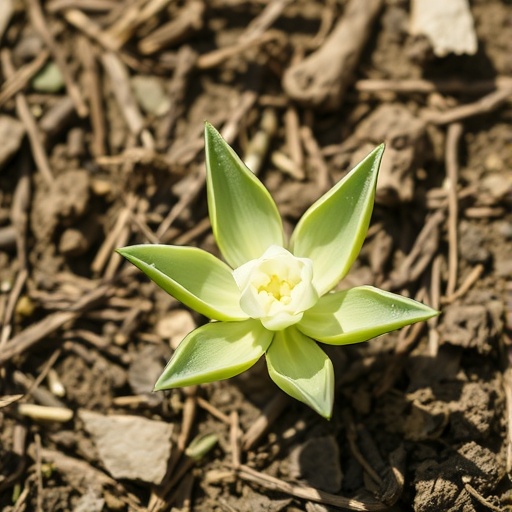
In the face of a relentless megadrought gripping the American Southwest and Mexico for over two and a half decades, researchers at the Salk Institute have made a groundbreaking advance that could transform agricultural resilience. As droughts intensify in frequency and severity, their consequent social and economic repercussions are profound, exemplified by the staggering $1.1 billion loss in California’s agriculture in 2021 alone. Understanding and mitigating the impact of water scarcity on crop productivity is therefore a global imperative. The recent study by Salk scientists addresses this challenge through an unprecedented exploration into the cell-specific genetic dynamics of plant leaves under drought stress, revealing mechanisms that could spearhead the development of drought-resilient crops.
Central to their investigation is Arabidopsis thaliana, a diminutive flowering plant widely recognized as a model organism in plant genetics and molecular biology. While far from a crop, its genetic parallels to key global staples like corn, wheat, and rice make it an invaluable proxy for agricultural research. The team meticulously profiled close to one million individual cell nuclei from Arabidopsis leaves exposed to varied drought intensities and developmental stages, constructing a high-resolution atlas that captures gene expression with unprecedented cellular detail. This atlas exposes the intricate ways drought expedites leaf aging while unveiling a critical gene component with the potential to sustain leaf growth in water-limited environments.
Traditional approaches analyzing whole leaves have provided only coarse data on gene expression, blurring the nuanced cellular responses that orchestrate plant adaptation to environmental stress. The Salk researchers overcame this limitation by employing single-nucleus RNA sequencing, which discerns the transcriptomic signatures of distinct leaf cell types. Leaves comprise several specialized cells: mesophyll cells conducting photosynthesis, vascular cells regulating water transport, epidermal cells forming protective barriers, among others. By isolating and profiling these cellular subsets, the researchers discerned that drought triggers an accelerated aging program primarily within mesophyll cells, compromising photosynthetic capacity and leaf size.
Their observations delineate a nine-day drought period during which drought-induced stress hastens the activation of genetic programs linked to leaf maturation and senescence. Notably, the severity of drought correlates directly with the intensity of this accelerated aging response. This premature aging ostensibly acts as a survival strategy, whereby plants expedite the shedding of older leaves while conserving resources by curtailing new leaf growth. While adaptive in preserving life under environmental duress, this strategy exacts a heavy toll on agricultural yield, limiting biomass accumulation and crop productivity.
Embedded within the transcriptomic landscape, the research spotlights Ferric Reduction Oxidase 6 (FRO6) — a gene whose expression is intricately tied to leaf size regulation under drought conditions. FRO6, previously implicated in iron homeostasis pathways, emerges here as a key modulator of growth resilience during stress. Importantly, the team demonstrated that enforced overexpression of FRO6 specifically in mesophyll cells enables plants to partially mitigate drought-induced growth suppression, sustaining leaf expansion despite water scarcity. This remarkable finding positions FRO6 as a promising target for bioengineering endeavors aiming to uncouple drought tolerance from growth inhibition.
Current drought-resistance breeding strategies often grapple with tradeoffs wherein enhanced survival comes at the expense of stunted development and yield penalties. By contrast, modulating FRO6 expression could preserve biomass production during moderate drought episodes, offering a nuanced approach that aligns agricultural imperatives with physiological adaptability. This discovery underscores the critical value of cell type-specific genetic insights in formulating precision strategies for crop improvement.
The newly developed atlas thus provides a foundational resource charting how diverse leaf cell types orchestrate their genetic programs in response to environmental variables. This technological milestone expands the frontier of plant molecular ecology, enabling researchers to dissect complex trait expression with spatial and temporal granularity previously unattainable. Such tools will prove indispensable as global climate change exacerbates abiotic stresses threatening food security worldwide.
These findings build upon complementary research from the Ecker lab detailing a post-drought immune mechanism termed Drought Recovery-Induced Immunity (DRII), which primes plants to rebound robustly following water stress. Collectively, these studies illuminate both the in-drought response and recovery phases, offering a comprehensive blueprint for enhancing crop durability through molecular intervention.
Senior author Joseph Ecker highlights the leap in scientific resolution achieved: “Instead of generalized snapshots, we now observe precise gene expression dynamics in every major cell type within the leaf. This atlas equips us with the granular insights needed to decipher how plants sense and respond to drought stress at the cellular level.” First author Joseph Swift emphasizes translational potential, stating, “Decoding these fine-tuned genetic programs opens avenues to engineer crops that maintain productivity under water limitations, a vital objective as drought becomes a global agricultural threat.”
Beyond immediate applications, the approach demonstrated by the Salk team exemplifies the power of systems biology and single-cell genomics to unravel complex physiological traits. As agriculture confronts an uncertain climatic future, leveraging such integrative methodologies to decode plant responses will be pivotal in safeguarding food supplies. The harmonization of detailed cell-type transcriptomics with functional genomics heralds a new era of precision crop science, where resilience and yield need not be mutually exclusive.
Supported by institutions such as the Life Science Research Foundation and the Howard Hughes Medical Institute, this pioneering research not only advances fundamental understanding but also charts a strategic course towards drought-tolerant crop varieties. The publicly available data from this study beckon a collaborative global effort across disciplines—genetics, physiology, agronomy—to translate these molecular insights into resilient, high-yielding cultivars adaptable to increasingly water-scarce landscapes.
The Salk Institute continues to lead in foundational biological research that addresses pressing societal challenges, expanding the scientific horizons necessary to mitigate climate-induced disruptions to agriculture. As plants face intensifying environmental pressures, unlocking the molecular choreography of stress resilience at the cellular level will be paramount in securing sustainable food production for the future.
Subject of Research: Genetics and molecular mechanisms underlying plant leaf responses to drought stress in Arabidopsis thaliana.
Article Title: Cell-Type-Resolved Gene Expression Atlas Reveals Drought-Accelerated Leaf Aging and a Growth-Promoting Role for Ferric Reduction Oxidase 6 in Arabidopsis thaliana.
News Publication Date: March 19, 2026.
Web References:
- Study published in Nature Plants: https://www.nature.com/articles/s41477-026-02254-3
- Drought Recovery-Induced Immunity (DRII) study: https://www.salk.edu/news-release/all-drii-ed-up-how-do-plants-recover-after-drought/
References: DOI 10.1038/s41477-026-02254-3
Image Credits: Salk Institute
Keywords: Plant genetics, drought tolerance, Arabidopsis thaliana, single-cell transcriptomics, leaf aging, Ferric Reduction Oxidase 6, cell-specific gene expression, agricultural resilience, photosynthesis, abiotic stress response, crop engineering, molecular plant biology


