

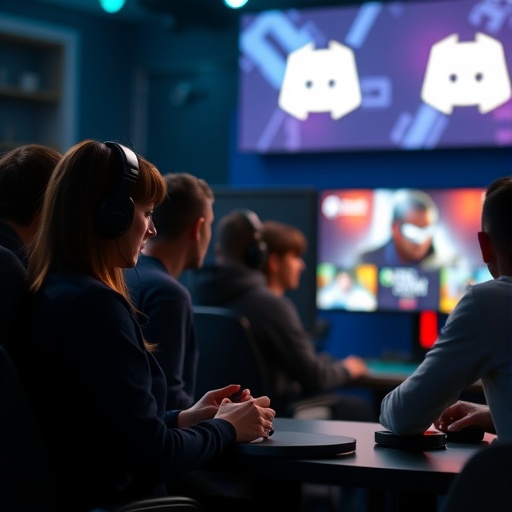
In an era where digital engagement increasingly defines social interaction, the notion of “third places”—environments separate from home and work that foster community and belonging—has evolved in profound ways. Traditionally, such spaces conjure images of cafes, parks, or neighborhood clubs, sites where people come to relax and connect. However, with the pervasive integration of online platforms into daily life, a compelling question emerges: Can virtual environments replicate the social functions of these physical third places? Recent research from Doshisha University in Japan provides illuminating insights into this phenomenon, revealing how online gaming communities, specifically those hosted on platforms like Discord, serve as vital social ecosystems.
Assistant Professor Mattias van Ommen and his colleague, former student Ginga Yahanashi, embarked on a comprehensive qualitative investigation into a Discord community known pseudonymously as Medimura. This community is centered around Splatoon 3, a competitive multiplayer game that has cultivated a dedicated player base in Japan. While competitive gaming is often demonized as a solitary or isolating activity, van Ommen’s research challenges this stereotype by revealing a dynamic social fabric underlying such gaming collectives. Their study, published in the December 2025 issue of Social Media + Society, meticulously charts the community’s evolution from a purely skill-driven hub to a socially rich environment promoting mutual support and camaraderie.
Initial motivations for joining Medimura were predominantly performance-focused, with players seeking to improve gameplay techniques and climb competitive ladders. However, over extended engagement, the research observed a notable shift in member priorities. Participants increasingly valued the social interactions available within the community, finding comfort and emotional support in day-to-day exchanges beyond the game’s competitive context. This transition underscores a fundamental human need for connection, demonstrating that even platforms centered on gaming can transcend their entertainment function to fulfill deeper social roles.
One of the key revelations of this study lies in how members seamlessly navigated the tension between competition and casual sociality. Matches retained their intensity and strategic depth, yet players routinely engaged in lighthearted conversations, humor, and personal disclosures within the same online space. This duality is critical: it reflects a sophisticated social environment where competitive drive coexists with empathetic communication, fostering a balanced community dynamic. Furthermore, clear behavioral guidelines within Medimura helped establish a respectful atmosphere, offering inclusivity to diverse participants and mitigating conflicts that could otherwise arise in a competitive context.
The concept of “third places” traditionally encapsulates locations where individuals experience relaxation and social bonding free from the rigid expectations associated with work or family life. Remarkably, Medimura manifested as such a third place, albeit entirely virtual. Many users identified the community as a rare sanctuary where they were accepted authentically without the pressures of formal social roles pervasive in Japanese workplaces and educational institutions. The study highlights how digital gaming environments, often stigmatized as isolating, can instead provide essential psychological refuge and social belonging.
Japan’s sociocultural context intensifies the significance of these findings. In many Japanese professional and academic settings, social interactions tend to be highly formalized and constrained, often limiting spontaneous or casual exchanges. Van Ommen’s research implies that gaming communities may fill a critical gap, enabling members to cultivate relationships and social identities otherwise difficult to express. This perspective challenges entrenched stereotypes regarding gamers, particularly the assumption that they lack social adeptness or meaningful interpersonal networks.
Medimura’s long-term qualitative observations reveal not only individual behavioral changes but also communal patterns that contribute to social cohesion. The researchers noted ritualized interactions, shared humor, and collective support mechanisms that mirrored traditional social clubs, yet in a digital environment. Such dynamics suggest that online platforms can sustain complex, culturally resonant forms of sociality, adapting longstanding social practices to new technological mediums. This adaptation underscores the fluidity of human social behavior in response to evolving communication landscapes.
Technologically, Discord’s robust feature set—including voice channels, text chats, and customized moderation tools—facilitated Medimura’s social infrastructure. These affordances enabled real-time interaction, asynchronous messaging, and community governance, collectively supporting diverse modes of engagement. The platform’s design helped mitigate issues common in online communities such as harassment or exclusion, demonstrating how technical architecture influences social outcomes. The integration of such technologies into everyday life thus holds promise for redefining social possibilities in the digital age.
Moreover, the study’s emphasis on voluntary participation and self-regulated norms within Medimura highlights the importance of community agency. Members collectively shape the social environment, negotiate acceptable behaviors, and establish mutual expectations, which are essential characteristics of resilient social systems. This process of social self-organization contrasts with top-down control models and showcases how digital communities can operate democratically, fostering shared responsibility and ownership.
The implications of these findings extend beyond gaming subcultures, challenging broader assumptions in social science and media studies about the isolating nature of online interaction. Van Ommen’s work adds nuance to the discourse by illustrating that digital spaces can nurture genuine social bonds and emotional intimacy. Such insights are particularly pertinent as hybrid offline-online lifestyles become the norm, prompting a reevaluation of how social well-being is maintained in a connected world.
Looking forward, this research invites further exploration into the design and cultivation of online third places across different cultural and technological settings. Understanding the mechanisms by which digital communities sustain affective ties can inform platform development, mental health interventions, and social policy aimed at fostering inclusivity and resilience in increasingly virtual societies. The Medimura case exemplifies how digital innovation, when aligned with human social needs, can create meaningful spaces that extend beyond the boundaries of traditional community.
In conclusion, the Doshisha University study disrupts conventional narratives about digital gaming and sociality by demonstrating how online gaming communities function as vital third places. Medimura’s evolution from a competitive enclave into a supportive social network highlights the transformative potential of virtual environments to cultivate belonging, emotional security, and personal expression—needs fundamental to the human condition. As digital engagement continues to permeate everyday life, recognizing and nurturing these online social habitats will be crucial for fostering connected and healthy communities worldwide.
Subject of Research: People
Article Title: Social Media + Society
News Publication Date: 1-Dec-2025
Web References:
https://doi.org/10.1177/20563051251399015
Image Credits: Valentin Ottone from Flickr
Keywords
Online gaming communities, third places, social connection, Discord, Splatoon 3, digital sociology, Japanese gaming culture, social media studies, virtual social spaces, competitive gaming, digital well-being, community dynamics


