

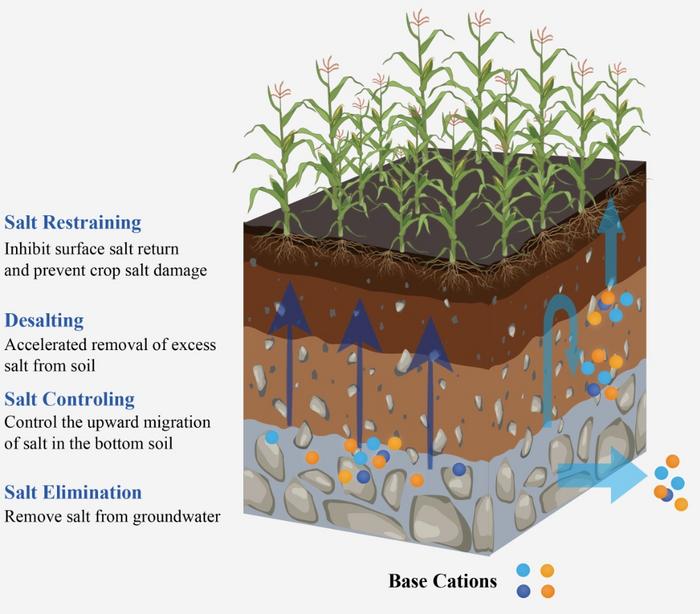
Soil salinization poses a threat to global agricultural production, food security and sustainable development. Affected by China’s population growth and social and economic development, China’s arable land has been decreasing in recent decades and is close to the critical value of 120 million hectares, the minimum area needed to maintain national food security. China has about 36.7 million hectares of saline-alkali land, of which about 12.3 million hectares have agricultural potential. About 6.67 million hectares can be used for arable land, reclamation and improvement of this part of the saline-alkali land can effectively expand land use, ease the pressure on food security, and help to increase food production to ensure national food security. In this context, saline-alkali land, as an important reserve resource, has garnered increasing attention. However, the question of how to effectively improve these soils to support plant growth and alleviate food security pressures remains urgent.

Credit: Guangzhou WANG , Gang NI , Gu FENG , Haley M. BURRILL , Jianfang LI , Junling ZHANG , Fusuo ZHANG
Soil salinization poses a threat to global agricultural production, food security and sustainable development. Affected by China’s population growth and social and economic development, China’s arable land has been decreasing in recent decades and is close to the critical value of 120 million hectares, the minimum area needed to maintain national food security. China has about 36.7 million hectares of saline-alkali land, of which about 12.3 million hectares have agricultural potential. About 6.67 million hectares can be used for arable land, reclamation and improvement of this part of the saline-alkali land can effectively expand land use, ease the pressure on food security, and help to increase food production to ensure national food security. In this context, saline-alkali land, as an important reserve resource, has garnered increasing attention. However, the question of how to effectively improve these soils to support plant growth and alleviate food security pressures remains urgent.
Recently, Dr. Wang Guangzhou from China Agricultural University (CAU) and his collaborators comprehensively reviewed the basic principles and strategies for the management and utilization of saline-alkali land in China, including freshwater irrigation and water table control, land cover and construction of deep isolation layer, balancing nutrient elements and salt ions through fertilization, and also other different farming management practices. These approaches help to reduce soil salinity, enhance soil fertility, and improve soil structure, thereby supporting healthy plant growth. The authors found that targeted improvement techniques are necessary for different regions. For instance, in the arid northwest part of China, mulched drip irrigation can significantly reduce water evaporation, control salt raising up, and improve irrigation water use efficiency. In the Northeast, rice planting can improve the physical structure of alkaline soils and lower soil pH. In the North China Plain, appropriate utilization saline water for agricultural irrigation is favorable to salt leaching and can also partially replace freshwater resources. Additionally, constructing fertile soil layers is crucial via employing various measures to improve soil quality and establish fertile arable layers.
In recent years, the concept of “crop for saline soil” in terms of improving plant tolerance to saline-alkali soil has been proposed, the authors review the relevant progress and development advances including halophyte planting, saline-alkali tolerant crop breeding and functional microbial agent researches. These plant-oriented approaches can not only significantly improve the utilization efficiency of saline-alkali land, but also improve the yield and quality of crops.
Facing future challenges, the authors propose a promising outlook for the sustainable use of saline-alkali land through customed technologies in typical region, precise regulation and management, comprehensive use of saline water resources, development of simplified and intelligent technologies, and commercial investment. These prospects provide new ideas and strategies for saline-alkali soil reclamation and utilization as well as boosting local employment and economic development.
This study has been published on the Journal of Frontiers of Agricultural Science and Engineering in 2024, 11(2) DOI: 10.15302/J-FASE-2024551.
Journal
Frontiers of Agricultural Science and Engineering
Method of Research
Experimental study
Subject of Research
Not applicable
Article Title
Saline-alkali soil reclamation and utilization in China: progress and prospects
Article Publication Date
18-Mar-2024

