

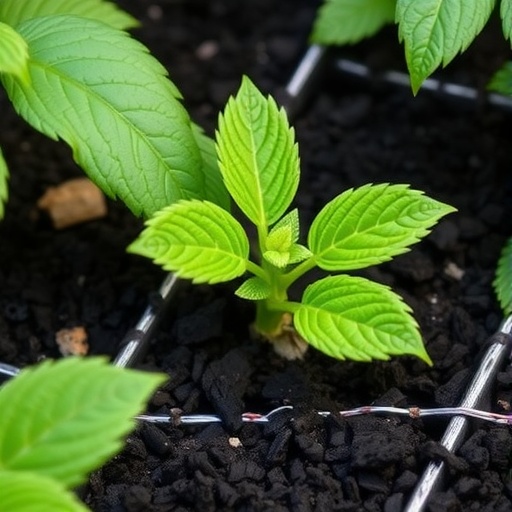
A groundbreaking study into the agricultural applications of biochar has highlighted the critical role of particle size in mediating its effectiveness against crop diseases. While biochar—a carbon-rich material derived from the pyrolysis of plant biomass—has for years been championed for its soil-enhancing properties and potential in disease suppression, this latest research underscores that its physical form ultimately governs the dynamics of pathogen control in soil environments. Specifically, the study delves into how fine versus coarse biochar particles differentially influence the management of Phytophthora blight in pepper plants, a devastating condition caused by the soil-borne pathogen Phytophthora capsici.
Previous understandings of biochar’s benefits typically emphasized its chemical attributes and carbon sequestration capabilities; however, the nuanced interplay between its particle size and biological activity in soils has remained elusive. Through a series of controlled greenhouse experiments, the research team demonstrated that biochar particle size dictates the release kinetics of critical minerals and labile organic carbon compounds, which in turn shape the soil microbial ecosystem responsible for antagonizing plant pathogens.
Fine biochar was observed to expedite disease suppression during the initial phases of pepper plant growth. This rapid onset of pathogen control corresponds with an accelerated leaching of minerals and bioavailable organic carbon, both essential nutrients that invigorate the proliferation of beneficial microorganisms in the rhizosphere. Such microbes effectively outcompete and suppress harmful pathogens, providing an early advantage to the plant’s health. Nonetheless, this protective effect proved to be transient, diminishing as these compounds were depleted from the soil matrix over time.
Contrastingly, coarse biochar exhibited a more gradual, sustained release of nutrients and organic molecules. Though its immediate impact on disease severity was more modest compared to its finer counterpart, the lasting availability of these compounds fostered a persistent microbial community capable of ongoing pathogen suppression. This protracted effectiveness suggests that coarse biochar supports long-term soil health and resilience, potentially reducing the need for repeated interventions.
Central to the biochar-driven disease suppression were pivotal microbial taxa such as Pseudomonas, Trichoderma, and Penicillium. These microbial genera are well known for their antagonistic properties against soil pathogens. Their abundance and activity were notably enhanced in biochar-amended soils, driven by the availability of released nutrients. This highlights biochar’s role as a modulator of soil microbial ecology, wherein nutrient release patterns tailored by particle size orchestrate complex microbial community dynamics that culminate in disease resistance.
The research also pinpointed electrical conductivity (EC) and labile organic carbon as key proxies for the compound release profiles from biochar. Elevated EC values aligned with mineral availability, a crucial driver of microbial metabolism and growth. Labile organic carbon represents a readily metabolizable substrate pool that fuels microbial energy demands, promoting antagonistic interactions such as competition, antibiosis, and parasitism of pathogens. These factors combined synergistically to depress Phytophthora capsici populations in the soil.
Importantly, this insight challenges the prevailing notion that biochar is a uniform intervention in agricultural systems. Instead, it advocates for a precision agriculture approach that leverages biochar particle size as a tunable parameter aligned with cultivation goals. For instance, in cropping scenarios where immediate disease suppression is critical, fine biochar could be preferentially applied for swift microbial activation. Conversely, for persistent disease pressure and long-term soil fertility, coarse biochar might offer superior benefits by sustaining microbial antagonism over protracted periods.
The broader implications of this work extend well beyond pepper cultivation and Phytophthora blight. Soil degradation, erosion, and the rising prevalence of soil-borne diseases threaten global food security, making sustainable disease management technologies essential. Biochar’s dual function—as both a carbon sequestration agent and a microbial ecosystem engineer—positions it as a potent tool in the global strategy to enhance crop resilience while reducing dependency on synthetic chemical pesticides.
Moreover, this study exemplifies how seemingly minor physical characteristics of amendments can exert outsized biological effects in agroecosystems. Unlocking the mechanisms by which physical attributes such as particle size govern biochemical release and microbial community shifts opens new avenues for optimizing soil amendments tailor-made for specific pathogen challenges and environmental conditions.
As the agricultural community grapples with pressures from climate change, land degradation, and evolving pathogen landscapes, findings such as these pave the way for innovative, environmentally friendly interventions. Coupling biochar science with microbial ecology not only enriches our understanding of soil-plant-microbe interactions but also empowers farmers with tools that blend sustainable resource management and high productivity.
Future research is poised to expand upon this foundation by exploring the interactive effects of biochar physicochemical traits with diverse crop species, soil types, and environmental stressors. Integrated multidisciplinary efforts spanning soil science, microbiology, and agronomy will further refine biochar application protocols to maximize its disease-mitigating and soil-enhancing potential at scale.
In summary, by elucidating how biochar particle size controls nutrient release and soil microbial dynamics critical for suppressing Phytophthora blight in peppers, this seminal study ushers in a new era of precision biochar use. It reframes biochar from a one-dimensional soil amendment into a sophisticated modulator of microbial ecosystems, promising more effective, long-lasting, and sustainable disease management strategies for modern agriculture.
Subject of Research: Influence of biochar particle size on microbial-mediated suppression of soil-borne plant diseases, particularly Phytophthora blight in pepper plants.
Article Title: Particle size influences biochar-mediated control of pepper Phytophthora blight: linking released compounds to soil microbial disease suppression.
News Publication Date: 7-Feb-2026
Web References:
http://dx.doi.org/10.1007/s42773-025-00566-9
References:
Wang, G., Ji, J., Lu, C. et al. Particle size influences biochar-mediated control of pepper Phytophthora blight: linking released compounds to soil microbial disease suppression. Biochar 8, 44 (2026).
Image Credits: Guangfei Wang, Jianbin Ji, Chao Lu, Yan Ma, Guihua Li & Jianfeng Zhang
Keywords
Biochar, particle size, soil microbial disease suppression, Phytophthora blight, pepper, soil health, labile organic carbon, electrical conductivity, microbial ecology, plant pathology, sustainable agriculture, disease management


