

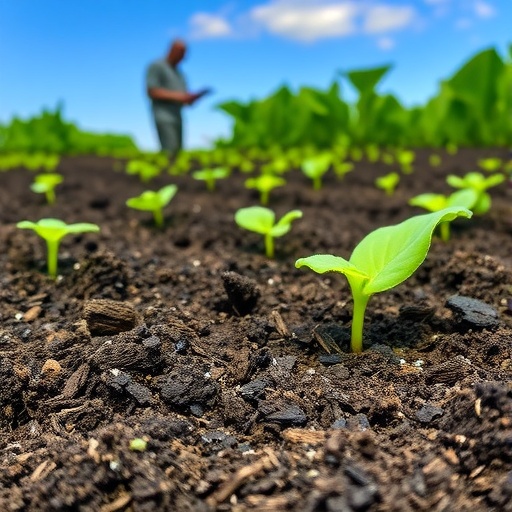
A groundbreaking new study, published in the journal Biochar, sheds fresh light on the intricate effects of biochar on soil emissions of nitrous oxide (N₂O), a highly potent greenhouse gas. Researchers have long touted biochar, a carbon-enriched material derived from biomass, as a promising solution to climate change due to its potential for enhancing soil properties and reducing greenhouse gases. However, this latest research reveals a far more complex interaction between biochar, soil types, and temperature, indicating that biochar’s influence on N₂O emissions varies dramatically depending on the specific environmental context.
Nitrous oxide, which has a global warming potential nearly 300 times greater than carbon dioxide over a century, is primarily released through microbial processes in soils. Its production and emission rates are influenced heavily by soil temperature, nitrogen availability, and microbial dynamics. This study, led by Xiaolin Liao and colleagues, investigates how biochar affects the temperature sensitivity of N₂O emissions, an important factor for predicting climate feedback loops in a warming world.
The research team conducted controlled laboratory incubation experiments using two distinctly different soil ecosystems: an agricultural soil and a forest soil. The experiment used two forms of biochar—one produced from wood and another from rice husks—applied at varying dosages. The soils were incubated across a temperature gradient spanning from 10°C to 30°C, enabling the team to quantify how temperature changes modulate N₂O emission rates with and without biochar amendments.
Findings revealed a stark difference in the temperature sensitivity of N₂O emissions between the two soil types, quantified by the Q10 metric, which measures the rate increase of a process with a 10-degree rise in temperature. Forest soils showed a noticeably higher Q10, indicating a stronger responsiveness of N₂O emissions to warming compared to agricultural soils. This observation underlines how soil properties and microbial communities can drastically shape greenhouse gas dynamics under climate change scenarios.
Notably, biochar’s role emerged as a complicated modulator rather than a uniform mitigator. High-application wood biochar displayed the most significant impact on temperature sensitivity. In agricultural soils, this biochar reduced the Q10 of N₂O emissions, effectively dampening the responsiveness of emissions to temperature increases. Conversely, in forest soils, the same biochar amplified temperature sensitivity, potentially accelerating N₂O emissions as the climate warms.
The mechanisms behind these contrasting responses involve biochar-induced alterations in nitrogen cycling and microbial processes. In the case of agricultural soils, wood biochar decreased nitrate availability, restricting the substrates that microbes use to generate N₂O. This limitation dampened the temperature-driven microbial acceleration of emissions. By contrast, in forest soils, biochar appeared to enhance the coupling between nitrification and denitrification, two microbial pathways instrumental in producing and consuming N₂O, thus increasing the sensitivity of emissions to thermal fluctuations.
These results challenge the prevailing assumption that biochar universally reduces greenhouse gas emissions. Instead, they suggest a nuanced interaction where biochar can either mitigate or exacerbate emissions depending on soil type, nitrogen dynamics, and microbial ecology. This paradigm underscores the critical need for site-specific assessments when deploying biochar for climate mitigation purposes.
The dominance of temperature in driving N₂O emissions remained clear across all treatments, as statistical modeling demonstrated. Biochar’s influence, while secondary, was pivotal in modulating underlying soil chemistry and microbial activity crucial for N₂O production. This distinction highlights biochar’s role not as a primary driver but as an influential factor shaping the ecosystem’s response to warming.
The implications of these findings are profound for agricultural management and forest conservation practices aimed at reducing greenhouse gas emissions. Applying biochar without consideration of soil-specific responses could lead to unintended consequences, particularly in sensitive forest ecosystems where biochar might amplify emissions under warmer conditions. Consequently, the study advocates for precision-guided biochar applications tailored to local soil properties and environmental contexts.
Moreover, the study advances our understanding of biochar’s functional mechanisms in soils. By dissecting nitrogen fluxes and microbial interactions, it provides a mechanistic framework to predict biochar’s effects across diverse ecosystems. This framework is crucial for refining climate models that incorporate soil greenhouse gas emissions and for designing effective mitigation strategies aligned with future climate realities.
As global temperatures continue to climb, the pressure mounts to identify reliable, scalable methods for limiting greenhouse gas emissions from terrestrial ecosystems. Biochar’s potential remains promising due to its multifunctionality in improving soil health and carbon sequestration capacity. However, this study serves as a critical reminder that simplistic approaches may fall short of capturing the complexities of ecosystem responses to emerging climatic conditions.
In conclusion, the research led by Liao et al. furnishes the scientific community and policymakers with vital insights into the conditional effects of biochar on nitrous oxide emission dynamics. It calls for a more sophisticated conception of climate mitigation tools—one that embraces environmental specificity and integrates biochemical, microbial, and physical soil attributes to optimize intervention outcomes in an era of rapid environmental change.
Subject of Research: The influence of biochar on temperature sensitivity of nitrous oxide emissions in different soil types and mechanisms driving these effects.
Article Title: Biochar modulates temperature sensitivity of soil N₂O emissions: soil-specific mechanisms
News Publication Date: 24 March 2026
Web References:
Journal Biochar
DOI: 10.1007/s42773-026-00591-2
References:
Luo, S., Li, Z., Hu, J., et al. (2026). Biochar modulates temperature sensitivity of soil N₂O emissions: soil-specific mechanisms. Biochar, 8, 81.
Image Credits: Siyu Luo, Zhibo Li, Jing Hu & Xiaolin Liao
Keywords: biochar, nitrous oxide, greenhouse gas emissions, soil temperature sensitivity, microbial processes, nitrogen cycling, climate mitigation, soil chemistry, agricultural soil, forest soil, warming impact, temperature sensitivity Q10


