

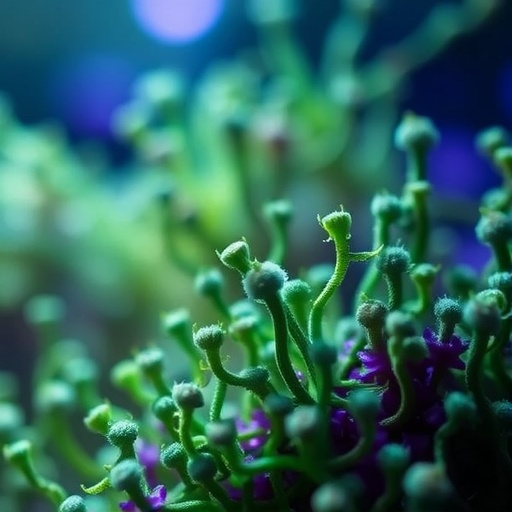
In shaded forests and murky freshwater ecosystems where light is scarce and often shifted toward the far-red spectrum, photosynthetic organisms face a daunting challenge: how to efficiently harness the limited energy available for survival and growth. A breakthrough study by a team of researchers at Osaka Metropolitan University has unveiled a sophisticated molecular strategy employed by the freshwater microalga Trachydiscus minutus to capture far-red light, drastically expanding our understanding of natural photosynthesis and promising new horizons for bioenergy technology.
Chlorophyll a, the primary pigment responsible for photosynthesis in most plants and algae, has long been known to struggle with absorbing far-red light—wavelengths at the edge of the visible spectrum that many organisms fail to exploit effectively. Yet, Trachydiscus minutus overcomes this biochemical hurdle not through the production of specialized chlorophyll variants but via an intricate reorganization of typical chlorophyll molecules within its light-harvesting complexes, enabling it to capture and utilize light that others cannot.
Central to this capability is the formation of a unique photosynthetic antenna known as the red-shifted violaxanthin–chlorophyll protein (rVCP). The research team utilized state-of-the-art cryo-electron microscopy to resolve the rVCP structure at an unprecedented resolution of 2.4 Å, revealing a novel tetrameric assembly composed of two distinct heterodimers. This structural configuration facilitates an exceptionally close packing of chlorophyll a molecules, allowing them to form large, cooperative pigment clusters that are crucial for far-red light absorption.
The significance of this tetramer lies in how it fosters exciton delocalization—a quantum mechanical phenomenon where excitation energy is shared across multiple chlorophyll molecules. This energy delocalization fundamentally alters the optical properties of the pigment cluster, shifting absorption toward longer wavelengths and thus enabling far-red light harvesting without modifying the chemical nature of the chlorophyll molecules themselves. Notably, this mechanism operates independently of charge-transfer effects, distinguishing it from other red-shifted light-harvesting systems observed in cyanobacteria and similar organisms.
This remarkable adaptation has profound implications for understanding photosynthetic resilience and efficiency. By precisely orchestrating protein scaffolding to control pigment interactions at the molecular level, Trachydiscus minutus optimizes light capture under suboptimal environmental conditions, ensuring energy acquisition even in habitats where light intensity and quality are severely limited. Such mechanistic insights contribute to a broader paradigm shift in how photosynthetic organisms can adapt to diverse ecological niches.
Beyond its natural significance, the discovery of the rVCP’s tetrameric organization opens exciting avenues for engineering artificial photosynthetic systems. Since the pigment arrangement is dictated by protein sequence, this newly elucidated blueprint provides a template for designing synthetic or enhanced photosynthetic complexes capable of far-red absorption. Such innovations could accelerate the development of biohybrid devices or tailor-made proteins optimized for solar energy capture in varied light environments.
Moreover, several eustigmatophyte algae, including Trachydiscus minutus, are recognized for their capacity to accumulate oils, positioning them as promising candidates for sustainable biofuel production. Unlocking their ability to photosynthesize efficiently under far-red light could revolutionize bioenergy, enabling cultivation in environments traditionally deemed unfit for intensive photosynthetic activity, such as shaded water bodies or vertically stacked bioreactors.
This study harnesses a multifaceted approach combining cryo-electron microscopy and sophisticated quantum chemical simulations, a testament to the power of integrating experimental and computational methodologies in modern molecular biology. Such interdisciplinary research deepens our molecular-level comprehension of photosynthetic complexes, illuminating pathways for optimizing light-harvesting beyond natural evolutionary constraints.
The team’s findings also shed light on the fundamental principles governing pigment–protein interactions within photosynthetic antennas, challenging existing models that primarily emphasize chemical pigment modifications. Instead, protein architecture emerges as a dominant factor modulating optical properties, a concept with potential ramifications across photobiology, nanotechnology, and renewable energy research sectors.
Looking ahead, the researchers aim to elucidate how energy absorbed by the rVCP complex is transferred downstream to photosystems and how this delivery system might be fine-tuned to maximize photosynthetic output. Understanding these dynamics may pave the way for bioengineered organisms or synthetic constructs with enhanced productivity, adaptable to changing global light environments resulting from climate change or agricultural demands.
Overall, this breakthrough exemplifies nature’s ingenuity in overcoming energetic barriers through subtle yet profound structural innovations. The convergence of detailed molecular characterization with quantum mechanical theory exemplifies the forefront of photosynthesis research, offering promising strategies for leveraging far-red light in both natural ecosystems and human-made applications.
As the quest for improving photosynthetic efficiency intensifies globally, the insights from Trachydiscus minutus stand as a beacon, guiding researchers toward harnessing underutilized solar spectra and redefining the possibilities of biological and artificial light-harvesting technologies.
Subject of Research: Photosynthetic mechanisms in freshwater algae, specifically far-red light absorption by chlorophyll a in Trachydiscus minutus.
Article Title: Exciton Delocalization Promotes Far-Red Absorption in a Tetrameric Chlorophyll a Light-Harvesting Complex from Trachydiscus minutus
News Publication Date: 13-Dec-2025
Web References: http://dx.doi.org/10.1021/jacs.5c17299
Image Credits: Yuki Isaji, Soichiro Seki
Keywords: photosynthesis, far-red light absorption, chlorophyll a, Trachydiscus minutus, light-harvesting complex, exciton delocalization, cryo-electron microscopy, quantum chemical calculations, bioenergy, eustigmatophyte algae, protein engineering, photosynthetic antenna


