

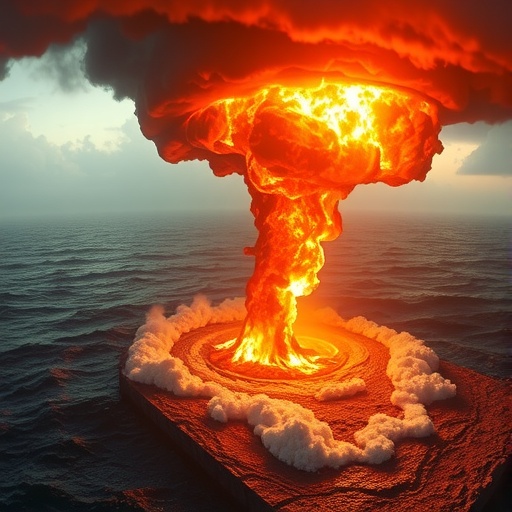
Offshore oil spills present a critical environmental challenge, demanding swift and effective response strategies to mitigate the devastating consequences on marine ecosystems. Traditional emergency responses often involve an agonizing choice between allowing the oil to spread unchecked or igniting it to create an in-situ fire pool, which, while containing the spill, generates toxic soot and leaves behind unburned residue. Recent pioneering research led by Dr. Elaine Oran from Texas A&M University has introduced an innovative alternative that promises a cleaner, faster, and more efficient solution: harnessing massive fire whirls, or swirling tornado-like flames, to combat oil spills.
This groundbreaking approach leverages the unique physics of fire whirls, whose rapid spinning motion enhances combustion by significantly increasing oxygen intake. This natural turbocharging effect results in flames that burn hotter and with greater intensity compared to the conventional static fire pools. The experimental results are remarkable—these fire whirls consume up to 95 percent of the oil fuel and produce 40 percent less soot, dramatically reducing harmful emissions. Such efficiency offers a dual benefit: faster elimination of the oil slick and a significant reduction in atmospheric pollution and toxic residues in marine environments.
The research team, supported by the Bureau of Safety and Environmental Enforcement (BSEE), includes Dr. Oran and Dr. Qingsheng Wang from Texas A&M University, alongside Dr. Michael Gollner from UC Berkeley. Their work signifies a leap forward in environmental engineering, providing new insight into fire dynamics and their practical applications. Traditionally, fire whirl studies have been confined to small laboratory setups, but this team’s large-scale experiments—conducted in a 16-foot-tall apparatus at the Texas A&M Engineering Extension Service’s Brayton Fire Training Field—mark a first in replicating real-world conditions with high fidelity.
The principal advantage of fire whirls is their unparalleled speed in addressing oil spills. Conventional in-situ burning is a slow process marred by incomplete combustion and significant pollutant release, but fire whirls expedite this cleanup phase. Their rapid burn rate effectively transforms the oil spill containment from a prolonged, often chaotic effort into a more controlled and decisive operation, potentially preventing slicks from reaching and wreaking havoc on sensitive marine habitats. This accelerated timeline is critical in minimizing ecological damage and aiding faster recovery of affected areas.
Moreover, the environmental ramifications of using fire whirls extend beyond efficient fuel consumption. The spinning vortex acts as a near-complete combustion chamber, meaning fewer particulates escape as smoke. These findings carry significant implications for atmospheric chemistry and public health, as reducing soot and black carbon emissions plays a crucial role in combating air pollution and its associated respiratory risks. The research opens the door to cleaner, more sustainable remediation techniques that balance ecological protection with operational necessity in oil spill emergencies.
Beyond oil spill response, the physics of fire whirls uncovered in these experiments possess broad applications. Understanding and controlling these powerful vortices may revolutionize combustion system designs, offering pathways to higher efficiency engines with reduced emissions. Likewise, fire management professionals could gain predictive capabilities regarding wildfire intensity and spread, turning one of nature’s most destructive forces into an instrument of precise control and safety.
However, the creation and maintenance of these blazing giants require striking a delicate balance of environmental variables. Fire whirls function optimally within a narrow ‘Goldilocks’ zone of conditions—where airflow, wind speed, and oil slick thickness are finely tuned. Excessive wind can destabilize or extinguish the vortex, while a thick oil layer dampens the fire’s vigor. Achieving this equilibrium is essential for maximizing the benefits of fire whirl combustion while avoiding uncontrolled flare-ups or incomplete burns.
The experimental structure itself, a triangular, three-walled construct standing over 16 feet tall, was meticulously designed to manipulate airflow patterns and sustain a stable fire whirl. At its core sat a 1.5-meter-wide pool of crude oil on water, replicating realistic spill scenarios at a scale not previously attempted. When ignited, the fire whirl towered nearly 17 feet high, an awe-inspiring demonstration of controlled combustion power harnessed through sophisticated engineering.
Publishing their findings in the journal Fuel, the research details quantified improvements in combustion efficiency, soot reduction, and fuel consumption. Dr. Oran emphasizes that these results represent not only a scientific breakthrough but also a practical tool for environmental disaster mitigation. With further development, mobile deployment units could be engineered to position these fire whirl-generating structures directly over spill sites, rapidly transforming hazardous oil slicks into controlled, high-efficiency flames.
This innovative strategy challenges traditional perceptions of fire as a purely destructive agent by positioning it as a restorative force. The potential to turn these fiery vortices into guardians of environmental health heralds a new era in oil spill response technology. The work is emblematic of how interdisciplinary collaboration—combining aerospace engineering principles with environmental science—can yield unexpected yet profoundly impactful solutions to pressing global challenges.
Looking ahead, the team envisions expanding their research to optimize the parameters controlling fire whirls, exploring scalable designs for practical field use, and investigating applications beyond marine oil spills. Whether in advancing combustion engine technologies, aiding wildfire management, or remediating hazardous waste, the implications of this research are vast and multifaceted.
In summary, the discovery and harnessing of fire whirls for oil spill remediation signify a promising paradigm shift. By leveraging enhanced combustion physics, fire whirls offer not just cleaner burning with near-total fuel consumption but also a rapid-response mechanism capable of protecting vulnerable marine environments from catastrophic damage. As research progresses, this approach may well become a cornerstone in the toolkit of environmental engineers and emergency responders worldwide.
Subject of Research: Environmental remediation techniques and combustion dynamics applied to oil spill response.
Article Title: Large-scale field experiments on enhancing In-Situ burning with fire whirls
News Publication Date: January 1, 2026
Web References:
- Texas A&M Aerospace Engineering profile of Dr. Elaine Oran: https://engineering.tamu.edu/aerospace/profiles/oran-elaine.html
- Texas A&M Chemical Engineering profile of Dr. Qingsheng Wang: https://engineering.tamu.edu/chemical/profiles/qingsheng-wang.html
- Texas A&M Engineering Extension Service Brayton Fire Training Field: https://teex.org/about-us/teex-brayton-fire-training-field/
- DOI link to the article: https://doi.org/10.1016/j.fuel.2025.136093
References: Oran, E. et al. “Large-scale field experiments on enhancing In-Situ burning with fire whirls.” Fuel, vol. 403, 136093, 2026.
Image Credits: Texas A&M University College of Engineering
Keywords: Oil spills, combustion, fire whirls, environmental remediation, air pollution, soot emissions, marine ecosystems, environmental engineering, wildfire management, fire dynamics, aerospace engineering, environmental monitoring


