

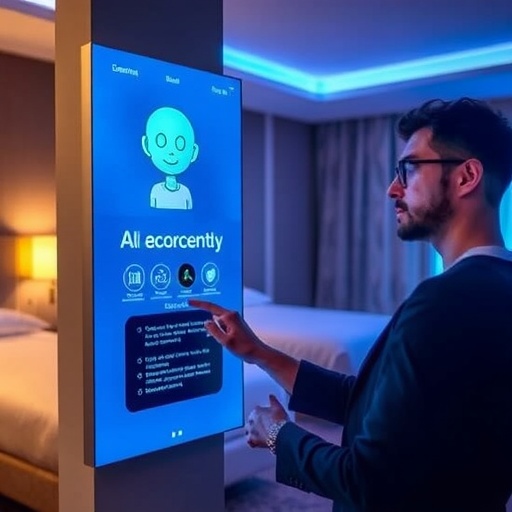
In the evolving landscape of hospitality, the integration of smart conversational AI voice assistants is transforming the dynamics of guest interactions and service delivery. A pioneering study conducted by the University of South Florida, recently published in the Journal of Hospitality and Tourism Technology, offers an unprecedented in-depth investigation into the nuanced preferences of hotel guests and the optimistic perspectives of hotel managers regarding this technological shift. The findings unveil a complex relationship between human-centered service and AI-driven efficiency, highlighting significant implications for the future design and deployment of intelligent guest service systems.
The hospitality industry has increasingly embraced voice-activated AI technologies such as Amazon Alexa and Apple Siri to streamline routine guest services, including simple requests like extra towels, late check-outs, or basic information inquiries. These AI concierges excel in providing immediate, around-the-clock assistance, alleviating pressure on traditional front desk staff. However, the research underscores that despite these operational advantages, a substantial portion of hotel guests retains a strong preference for human interaction, especially when the service demands a personal touch imbued with empathy and emotional sensitivity.
This divergence between guest expectations and managerial enthusiasm represents one of the study’s most salient revelations. Through a mixed methodology using surveys and focus groups involving 145 participants—including industry practitioners and recent hotel guests—the study meticulously maps out how embedded AI is perceived at different touchpoints of the hospitality experience. Hotel managers tend to view AI as a pivotal technological advancement with notable promise to alleviate staffing shortages and operational inefficiencies. Conversely, guests demonstrate considerable caution, particularly driven by concerns related to emotional authenticity and privacy.
Emotional authenticity emerges as a critical challenge for conversational AI systems operating in hospitality contexts. Unlike humans, AI lacks genuine empathy, nuance, and interpretative capabilities essential for understanding complex emotional undertones or personal preferences. The study reports that over 80% of respondents identified this absence as a fundamental barrier to fully embracing AI as a replacement for human concierges. Situations requiring tailored recommendations—such as selecting a romantic dinner venue or requesting special arrangements for significant occasions—still predominantly call for human touchpoints where judgment and emotional intelligence are paramount.
Privacy concerns compound the skepticism surrounding AI adoption. Voice-based interactions, especially in public or semi-public environments like hotel lobbies or shared spaces, raise significant fears about data security and unauthorized access. Approximately three-quarters of surveyed participants expressed apprehension about how their voice data might be captured, stored, or potentially exploited. Comments including worries about potential hacking incidents and the inability of AI to respect personal boundaries illustrate the intricate trust dynamics at play in hospitality’s digital transformation.
The research advocates for a carefully calibrated hybrid service model that leverages the strengths of both AI and human concierges. Rather than positioning AI as a wholesale replacement, the optimal strategy involves integrating voice AI systems as first responders for straightforward tasks while enabling seamless escalation to human staff when requests necessitate personalized insight or emotional engagement. Such an approach ensures operational efficiency without compromising the quality and warmth of guest experiences fundamental to hospitality’s ethos.
Underlying these findings is a broader paradigm shift within the industry, where the conventional high-touch, labor-intensive service model is gradually evolving toward a high-tech, digitally augmented framework. This transition is not purely technological but involves a strategic realignment of human-machine collaboration, requiring innovations in interface design, data policy, and user experience to foster trust, convenience, and satisfaction. The study’s insights thus serve as a roadmap for hoteliers seeking competitive differentiation through intelligent technology adoption.
From a technical standpoint, the study emphasizes the importance of multi-channel AI deployments. This includes voice assistants embedded in in-room devices, mobile applications, kiosks, and online platforms, forming an interconnected ecosystem capable of responding to diverse guest needs and contexts. Such systems must be designed for fluid interaction flow management, recognizing when to initiate handoffs between AI and human teams based on the complexity and emotional content of the inquiry, ensuring consistent service excellence.
As the hospitality sector grapples with labor shortages and customer expectations in the wake of digital disruption, leveraging advanced AI technologies offers feasible pathways to enhanced scalability and responsiveness. Nevertheless, the research warns against overreliance on automation, flagging ethical considerations and the irreplaceable value of human empathy. It calls for ongoing research and iterative user-centered design processes to refine conversational AI models capable of richer emotional intelligence while safeguarding privacy through transparent data governance frameworks.
The implications of this study reach beyond hospitality into broader domains where human-AI interaction models are critical. By illustrating a pragmatic synthesis of technological capability and human judgment, the research from the University of South Florida helps delineate the future contours of service industries increasingly mediated by intelligent machines yet fundamentally reliant on human values.
Subject of Research: People
Article Title: Investigating customer service and engagement levels in the lodging industry: high-touch to high-tech conversational AI
News Publication Date: 4-Feb-2026
Web References: http://dx.doi.org/10.1108/JHTT-08-2025-0669
Image Credits: USF


