

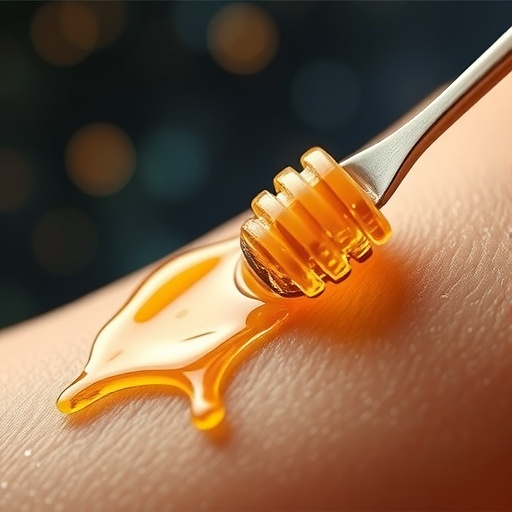
Recent advancements in wound healing therapies have captured the attention of both the scientific community and the public, shedding light on innovative approaches that could enhance recovery rates from injuries. A pioneering study has emerged, exploring the combined effects of honey and silver nanoparticles on wound healing in human dermal fibroblast cells. The findings not only provide insight into how these two natural and technologically advanced substances interact but also offer fresh perspectives on enhancing tissue regeneration.
Honey has long been recognized for its therapeutic properties, particularly in wound care. Its natural antimicrobial, anti-inflammatory, and soothing properties make it a staple in traditional healing practices. Researchers have observed that honey can create a moist environment conducive to healing, promote angiogenesis, and even stimulate the immune response. Despite these benefits, the mechanisms by which honey affects cellular processes, particularly in fibroblast cells, have yet to be fully understood.
The study under discussion meticulously investigates the synergistic effects of honey combined with silver nanoparticles—a subject that could revolutionize how we approach wound treatments. Silver nanoparticles have garnered considerable interest in the biomedical field due to their potent antimicrobial properties. They are effective against a range of bacteria, making them suitable for preventing infections in wounds. Moreover, their unique physical and chemical properties at the nanoscale can modulate biological responses in ways that bulk materials cannot.
In this research, Taherpour et al. explored how honey and silver nanoparticles could work together, positing that their combined applications might enhance the healing process beyond what either substance could achieve alone. They meticulously cultured human dermal fibroblast cells, which are pivotal for wound healing, as they are essential for synthesizing the extracellular matrix and producing collagen. This collaborative effort offered profound insights into the biomechanical aspects of regeneration.
The experiment utilized various concentrations of honey and silver nanoparticles to ascertain the optimal combination for promoting fibroblast proliferation and migration. Fibroblast migration is crucial as it facilitates the closure of wounds. The researchers anticipated that the honey would create a favorable microenvironment for fibroblast activity while the silver nanoparticles would add an antibacterial component essential for infection control.
The results of the study were compelling. It was found that the combination of honey and silver nanoparticles significantly enhanced fibroblast proliferation rates compared to control samples lacking either component. This result indicates that the two agents work synergistically, each amplifying the beneficial effects of the other. These findings highlight the potential for developing new therapeutic modalities that leverage the best of both natural and engineered agents for wound healing.
Further investigation into the molecular pathways activated by this combination was conducted, revealing an upregulation in several growth factors associated with wound healing. This suggests that honey, with its bioactive compounds, might stimulate fibroblasts to produce more vital proteins that encourage tissue repair. Meanwhile, silver nanoparticles appear to exert a supportive role, preventing the onset of infection during critical healing phases.
An exciting aspect of this study is the potential to tailor wound treatments to patient-specific needs. While honey has been used in various contexts for centuries, the incorporation of nanotechnology elevates this natural remedy into a modern therapeutic arsenal. The versatility of such a combination could pave the way for personalized medicine approaches in treating chronic wounds, burns, and surgical incisions.
The introduction of these advanced materials into clinical practices could dramatically change wound care management, particularly in an era where antibiotic resistance is a growing concern. The use of silver nanoparticles could provide an alternative to traditional antibiotics for managing wound infections, significantly reducing the risk of microbial resistance while maintaining effective healing.
This exploration into the combined efficacy of honey and silver nanoparticles not only reveals promising findings but also underscores the importance of understanding how natural and synthetic substances can work together. Collaborations between researchers in natural product chemistry and nanomedicine could lead to innovative solutions that bridge traditional healing wisdom with cutting-edge technology.
As this study progresses from the lab to potential clinical applications, it beckons a future where wound care is more effective, less reliant on single agents, and tailored to individual patient needs. Future research will no doubt focus on clinical trials to test these findings in real-world settings, potentially leading to a new gold standard in wound healing therapies.
This research provides a fascinating glimpse into the potential future of wound healing, marrying ancient remedies with modern science. As we await further studies to validate these findings, it is clear that the synthesis of honey and silver nanoparticles may mark the beginning of a new era in regenerative medicine.
The implications for public health are significant, especially in developing regions where access to healthcare is limited. Enhanced wound care methods could reduce morbidity and mortality associated with infections and delayed healing, representing a meaningful advancement in global health initiatives.
In conclusion, the study authored by Taherpour et al. offers both a hopeful narrative and a scientific roadmap for the future of wound healing. By harnessing the natural healing properties of honey and the antimicrobial prowess of silver nanoparticles, we may be on the brink of scientific breakthroughs that could redefine how we treat wounds, offering more holistic and effective care options for patients worldwide.
Subject of Research: Combined effects of honey and silver nanoparticles on wound healing in human dermal fibroblast cells.
Article Title: Combined effects of honey and silver nanoparticles on wound healing in human dermal fibroblast cells.
Article References:
Taherpour, A., Mirzavi, F., Shafaei, E. et al. Combined effects of honey and silver nanoparticles on wound healing in human dermal fibroblast cells. BMC Complement Med Ther 25, 446 (2025). https://doi.org/10.1186/s12906-025-05171-8
Image Credits: AI Generated
DOI: https://doi.org/10.1186/s12906-025-05171-8
Keywords: wound healing, honey, silver nanoparticles, fibroblast cells, tissue regeneration, nanomedicine, antimicrobial properties, personalized medicine, chronic wounds.


