

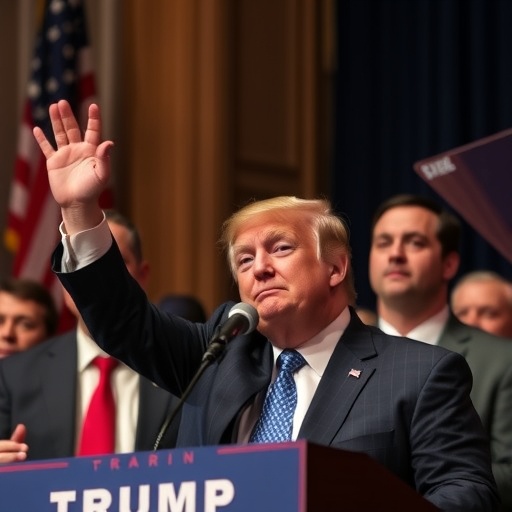
In recent years, the political landscape in many nations has witnessed a significant rise in populist rhetoric—an explosive trend characterized by political messages that emphasize the supremacy of the “will of the people” and vocal opposition to a purportedly corrupt elite. This surge in populist discourse does more than sway elections; new research reveals that it carries profound consequences for economic behavior, particularly among budding entrepreneurs. A groundbreaking study published in the Journal of Business Venturing reveals a sharp inverse relationship between populist rhetoric and the likelihood that entrepreneurs will formally register their businesses, thus illuminating a growing trend toward informal economic activity as a strategic response to political and institutional uncertainty.
The research, led by Tim Michaelis, assistant professor of psychology at North Carolina State University, delves into how the widespread prevalence of populist rhetoric may catalyze a shift toward the informal economy. By increasing distrust in government institutions and established regulatory frameworks, populist discourse effectively raises barriers to formal business registration, prompting many entrepreneurs to seek the perceived flexibility of informal venture entry. This move circumvents taxes and regulations but comes at a cost—hampering business growth potential and national economic oversight.
Populist rhetoric operates by amplifying uncertainty about institutional trustworthiness. It creates an environment in which citizens become skeptical of the integrity and efficacy of the government and allied mechanisms such as banks or judicial entities. Entrepreneurs, who rely heavily on predictable regulatory environments to plan and scale their activities, find themselves navigating an unstable ecosystem. Under these conditions, informal venture entry functions as an adaptive strategy, allowing individuals to launch economic activities without the upfront costs and bureaucratic complexities of formal registration.
In an attempt to unpack this global phenomenon, Michaelis and his co-authors incorporated data from over 10,000 entrepreneurial ventures across 13 countries, integrating diverse economic contexts ranging from lower- and middle-income economies to affluent high-income nations. Alongside business registry data from the World Bank Enterprise Survey, the study utilized populist rhetoric metrics from the Global Populism Database and, crucially, introduced a socio-cultural dimension through the lens of “cultural tightness”—a construct describing the extent to which societies enforce conformity to social norms.
Cultural tightness fundamentally affects behavioral compliance, with “tight” cultures enforcing stringent norms and social discipline, while “loose” cultures allow for broader behavioral diversity. The study’s novel insight lies in how cultural tightness modulates the impact of populist rhetoric: in cultures with high tightness, the erosion of institutional trust sparked by populism is amplified. In such societies, the expectation to uphold social norms and obey rules conflicts with growing doubts about government legitimacy, perversely intensifying the drift toward informal economic activity among entrepreneurs.
The statistical analysis is striking. Populist rhetoric was quantified on a scale from zero to two, with a full unit increase correlating with a staggering 76% uptick in informal business formation. To contextualize, a one-unit rise translated an increase in unregistered new businesses from 5% to 8.6%. When factoring in cultural tightness, this figure escalated even further, reaching an alarming 11.5% in highly tight cultures. Consider the magnitude: with millions of new ventures launched annually in many economies, these shifts represent millions of business activities operating outside government purview.
What drives entrepreneurs toward such risky informal ventures? Uncertainty stands at the core. Entrepreneurs prize stability and reliability, seeking predictable institutional environments that promise consistent enforcement of rules and legal protections. When political rhetoric publicly undermines these assurances, confidence wanes. Informality becomes a rational choice—providing agility and shielding nascent businesses from potentially capricious enforcement, but sacrificing access to resources, formal market opportunities, and long-term scalability.
An intriguing facet examined by the study is the differential role of political ideology within populist discourse. Analysis reveals that left-leaning populist rhetoric, which tends to target institutional elites and call for systemic overhaul, exerts a stronger influence on informal venture entry compared to right-leaning populism, which often focuses on social groups such as minorities or immigrants. This ideological nuance underscores how the substance of populist messaging shapes entrepreneurial responses and economic decisions in unique ways.
From the business owner’s vantage point, this research casts informal venture creation as a strategic, albeit double-edged, decision. The immediate benefits include increased operational flexibility and freedom from tax and regulatory burdens. However, entrepreneurs forego significant opportunities for business evolution, particularly the capacity to grow domestically through formal channels or to access global markets. Informality acts as a glass ceiling, limiting networks, partnerships, and access to financing.
Governments, on the other hand, face a complex dilemma. The rise of informal enterprises complicates tax collection and equity, depriving public coffers of revenues critical for public services and infrastructure. Moreover, informal businesses elude safety and quality controls—posing risks in workplace conditions, environmental impact, and consumer protection. As populist rhetoric intensifies, regulatory capture weakens, and informal economies burgeon, the state’s capacity to govern effectively diminishes, feeding a vicious cycle of distrust and regulatory evasion.
The findings underscore the intricate interplay between political communication, socio-cultural norms, and economic behaviors. They highlight a need for nuanced policy responses addressing not only economic incentives but also the psychological and cultural contexts shaping entrepreneurial choices. As political polarization and populism continue to escalate globally, understanding these dynamics becomes ever more urgent.
This study, titled “Populism, cultural tightness, and informal venture entry,” co-authored by Paul Sanchez-Ruiz, Jorge Arteaga-Fonseca, and Christopher Sutter along with Michaelis, opens critical avenues for future exploration. It calls for investigations into how rebuilding trust in institutions or moderating political rhetoric might reverse the drift toward informality. Equally, it suggests that culturally sensitive approaches to economic policy, recognizing how social norms interplay with political climate, are needed to foster formal enterprise development and inclusive economic growth.
In sum, this research offers a compelling portrait of how populist rhetoric reshapes the entrepreneurial landscape. By diminishing institutional trust and fueling informal business formation—especially in culturally tight settings—it challenges policymakers to address the root causes of economic informality that transcend mere economic incentives. It provides essential knowledge for governments, business leaders, and scholars seeking to navigate one of the defining economic and political tensions of our era.
Subject of Research: Entrepreneurship, Political Rhetoric, Cultural Norms, Informal Economy
Article Title: Populism, Cultural Tightness, and Informal Venture Entry
News Publication Date: 25-Feb-2026
Web References: https://www.sciencedirect.com/science/article/pii/S0883902626000170
References: Michaelis, T., Sanchez-Ruiz, P., Arteaga-Fonseca, J., & Sutter, C. (2026). Populism, cultural tightness, and informal venture entry. Journal of Business Venturing. DOI: 10.1016/j.jbusvent.2026.106587
Keywords: Populist Rhetoric, Informal Economy, Entrepreneurial Behavior, Cultural Tightness, Institutional Trust, Political Ideology, Business Registration, Economic Uncertainty


