

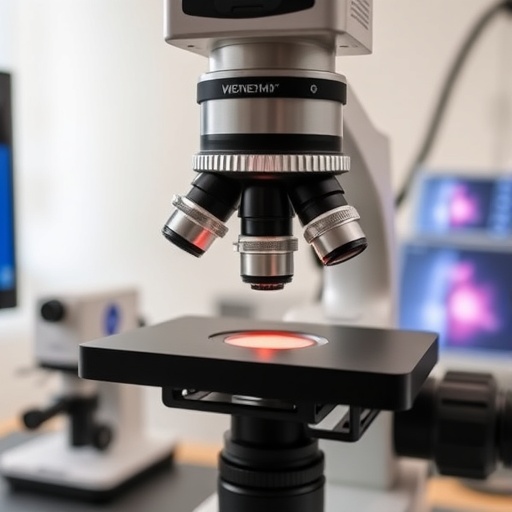
In a groundbreaking advancement that promises to redefine optical imaging, a team of researchers led by Yu, DX., Jiang, Z., and Zheng, Y. has developed a novel microscope system boasting an unprecedented large zoom ratio combined with adaptive aberration correction. Published in the prestigious journal Light: Science & Applications, this development introduces a sophisticated microscope that leverages a 4D Point Spread Function (4DPSF)-aware Physical Degradation-guided Network, empowering researchers with enhanced image fidelity and resolution beyond traditional limitations. The innovation is set to revolutionize diverse fields from biomedical imaging to industrial inspection by overcoming critical challenges inherent in optical systems.
Optical microscopy has long faced the daunting task of balancing zoom capabilities against the detrimental effects of aberrations, which diminish image clarity and resolution as magnification increases. Conventional systems struggle with fixed aberration correction methods that are neither adaptive nor capable of responding dynamically to changing imaging conditions. The novel approach presented employs a deep learning-based framework that integrates physical degradation models with a 4DPSF-aware network, effectively ushering in a new era where zoom magnification and image quality harmoniously coexist.
At the heart of this technological leap is the 4DPSF, a complex model characterizing the spatial, angular, and chromatic information of light as it propagates through the microscope’s optical system. Traditional point spread functions typically consider only spatial properties, but the augmentation to four dimensions allows the system to account for a richer dataset encompassing directional intensity distributions and wavelength-dependent behaviors. This additional dimensionality empowers the adaptive algorithm to detect and correct aberrations with remarkable precision in real-time, tailored uniquely for each zoom level and imaging condition.
The Physical Degradation-guided Network operates by simulating realistic degradation effects observable in the optical apparatus and training neural networks to reverse these effects effectively. This synergy between physical modeling and machine learning provides a resilient framework where the microscope can adaptively recalibrate itself, ensuring optimal imaging performance. Unlike heuristic or empirical correction methods, this network-based strategy continuously learns and adapts, thereby remaining robust in the face of unpredictable optical aberrations encountered during large-range zooming.
What truly distinguishes this microscope is the extensive zoom ratio it achieves without compromising on image integrity. In typical microscopes, increasing zoom often leads to exacerbated aberrations such as spherical and chromatic distortions, which blur and distort the visual field. This state-of-the-art instrument harnesses its adaptive correction capabilities to maintain sub-diffraction-limited resolution across all magnifications. Such performance elevates the capability to observe intricate biological processes, microelectromechanical systems, and nanoscale structures with astounding clarity.
Furthermore, the implications of this technology extend beyond mere academic interest. In biomedical research, the ability to switch seamlessly from wide-field overviews to highly detailed zoom-ins enables rapid, multifaceted examinations of cellular and subcellular structures. Pathologists and life scientists can now visualize complex biological interactions dynamically, reducing the need for multiple imaging instruments, thereby streamlining workflows and accelerating discoveries. In industrial quality control, this microscope can inspect components with precision while allowing operators to zoom effortlessly without adjusting or recalibrating hardware manually.
The researchers meticulously evaluated the system’s capabilities against existing technologies, demonstrating superior performance metrics. The adaptive aberration correction was validated across a variety of samples and illumination conditions, showing consistent improvements in image contrast, resolution, and signal-to-noise ratio. By employing a combination of simulation and experimental validation, they confirmed that the network generalizes well across different optical setups and specimen types, a crucial aspect for broad adoption.
Intriguingly, the architecture of the Physical Degradation-guided Network is modular and extensible, designed to incorporate additional data types and physical phenomena beyond 4DPSF metrics. This versatility sets the stage for future enhancements where new aberration factors or imaging modalities can be integrated seamlessly. The learning framework’s ability to adapt to complex optical distortions highlights a profound marriage of physics-informed AI and traditional optics, pointing toward intelligent microscopes that self-optimize with minimal human intervention.
Another notable feature of this system is its compatibility with existing microscope hardware. The model can be implemented via software upgrades or minimal hardware modifications, enabling widespread deployment without prohibitive costs. This practical aspect drastically lowers the barrier for laboratories and industries to adopt this cutting-edge capability, ensuring rapid dissemination across various scientific and technological domains.
The broader scientific community stands to benefit immensely from the open-access nature of the researchers’ publication and the accompanying code repositories. By sharing their datasets and neural network training paradigms, Yu and colleagues invite collaboration and iterative improvements, fostering a vibrant ecosystem of innovation around adaptive optical systems. This democratization of technology accelerates progress while inspiring novel applications, such as multimodal imaging and real-time diagnostics.
In conclusion, the introduction of a large zoom ratio microscope with adaptive aberration correction facilitated by a 4DPSF-aware Physical Degradation-guided Network represents a seminal contribution to optical engineering. It fundamentally overcomes pervasive constraints related to aberration-induced image degradation during high-magnification imaging. The fusion of physics-driven models with artificial intelligence paves the way for intelligent, self-correcting microscopes that can unlock unprecedented levels of detail and accuracy, promising transformative impacts across scientific research, medical diagnostics, and industrial inspection.
As the microscopic frontier expands, this technology exemplifies the critical role of interdisciplinary innovation, blending computational intelligence with classical optics to transcend traditional limits. The promising results demonstrate that future microscopes need not trade zoom versatility for precision but can instead offer both in an integrated, autonomous system. With vast potential applications, from unraveling complex cell biology to examining nano-engineered devices, such adaptive microscopy systems are poised to become indispensable tools in the technological and scientific arsenals of tomorrow.
The revolutionary work by Yu, DX., Jiang, Z., Zheng, Y., and their team not only sets a benchmark but also inspires a new paradigm, where adaptive correction becomes intrinsic to microscopic observation. This approach anticipates a future where researchers are empowered by real-time, high-fidelity imaging that can dynamically respond to the nuances of light propagation and specimen variability. Their achievement marks a significant milestone demonstrating how leveraging advanced AI models informed by physical principles can lead to highly practical and impactful scientific instruments.
As this research gains traction, expectations rise for subsequent generations of microscopes to incorporate these adaptive learning frameworks more broadly. The implications extend to educational platforms, where interactive, crystal-clear visualizations become more accessible; to clinical environments, where precision imaging directly translates into more accurate diagnoses; and to manufacturing sectors, where minute inspection accuracy can enhance product quality dramatically. This convergence of technology heralds a new chapter in how humanity explores and understands the microscopic world.
Subject of Research: Large zoom microscopy with adaptive aberration correction using machine learning.
Article Title: Large zoom ratio and adaptive aberration correction microscope using 4DPSF-aware Physical Degradation-guided Network.
Article References: Yu, DX., Jiang, Z., Zheng, Y. et al. Large zoom ratio and adaptive aberration correction microscope using 4DPSF-aware Physical Degradation-guided Network. Light Sci Appl 15, 140 (2026). https://doi.org/10.1038/s41377-025-02155-8
Image Credits: AI Generated
DOI: 10.1038/s41377-025-02155-8 (03 March 2026)


