

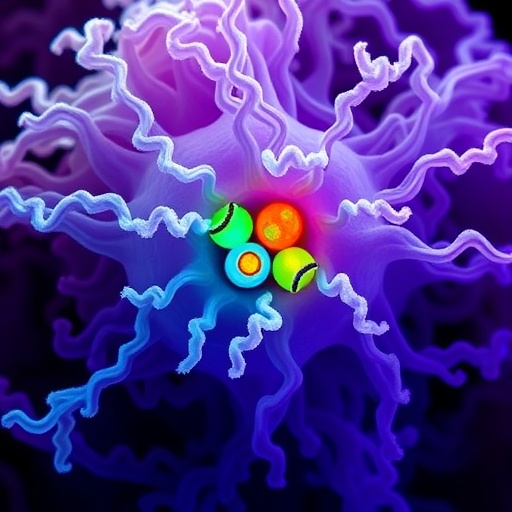
In a groundbreaking study that pushes the frontier of photosynthetic research, scientists have unraveled the intricate structural details of the light-harvesting 1-reaction center (LH1-RC) complex in Rhodovulum sulfidophilum, a marine purple nonsulfur bacterium distinguished for its exceptional oxygen tolerance. Photosynthesis, a process fundamental to life, is traditionally associated with oxygenic mechanisms in plants and cyanobacteria. However, photosynthetic bacteria like R. sulfidophilum utilize anoxygenic photosynthesis, a pathway that does not release oxygen yet effectively converts solar energy into chemical energy. This study offers unprecedented atomic-level insights into how these bacteria perform such efficient energy conversion in oxygen-rich environments, expanding our understanding of their unique photochemical strategies.
The research team employed cryogenic electron microscopy (cryo-EM) to determine the structure of the LH1-RC complex at an extraordinary resolution of 1.8 angstroms. Achieving this level of resolution allowed the visualization of minute molecular features central to photosynthetic function, including pigment-protein interactions and metal ion coordination. LH1-RC complexes are vital components in bacterial photosynthesis, capturing near-infrared light—often inaccessible to conventional plant photosystems—and funneling the excitation energy toward reaction centers where photochemical energy conversion occurs. These complexes are embedded in the bacterial membrane, and their efficiency under oxic conditions has long remained a biochemical puzzle.
A seminal discovery from the structural analysis was the identification of a previously unknown membrane protein, designated protein-3h. This protein resides within the opening of the LH1 ring, a region critical for facilitating electron transfer and quinone exchange. The presence of protein-3h suggests a specialized adaptation mechanism in R. sulfidophilum’s photosynthetic apparatus, potentially acting as a structural stabilizer or modulator of electron flow. This insight opens new avenues for understanding how membrane-bound proteins cooperate to optimize photosynthetic performance, especially under oxygen stress, which can lead to photoinhibition in other photosynthetic organisms.
In addition to protein-3h, the researchers uncovered a non-heme iron (Fe) ion coordinated near the triheme cytochrome subunit of the reaction center. Unlike heme-bound iron typically involved in electron transport, this Fe ion is ligated through a unique environment comprised of a histidine residue and surrounding water molecules. This non-classical coordination environment implies a versatile role for the Fe ion, possibly acting as an intermediate electron transfer site or an electron sink. The strategic positioning of this iron atom may be critical for managing electron flow and protecting the photosynthetic machinery from oxidative damage that could arise in oxygenated conditions.
The marine bacterium Rhodovulum sulfidophilum is particularly notable for its ability to thrive in diverse and sometimes hostile environments, such as oxygen-rich marine waters and sulfide-rich hot springs. Its LH1-RC complex, adapted to harness near-infrared light effectively, facilitates energy capture beyond the visible range used by terrestrial plants. The elucidation of its complex architecture provides a molecular framework to comprehend how such bacteria maintain high photosynthetic efficiency, especially when confronted with oxygen, which conventionally poses a threat to anoxygenic photosynthetic organisms by generating reactive oxygen species that can impair their function.
Understanding the photochemistry of LH1-RC in R. sulfidophilum offers profound implications for bioengineering applications. The newfound structural knowledge enables the potential design of genetically engineered phototrophic systems that integrate or mimic these oxygen-tolerant mechanisms. Such systems could improve solar energy utilization in biohybrid devices or synthetic biology applications, wherein robustness under aerobic conditions is paramount. Moreover, these discoveries may pave the way for biotechnological innovations, including the development of photosynthetic platforms capable of environmental remediation and bioenergy production.
One intriguing application contemplated by the authors relates to the bioremediation of hydrogen sulfide-containing wastewater. Hydrogen sulfide is a notable environmental pollutant with toxic and corrosive properties. Photosynthetic bacteria like R. sulfidophilum, which can metabolize sulfur compounds and function effectively within aerobic and sulfide-rich contexts, offer a biological solution to detoxify such waste streams. By leveraging the structural insights into LH1-RC, researchers could engineer or enhance bacterial strains tailored for optimized sulfide oxidation under industrial conditions.
The researchers also highlighted the unique electron transfer pathways enabled by the structural features uncovered. The positioning of protein-3h within the LH1 opening and the special coordination of the non-heme iron create a distinct microenvironment conducive to efficient electron flux. This arrangement might protect the photosynthetic apparatus by managing redox potentials meticulously, thus suppressing deleterious side reactions. Such nuanced control of electron dynamics is a testament to the evolutionary fine-tuning present in marine phototrophs and underscores the sophistication of bacterial photosynthetic systems.
The quantum efficiency witnessed in these bacterial complexes is also attributable to their ability to absorb near-infrared light, a spectral region largely untapped by green plants. This spectral complementarity allows R. sulfidophilum to occupy ecological niches where competition for visible light is less intense. The high-resolution structural data confirm how the arrangement of pigments and proteins within the LH1-RC complex facilitates this unique light absorption capability. These findings enrich the broader understanding of biological light capture and energy conversion diversity across different organisms.
This exceptional scientific achievement was enabled by integrating state-of-the-art cryo-EM techniques with computational modeling, reflecting a multidisciplinary approach combining structural biology, biophysics, and biochemistry. The detailed visualization of the LH1-RC complex at atomic resolution provides a platform for further functional studies, including site-directed mutagenesis and ultrafast spectroscopy, to probe the dynamics of energy transfer and electron transport processes in this fascinating bacterial system.
Moving forward, the integration of these structural insights with genetic and biochemical data will be instrumental in unraveling the full mechanistic map governing photosynthetic electron flow in R. sulfidophilum. The study not only advances fundamental knowledge but also sparks curiosity about the evolutionary origins of photosynthetic diversity and the adaptability of bacterial architectures in fluctuating environmental conditions. It poses exciting challenges for synthetic biology to harness these mechanisms for human benefit.
In conclusion, the elucidation of the LH1-RC complex’s high-resolution structure in Rhodovulum sulfidophilum reveals distinctive molecular components and configurations that underpin its remarkable photosynthetic efficiency and oxygen tolerance. This work sets a new benchmark for understanding bacterial photosynthesis at a molecular level and projects significant potential for translational research aimed at sustainable energy and environmental solutions. The discovery of protein-3h and the non-heme iron ion as critical elements within the photosynthetic core represents a milestone that will undoubtedly catalyze future studies and innovations in microbial photochemistry.
Subject of Research: Photosynthetic mechanism and structural biology of the LH1-RC complex in purple nonsulfur bacteria
Article Title: Structural insights into the photochemistry of the LH1-RC complex from the marine purple phototrophic bacterium Rhodovulum sulfidophilum
News Publication Date: 2-Mar-2026
Web References:
https://doi.org/10.1038/s42003-026-09755-z
Image Credits: University of Tsukuba
Keywords: Photosynthesis, biomolecular structure, LH1-RC complex, Rhodovulum sulfidophilum, photosynthetic bacteria, cryo-electron microscopy, protein-3h, non-heme iron, electron transfer, photochemistry, near-infrared light, bacterial photosynthesis


