

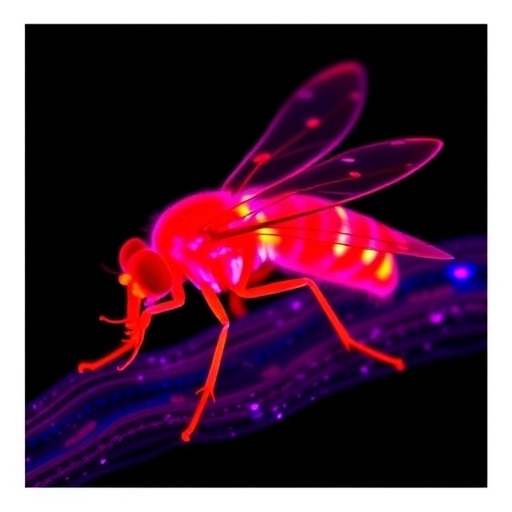
In a groundbreaking advancement bridging the realms of photonics and neurobiology, researchers have unveiled a high-power pulsed electrochemiluminescence (ECL) system designed for optogenetic manipulation of Drosophila larvae. This novel technique promises to revolutionize how scientists probe and control neural circuits with unprecedented precision and minimal invasiveness. As optogenetics continues to transform neuroscience by offering targeted control over neuronal activity, the integration of high-power pulsed ECL represents a significant step forward in enhancing the efficiency, spatial resolution, and temporal fidelity of neural modulation.
Electrochemiluminescence, traditionally employed in bioassays and analytical chemistry, involves the generation of light through electrochemical reactions. Its application in optogenetics marks a novel utilization of the phenomenon, leveraging ECL’s ability to produce intense, well-defined light pulses to activate light-sensitive proteins in specific neurons. The research team, comprising Moon, König, Sircar, and collaborators, meticulously engineered a pulsed ECL device capable of delivering high-intensity light bursts with precise control over timing and intensity. This capability addresses critical limitations in current optogenetic stimulation methods, chiefly those relying on external light sources like lasers or LEDs, which suffer from issues like tissue scattering, phototoxicity, and mechanical invasiveness.
Central to this innovation is the device’s ability to generate light at specific wavelengths that optimally match the absorption spectra of common opsins used in Drosophila models. The researchers fashioned electrodes coated with specialized luminescent materials that exhibit robust ECL when subjected to controlled electrical pulses. By tuning the electrical parameters, the system ensures consistent and repeatable light emission, enabling reliable activation of genetically encoded light-sensitive channels or pumps in larval neurons. Notably, the electrical stimulation parameters are optimized to minimize heat generation and photodamage, crucial for preserving the biological integrity during prolonged or repetitive experiments.
The choice of Drosophila larvae as the biological model underscores the method’s potential utility in fundamental neuroscience. These larvae offer a simplified nervous system amenable to genetic manipulation, making them ideal for dissecting neural circuit functions underlying behavior. The research team demonstrated that their high-power pulsed ECL system could effectively activate or inhibit specific neural pathways, eliciting controlled behavioral responses in the larvae. Larval locomotion patterns, known to be modulated by discrete neural populations, were altered predictably upon ECL-based optogenetic stimulation, illustrating functional connectivity with high spatial precision.
Beyond behavioral assays, the ECL device’s compact and wireless-friendly design suggests promising applications for in vivo neural modulation without the constraints imposed by tethered optical setups. The researchers envisage that this technology can be integrated into implantable microelectrode arrays, enabling chronic studies of neural dynamics in freely moving organisms. This advancement opens avenues for sophisticated neuroengineering applications, including closed-loop systems where neural activity is monitored and modulated in real time via electrochemiluminescence-driven optogenetics.
Technically, the study delves deep into the electrochemical mechanisms facilitating high-power pulsed ECL. It elucidates how modulating pulse frequency and amplitude influences luminescence intensity and duration, enabling custom-tailored stimulation protocols that mimic naturalistic neuronal firing patterns. The interplay between electrode material properties, electrolyte composition, and pulse shape was critical in maximizing light output while maintaining electrochemical stability. Through rigorous characterization using spectrometry and high-speed photodetection, the team fine-tuned the system to optimize both efficiency and biocompatibility.
One particularly transformative aspect of this work lies in the temporal resolution afforded by pulsed ECL. The light pulses generated had durations in the microsecond to millisecond range, aligning closely with timescales relevant for synaptic transmission and action potential generation. This temporal precision allows for nuanced manipulation of neural signals, surpassing continuous wave or steady-state light sources in controlling fast and complex neural circuitry. As such, the system can evoke transient neural responses, supporting the study of dynamic processes such as sensory encoding and motor pattern generation.
Moreover, the researchers addressed concerns about potential cytotoxic effects arising from electrochemical byproducts or excessive light exposure. Through in vitro experiments and post-stimulation viability assessments, they confirmed that the pulsed ECL parameters used avoided detrimental effects on neural tissue health. This finding affirms the approach’s suitability for longitudinal studies, which demand sustained neural integration without compromising cellular function.
Another remarkable outcome was the ability to spatially constrain the ECL emission to focal regions within the larval tissue, achieved via microfabricated electrode arrays and precise electrical control schemes. This spatial targeting reduces off-target activation and improves the fidelity of behavioral manipulations, consequently allowing better mapping of neural circuit components responsible for specific behaviors. This precision underscores the advantages of direct electrochemical stimulation over conventional optical fiber delivery, which often diffuses light over larger volumes.
In addition to its biological and technical merits, the high-power pulsed ECL platform exemplifies a scalable and cost-effective alternative to prevalent optogenetic equipment. The simplicity of the electrochemical setup and the non-reliance on complex optics reduce barriers to adoption in diverse laboratory settings. This democratization of advanced optogenetic manipulation technologies is poised to accelerate neuroscience discoveries worldwide, particularly in resource-constrained environments.
Looking ahead, the research opens new frontiers for integrating high-power pulsed ECL with multimodal recording technologies. Combining electrophysiological sensors with luminescent stimulation could foster sophisticated feedback loops for real-time control of neuronal populations, enhancing our ability to decode brain function and dysfunction. Such developments are anticipated to impact fields ranging from basic neurobiology to therapeutic interventions for neurological disorders.
In conclusion, the introduction of high-power pulsed electrochemiluminescence as a tool for optogenetic control represents a paradigmatic shift in neural engineering. By enabling precise, efficient, minimally invasive stimulation of neural circuits in Drosophila larvae, this innovative approach heralds a new era in neuroscience research tools. The work by Moon, König, Sircar, and colleagues not only advances fundamental understanding of brain function but also paves the way for next-generation neurotechnologies with broad implications across biological and clinical sciences.
Subject of Research: Optogenetic manipulation of neural circuits in Drosophila larvae using high-power pulsed electrochemiluminescence.
Article Title: High-power pulsed electrochemiluminescence for optogenetic manipulation of Drosophila larval behaviour.
Article References:
Moon, CK., König, M., Sircar, R. et al. High-power pulsed electrochemiluminescence for optogenetic manipulation of Drosophila larval behaviour. Light Sci Appl 15, 104 (2026). https://doi.org/10.1038/s41377-025-02143-y
Image Credits: AI Generated
DOI: 10.1038/s41377-025-02143-y


