

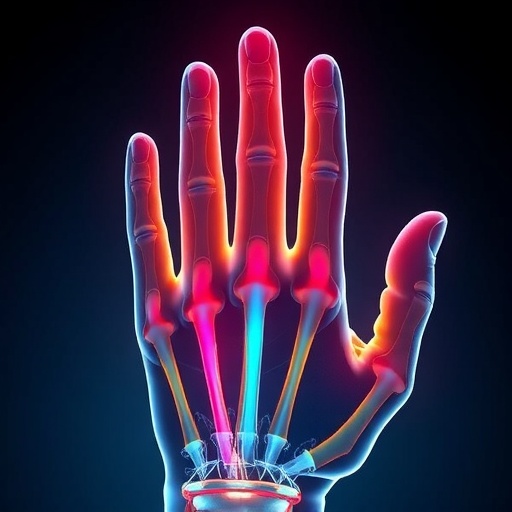
In a groundbreaking study that redefines our understanding of motor control, researchers at the University of California, Riverside have uncovered a complex neural network linking the brainstem and spinal cord, which plays a pivotal role in orchestrating voluntary hand and arm movements. This discovery challenges the long-held belief that the cerebral cortex alone governs fine motor skills, suggesting instead an intricate multi-level pathway that integrates signals from evolutionarily ancient brain structures. This insight opens new avenues for therapeutic interventions aimed at restoring motor function following neurological injuries such as stroke.
Traditionally, the cerebral cortex, the brain’s large and convoluted outer layer, has been regarded as the central executor of voluntary movement and cognitive processing. However, this new research, published in the Proceedings of the National Academy of Sciences, highlights the significant involvement of the brainstem—specifically its medullary region—and cervical segments of the spinal cord in refining and relaying motor commands. The brainstem, a compact tube-like structure located beneath the cortex and above the spinal cord, is traditionally known for regulating vital autonomic functions like respiration and cardiovascular control. Yet its role in voluntary motor control has until now been grossly underestimated.
Using cutting-edge functional magnetic resonance imaging (fMRI) techniques, the investigators precisely mapped brain activity patterns during controlled forelimb tasks in both mice and humans. In murine models, the animals were conditioned to press a lever with their forepaws, enabling simultaneous recording of neural activity spanning the cortex, brainstem, and spinal cord. Complementarily, human participants were instructed to exert varying grip forces while undergoing fMRI scans. This comparative approach revealed striking parallels in neural circuit architecture across species, underscoring an evolutionarily conserved mechanism for motor regulation.
The medullary nuclei identified in this study are located in the lowest portion of the brainstem, immediately superior to the spinal cord. These nuclei act as crucial relay centers, facilitating bidirectional communication between the cortex and spinal motor circuits. Intriguingly, the study demonstrates that cervical spinal segments C3 and C4, positioned at the upper neck level, serve as intermediary stations, integrating descending signals from the medulla before transmitting commands to motor neurons responsible for hand musculature. This propriospinal pathway effectively adds an intermediate processing step that refines motor output, enhancing the precision and adaptability of limb movements.
This findings realign the conceptual framework of voluntary movement control to a more distributed architecture, involving hierarchical integration from cortical planning centers through the brainstem to spinal motor circuits. Such a distributed system likely provides redundancy and flexibility, traits highly advantageous for fine motor tasks like grasping, holding, and manipulating objects in dynamic environments. Understanding this multi-tiered network provides critical insight into both normal neurophysiology and the pathological consequences stemming from injury to these brain and spinal regions.
From a translational medicine perspective, these discoveries bear significant implications for neurorehabilitation strategies. Standard stroke recovery efforts predominantly target cortical areas, but damage to these zones often results in lingering deficits in hand and arm control. Identifying additional intact pathways involving the brainstem and cervical spinal cord opens new potential therapeutic targets for neuromodulation technologies such as electrical stimulation or pharmacological modulation aimed at reactivating these preserved circuits. Such approaches hold promise for enhancing functional recovery beyond current modalities.
Moreover, the conservation of these propriospinal pathways in both rodents and humans indicates their fundamental role in motor control across mammals, providing compelling opportunities to leverage animal models to better understand human motor disorders. By leveraging this knowledge, researchers may develop tailored interventions that stimulate or retrain these integrative networks, potentially accelerating and improving outcomes for patients suffering from a range of neurological impairments including spinal cord injury and degenerative diseases.
The study’s methodological rigor, combining behavioral paradigms with high-resolution neuroimaging in parallel species, exemplifies a powerful experimental framework for dissecting complex neural circuits. The incorporation of the cervical spinal cord, often neglected in human fMRI studies due to technical challenges, represents a significant advance, highlighting the critical need to include this region in future motor control research. Collectively, this work propels the field toward a more comprehensive and nuanced understanding of the neural substrates underpinning dexterous limb movement.
As noted by the study’s lead author, Shahabeddin Vahdat, assistant professor of bioengineering at UCR, the findings underscore that brainstem circuits, which evolved earlier than the cortex, maintain a crucial role in the control of fine motor skills. This perspective reshapes the neuroanatomical hierarchy and inspires a reconsideration of how neural pathways are prioritized and targeted in therapeutic contexts. The revelation of these medullary and propriospinal relays not only enriches basic neuroscience but also paves a translational pathway toward restoring independence and quality of life for individuals affected by neurological injury.
In sum, this landmark research ushers in a paradigm shift in motor neuroscience by elucidating an intricate, multi-staged relay pathway involving cortical, medullary, and spinal components that collaboratively govern forelimb movements. The confirmation of this conserved circuitry across species accentuates its evolutionary significance and sets the stage for novel clinical interventions targeting these newly recognized substrates. Future investigations will likely expand upon these findings to unravel additional complexities and optimize strategies that harness these pathways for functional repair.
Subject of Research: Neural pathways underlying voluntary forelimb movement control involving brainstem and cervical spinal cord integration.
Article Title: Medullary and C3–C4 propriospinal pathways underlying mammalian forelimb movement control
News Publication Date: 28-Jan-2026
Web References:
– https://www.pnas.org/doi/10.1073/pnas.2518217123
Image Credits: Shahabeddin Vahdat et al / UCR
Keywords
Human brain, Spinal cord, Brainstem, Motor control, Forelimb movement, Medulla, Propriospinal pathways, fMRI, Neurorehabilitation, Stroke therapy, Comparative neuroanatomy, Bioengineering


