

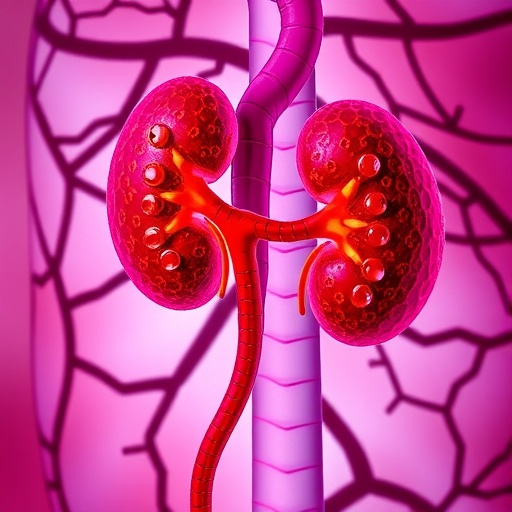
In a groundbreaking discovery set to redefine our understanding of organ interplay, researchers have identified a pivotal molecular mediator that orchestrates communication between the liver and kidneys, driving the progression of renal fibrosis. Published in Nature Communications, this study unveils the hepatokine—fibrinogen-like protein 1 (FGL1)—as a central player in liver-kidney crosstalk, heralding new avenues for therapeutic intervention in chronic kidney diseases.
Renal fibrosis, characterized by excessive accumulation of extracellular matrix proteins leading to kidney scarring, remains a cardinal feature of chronic kidney disease and a precursor to end-stage renal failure. Despite extensive research into its pathogenesis, the systemic signals that potentiate fibrotic progression have remained elusive. The present research, led by Wu, Zhu, Liu, and their collaborators, fills this critical knowledge gap by elucidating the role of hepatic-secreted FGL1 in modulating renal fibrogenesis.
FGL1, traditionally recognized for its liver-derived functions, emerges from this study as an endocrine mediator with far-reaching effects beyond hepatic boundaries. The research team employed a combination of genetically engineered mouse models, in vitro cellular assays, and patient-derived samples to demonstrate that elevated hepatic FGL1 secretion correlates with exacerbated renal fibrosis. Mechanistically, FGL1 engages with renal fibroblasts and tubular epithelial cells, activating profibrotic signaling cascades that culminate in extracellular matrix deposition and tubular atrophy.
At the molecular level, the investigators delineated the signaling pathways triggered by FGL1 in renal parenchymal cells. Binding of FGL1 to its cognate receptor on renal cells initiates downstream activation of STAT3 and TGF-β pathways, both well-recognized drivers of fibrogenesis. This receptor-mediated cascade fosters a microenvironment conducive to fibroblast activation and myofibroblast differentiation, essential steps for fibrotic matrix expansion. Notably, pharmacological blockade of these signaling nodes attenuated FGL1-induced fibrotic responses, underscoring their therapeutic promise.
The study further explores how systemic metabolic disorders, including non-alcoholic fatty liver disease and diabetes, may enhance hepatic production of FGL1, thereby exacerbating kidney injury. This hepatokine-mediated axis offers a mechanistic explanation for the clinical observation that liver dysfunction often precedes or coincides with renal decline in multisystem diseases. Moreover, serum levels of FGL1 might serve as a prognostic biomarker, enabling early identification of patients at heightened risk of rapid renal deterioration.
Intriguingly, FGL1’s dual role as both a hepatic acute-phase reactant and an endocrine effector delineates a paradigm shift in understanding organ crosstalk. The liver, classically viewed as a metabolic hub, assumes a novel immunomodulatory and fibrotic signaling role via FGL1 secretion. This insight broadens the conceptual framework of the liver-kidney axis, illustrating how metabolic and inflammatory cues intersect in cross-organ fibrosis.
The translational implications of these findings are profound. Targeting FGL1 or its downstream effectors could revolutionize current therapeutic strategies focused predominantly on the kidney itself. Anti-FGL1 monoclonal antibodies or small molecule inhibitors designed to disrupt its receptor interactions may emerge as potent antifibrotic agents. Such interventions could complement existing renoprotective treatments, ultimately improving patient outcomes.
In the context of clinical management, monitoring FGL1 serum levels could enhance precision medicine approaches by stratifying patients based on their fibrotic burden and progression risk. This prognostic capacity aligns with the burgeoning field of organ-specific biomarkers, facilitating timely therapeutic adjustments.
Additionally, the study offers a compelling rationale to reevaluate liver health as a determinant of renal disease trajectories. Integrated care models addressing hepatic and renal function concurrently might become standard practice, particularly in metabolic syndrome and chronic liver disease populations. This holistic approach underscores the importance of inter-organ communication in systemic disease management.
The researchers also highlight potential feedback loops wherein kidney injury reciprocally influences hepatic FGL1 expression, suggesting a vicious cycle that exacerbates multisystem fibrosis. Deciphering these bidirectional interactions may uncover novel checkpoints amenable to therapeutic modulation.
Beyond renal implications, FGL1’s role could extend to other fibrotic pathologies where liver-derived mediators influence distant organs. This paradigm invites broader investigations into hepatokines as systemic regulators of fibrosis and inflammation, potentially linking metabolic and fibrotic disorders.
Importantly, this work leverages advanced omics technologies and integrative bioinformatics to map the FGL1 signaling network, establishing a comprehensive atlas of hepatic-renal crosstalk. Such datasets will inform future mechanistic studies and drug discovery efforts, accelerating the translation of benchside insights into clinical innovations.
The revelation of FGL1 as a key hepatokine in renal fibrosis holds promise for transforming the landscape of chronic kidney disease research. By bridging gaps between hepatic metabolism and renal pathology, this study accentuates the intricate biological symphony underpinning organ health and disease.
In sum, the meticulous work by Wu et al. delineates a novel mechanistic axis whereby hepatic fibrinogen-like protein 1 exerts a pathogenic influence on kidney fibrosis. These findings not only deepen our molecular understanding but also spotlight new biomarkers and therapeutic targets, offering hope for millions affected by chronic kidney disease worldwide.
Subject of Research: The study investigates the role of the hepatokine fibrinogen-like protein 1 (FGL1) in mediating communication between the liver and kidneys, specifically focusing on its contribution to the development and progression of renal fibrosis.
Article Title: Hepatokine fibrinogen-like protein 1 drives liver-kidney crosstalk to promote renal fibrosis.
Article References:
Wu, WH., Zhu, LZ., Liu, K. et al. Hepatokine fibrinogen-like protein 1 drives liver-kidney crosstalk to promote renal fibrosis. Nat Commun (2026). https://doi.org/10.1038/s41467-025-68188-0
Image Credits: AI Generated


