

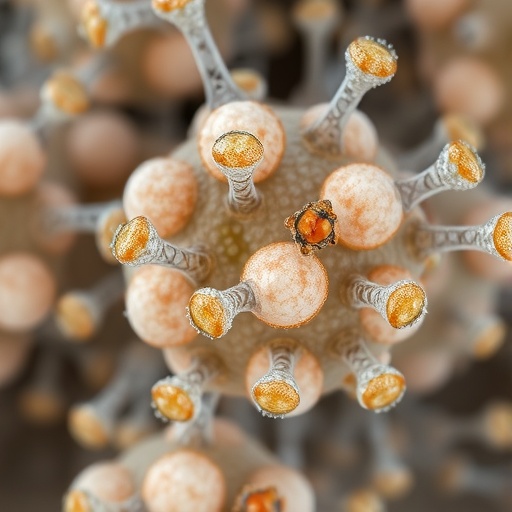
In a groundbreaking study published in Nature Chemical Biology, researchers have uncovered a fascinating biochemical mechanism underlying the assembly and functionality of mast cell extracellular granules. These granules, long known to play a pivotal role in immune responses, especially in allergic reactions and inflammation, are now revealed to be bioactive condensates meticulously assembled through the interactions of heparin and polyamines. This revelation not only advances our understanding of mast cell biology but also opens new avenues for therapeutic interventions aimed at modulating immune activity.
Mast cells are integral components of the immune system, particularly involved in immediate hypersensitivity reactions. Upon activation, these cells release a cocktail of bioactive molecules stored in granules, including histamine, proteases, cytokines, and other mediators. The granular release triggers downstream inflammatory responses, yet the precise molecular architecture and physicochemical properties of these extracellular granules remained elusive until now.
The research team, led by Xiong, Tomares, Guo, and colleagues, employed a multidisciplinary approach combining biochemical analysis, advanced imaging techniques, and synthetic modeling to characterize the composition and assembly dynamics of mast cell extracellular granules. Their data revealed that the granules are not random aggregates but rather highly organized biomolecular condensates formed through phase separation driven by heparin and polyamines.
Heparin, a sulfated glycosaminoglycan known for its anticoagulant properties, is abundantly present within the granules. It provides a dense, negatively charged scaffold that attracts and organizes polyamines—small organic cations abundantly found in cells. The interplay between heparin’s polyanionic nature and the multivalent binding capacity of polyamines creates a microenvironment favorable for phase separation, leading to the condensation and stabilization of granule contents.
This biophysical characteristic of the granules as condensates adds a new layer of complexity to their function. Unlike classical secretion that often involves soluble factors, these condensates provide a concentrated reservoir of bioactive molecules that can be released in a controlled, tunable manner. The condensate nature also allows the granules to resist premature degradation and maintain their integrity in the extracellular matrix until they reach their target sites.
Moreover, the study delineates how the balance of heparin and polyamine concentrations regulates granule assembly and disassembly. Perturbations in this balance could influence mast cell degranulation effectiveness, potentially explaining variations in allergic sensitivity or immune responses among individuals. This insight suggests that targeting the biochemical interactions within these condensates could form the basis for novel allergy therapies or immune modulators.
An exciting aspect is the demonstration of bioactivity retained by these granules as condensates outside the cell. Upon release, the physical state of the granules preserves essential molecular interactions that potentiate their signaling capacity more effectively than if the components were freely diffusing. This paradigm challenges traditional views of secretion and emphasizes the importance of molecular condensates in extracellular signaling.
The authors also explored the molecular specificity underlying heparin-polyamine interactions. They identified that certain polyamine species exhibit higher affinity and efficacy in promoting condensate formation, suggesting a selective mechanism modulating granule assembly. This specificity could be exploited in designing synthetic molecules that mimic or disrupt these interactions to modulate immune responses.
Advanced microscopy techniques employed in this research, such as super-resolution and fluorescence resonance energy transfer (FRET), allowed visualization of condensate formation in real time, offering unprecedented insights into the kinetics and spatial organization of granule assembly. These technological innovations not only strengthen the findings but also set a benchmark for future studies on biomolecular condensates in immune cells.
The implications of this study extend beyond mast cells. Biomolecular condensates are emerging as fundamental organizational units in biology, governing processes from gene regulation to signal transduction. By establishing extracellular granules as condensates formed by specific molecular interactions, the work provides a model that could be applicable to other secretory cells and extracellular matrices.
From a therapeutic perspective, manipulating the heparin-polyamine condensates could allow fine-tuning of mast cell degranulation, thereby controlling allergic inflammation with greater precision than conventional antihistamines or steroids. This approach could reduce side effects and improve patient outcomes in allergy and asthma management.
Future research inspired by these findings may investigate how environmental factors such as pH, ionic strength, or enzymatic activity influence condensate stability and function. Understanding these extrinsic modulators could reveal how pathological conditions alter mast cell behavior and suggest interventions to restore normal immune responses.
Intriguingly, the presence of polyamines, which are known to be involved in cell growth and differentiation, indicates a potential link between mast cell granule dynamics and broader cellular metabolic states. This connection offers fertile ground for exploring how systemic metabolic changes might impact immune function through condensate modulation.
In summary, the discovery of mast cell extracellular granules as bioactive condensates assembled by heparin and polyamine reshapes the conceptual framework of immune cell secretion. It highlights a sophisticated molecular architecture underpinning key physiological processes and opens transformative possibilities for immunomodulation and disease treatment.
As the field of biomolecular condensates continues to expand, studies like this emphasize the intricate chemical and physical principles guiding cellular function and intercellular communication. By leveraging these insights, future science may unlock new dimensions of control over the immune system and beyond.
Subject of Research: Mast cell extracellular granules and their biochemical assembly as bioactive condensates involving heparin and polyamines.
Article Title: Mast cell extracellular granules are bioactive condensates assembled by heparin and polyamine.
Article References:
Xiong, Y., Tomares, D.T., Guo, J. et al. Mast cell extracellular granules are bioactive condensates assembled by heparin and polyamine. Nat Chem Biol (2026). https://doi.org/10.1038/s41589-026-02165-6
Image Credits: AI Generated


