
Saturday, February 7, 2026
Science
No Result
View All Result
  • Login
  • HOME
  • SCIENCE NEWS
  • CONTACT US
  • HOME
  • SCIENCE NEWS
  • CONTACT US
No Result
View All Result
Scienmag
No Result
View All Result
Home Science News Cancer

Health and economic benefits of breastfeeding quantified

May 22, 2024
in Cancer
Reading Time: 3 mins read
0
Levelling up health in the early years: A cost-analysis of infant feeding and healthcare
66
SHARES
597
VIEWS
Share on FacebookShare on Twitter
ADVERTISEMENT

Breastmilk can promote equitable child health and save healthcare costs by reducing childhood illnesses and healthcare utilization in the early years, according to a new study published this week in the open-access journal PLOS ONE by Tomi Ajetunmobi of the Glasgow Centre for Population Health, Scotland, and colleagues.

Levelling up health in the early years: A cost-analysis of infant feeding and healthcare

Credit: Berengere Chabanis, CC0 (

Breastmilk can promote equitable child health and save healthcare costs by reducing childhood illnesses and healthcare utilization in the early years, according to a new study published this week in the open-access journal PLOS ONE by Tomi Ajetunmobi of the Glasgow Centre for Population Health, Scotland, and colleagues.

Breastfeeding has previously been found to promote development and prevent disease among infants. In Scotland – as well as other developed countries – low rates of breastfeeding in more economically deprived areas are thought to contribute to inequalities in early childhood health. However, government policies to promote child health have made little progress and more evidence on the effectiveness of interventions may be needed.

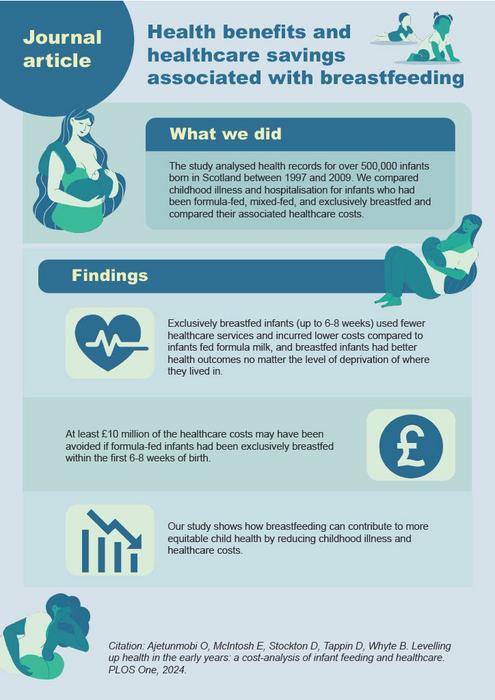
In the new study, researchers used administrative datasets on 502,948 babies born in Scotland between 1997 and 2009. Data were available on whether or not infants were breastfed during the first 6-8 weeks, the occurrence of ten common childhood conditions from birth to 27 months, and the details of hospital admissions, primary care consultations and prescriptions.

Among all infants included in the study, 27% were exclusively breastfed, 9% mixed fed and 64% formula fed during the first 6-8 weeks of life. The rates of exclusively breastfed infants ranged from 45% in the least deprived areas to 13% in the most deprived areas.

The researchers found that, within each quintile of deprivation, exclusively breastfed infants used fewer healthcare services and incurred lower costs compared to infants fed any formula milk. On average, breastfed infants had lower average costs of hospital care per admission (£42) compared to formula-fed infants (£79) in the first six months of life and fewer GP consultations (1.72, 95% CI: 1.66 – 1.79) than formula-fed infants (1.92 95% CI: 1.88 – 1.94). At least £10 million of healthcare costs could have been avoided if all formula-fed infants had instead been exclusively breastfed for the first 6-8 weeks of life, the researchers calculated.

The authors conclude that breastfeeding has a significant health and economic benefit and that increasing breastfeeding rates in the most deprived areas could contribute to the narrowing of inequalities in the early years.

#####

In your coverage please use this URL to provide access to the freely available article in PLOS ONE:

Citation: Ajetunmobi O, McIntosh E, Stockton D, Tappin D, Whyte B (2024) Levelling up health in the early years: A cost-analysis of infant feeding and healthcare. PLoS ONE 19(5): e0300267.

Author Countries: UK

Funding: The original study was jointly funded by the Scottish Collaboration of Public Health Research and Policy (SCPH/08) and the Glasgow Centre for Population Health. The funders had no role in the study design, data-linkage/analyses, decision to publish or preparation of this manuscript.


Journal

PLoS ONE

DOI

10.1371/journal.pone.0300267

Method of Research

Observational study

Subject of Research

People

Article Title

Levelling up health in the early years: A cost-analysis of infant feeding and healthcare

Article Publication Date

22-May-2024

COI Statement

The authors have declared that no competing interests exist.

Share26Tweet17
Previous Post

Study: Social networks can influence perception of climate-change risk

Next Post

Smoking fentanyl, rising in SF, is a deadly new risk for overdose

Related Posts

blank
Cancer

Deep Learning Uncovers Tetrahydrocarbazoles as Potent Broad-Spectrum Antitumor Agents with Click-Activated Targeted Cancer Therapy Approach

February 7, 2026
blank
Cancer

Newly Discovered Limonoid DHL-11 from Munronia henryi Targets IMPDH2 to Combat Triple-Negative Breast Cancer

February 7, 2026
blank
Cancer

New Discovery Reveals Why Ovarian Cancer Spreads Rapidly in the Abdomen

February 6, 2026
blank
Cancer

New Study Finds Americans Favor In-Clinic Screening Over At-Home Tests for Cervical Cancer

February 6, 2026
blank
Cancer

Dual-Action Molecule Targets Tumor Cells to Enable Higher-Dose Cancer Therapy

February 6, 2026
blank
Cancer

Scientists Uncover How ABCA1 Protein Lifts Molecular Brakes to Boost Solid Tumor Immunotherapy

February 6, 2026
Next Post

Smoking fentanyl, rising in SF, is a deadly new risk for overdose

  • Mothers who receive childcare support from maternal grandparents show more parental warmth, finds NTU Singapore study

    Mothers who receive childcare support from maternal grandparents show more parental warmth, finds NTU Singapore study

    27610 shares
    Share 11040 Tweet 6900
  • University of Seville Breaks 120-Year-Old Mystery, Revises a Key Einstein Concept

    1017 shares
    Share 407 Tweet 254
  • Bee body mass, pathogens and local climate influence heat tolerance

    662 shares
    Share 265 Tweet 166
  • Researchers record first-ever images and data of a shark experiencing a boat strike

    529 shares
    Share 212 Tweet 132
  • Groundbreaking Clinical Trial Reveals Lubiprostone Enhances Kidney Function

    515 shares
    Share 206 Tweet 129
Science

Embark on a thrilling journey of discovery with Scienmag.com—your ultimate source for cutting-edge breakthroughs. Immerse yourself in a world where curiosity knows no limits and tomorrow’s possibilities become today’s reality!

RECENT NEWS

  • How Institutional Quality Affects Inflation and Food Security
  • Inflammasome Protein ASC Drives Pancreatic Cancer Metabolism
  • Personalized Guide to Understanding and Reducing Chemicals
  • Phage-Antibiotic Combo Beats Resistant Peritoneal Infection

Categories

  • Agriculture
  • Anthropology
  • Archaeology
  • Athmospheric
  • Biology
  • Biotechnology
  • Blog
  • Bussines
  • Cancer
  • Chemistry
  • Climate
  • Earth Science
  • Editorial Policy
  • Marine
  • Mathematics
  • Medicine
  • Pediatry
  • Policy
  • Psychology & Psychiatry
  • Science Education
  • Social Science
  • Space
  • Technology and Engineering

Subscribe to Blog via Email

Enter your email address to subscribe to this blog and receive notifications of new posts by email.

Join 5,190 other subscribers

© 2025 Scienmag - Science Magazine

Welcome Back!

Login to your account below

Forgotten Password?

Retrieve your password

Please enter your username or email address to reset your password.

Log In
No Result
View All Result
  • HOME
  • SCIENCE NEWS
  • CONTACT US

© 2025 Scienmag - Science Magazine

Discover more from Science

Subscribe now to keep reading and get access to the full archive.

Continue reading