

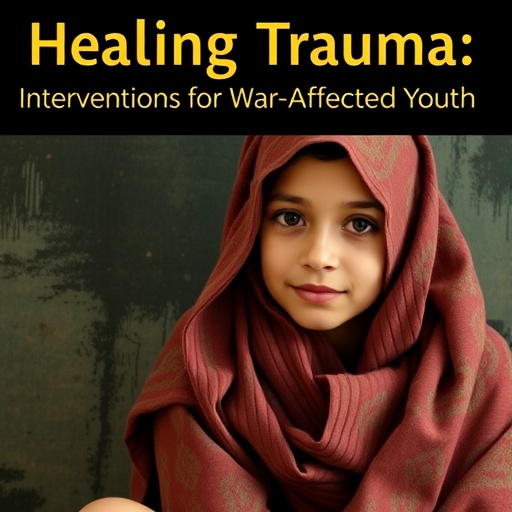
In recent decades, the psychological impact of war on children and adolescents has become an increasingly pressing concern for researchers and mental health professionals worldwide. The scars of conflict often go beyond the physical; they linger in the mind, manifesting as emotional distress, developmental disruptions, and difficulties in social interactions. As part of this ongoing discourse, Z. Asgari’s recent narrative review, “Healing the Invisible Wounds: A Narrative Review of Trauma-Focused Interventions for War-Affected Children and Adolescents,” offers vital insights into trauma-focused interventions tailored to these vulnerable populations. This comprehensive exploration underscores the necessity for tailored approaches to heal psychological wounds inflicted by war.
The review meticulously synthesizes existing literature surrounding trauma-focused interventions aimed explicitly at children and adolescents affected by conflict. Asgari emphasizes that traditional therapeutic methods may not suffice for these young individuals who often experience unique and complex trauma histories that necessitate specialized care. Many of these children, subjected to violence, displacement, and loss, face a multitude of mental health challenges, including PTSD, depression, and anxiety, which can derail their academic and social development.
A significant portion of the narrative review delves into various trauma-informed approaches that researchers and practitioners have developed over time. Asgari outlines several intervention frameworks, some centering on cognitive-behavioral techniques designed to help children cognitively process their experiences and develop coping strategies. Others include expressive arts therapies, which allow children to communicate their feelings through art, music, or play—mediums that can circumvent the limitations of verbal communication. This spectrum of interventions highlights the need for flexibility in therapeutic approaches to suit the diverse expression of trauma among war-affected youth.
Another critical aspect of the review focuses on the importance of community involvement in the healing process. Asgari posits that leveraging community resources and support systems can significantly enhance the efficacy of interventions. Engaging family members, peers, and educators not only helps to create a support network but also integrates healing into the broader social fabric, which is essential in ensuring a child’s recovery is holistic and sustainable over the long term. The narrative stresses that standalone individual therapy often fails to account for the communal context in which these children live.
In exploring the effectiveness of various intervention strategies, the review highlights mixed outcomes in current research, suggesting that while many trauma-informed approaches show promise, there is still much to be done to standardize best practices. Asgari points out that while some studies demonstrate significant improvements in psychosocial functioning through structured interventions, others reveal little to no effect on long-term mental health outcomes. This inconsistency calls for ongoing research and a re-evaluation of methodologies used in therapeutic settings.
Moreover, Asgari draws attention to the cultural considerations necessary in trauma treatment. Intervention strategies must be contextually grounded, taking into account the cultural, social, and economic factors influencing the experiences of war-affected children. For instance, rituals and practices that are culturally significant can bolster healing processes, making it crucial for practitioners working in conflict zones to understand these nuances. Such cultural sensitivity ensures that interventions are not only effective but also respectful and relevant to the communities they seek to serve.
The integration of technology into trauma-focused interventions is another area that Asgari examines. Digital platforms are increasingly being utilized to reach children in conflict zones, bridging gaps in access to traditional therapy. While technology presents exciting possibilities for wider reach and immediacy, Asgari cautions against potential pitfalls, such as the risk of oversimplifying complex psychological issues or compromising the therapeutic relationship. However, when utilized judiciously, technology could provide significant support to children unable to attend face-to-face therapy sessions due to various barriers.
Throughout the review, Asgari emphasizes the necessity for interdisciplinary collaboration to enhance the effectiveness of trauma-focused interventions. Mental health professionals, educators, social workers, and community leaders need to work together to create comprehensive frameworks that address the myriad of challenges faced by war-affected youth. Training for professionals across disciplines in trauma-informed care is essential to foster a shared understanding of the complexities of trauma and recovery in these populations.
One significant takeaway from the narrative review is the urgent need for policy advocacy focusing on mental health support for children in conflict zones. Asgari advocates for a shift in how governments and organizations prioritize mental health in post-war recovery strategies. Investing in mental health interventions for children is not merely a therapeutic necessity but a societal imperative that influences future generations. The long-term consequences of neglecting mental health during critical developmental phases can perpetuate cycles of violence, trauma, and instability.
Asgari’s review also serves as a call to action for researchers to continue exploring innovative methods for trauma treatment. Future studies need to investigate longitudinal outcomes of various interventions, focusing on resilience and strengths-based approaches rather than merely deficiencies in mental health. Instrumental to this is participatory research that involves war-affected children and adolescents themselves in the design and evaluation of interventions, ensuring their voices shape the frameworks that aim to heal their wounds.
Through the lens of Asgari’s analysis, it becomes clear that healing the psychological ramifications of war on children and adolescents requires a concerted effort that transcends traditional boundaries. By amalgamating knowledge from various disciplines, integrating cultural contexts, and utilizing innovative methods, practitioners can hope to foster resilience and recovery in the face of profound adversity. As the landscape of war continues to evolve, so must our understanding and approaches to mental health interventions, ensuring that vulnerable populations do not remain hidden in the shadows of conflict.
In conclusion, Asgari’s narrative review serves as a comprehensive resource that not only encapsulates the state of current trauma-focused interventions for war-affected youth but also charts a path forward for researchers and practitioners grappling with the intricate realities of emotional healing in conflict contexts. As we approach an increasingly complex world, the insights provided in this review remain an urgent reminder of the stakes involved in addressing the mental health needs of future generations scarred by war.
Subject of Research: Trauma-focused interventions for children and adolescents affected by war.
Article Title: Healing the Invisible Wounds: A Narrative Review of Trauma-Focused Interventions for War-Affected Children and Adolescents.
Article References:
Asgari, Z. Healing the Invisible Wounds: A Narrative Review of Trauma-Focused Interventions for War-Affected Children and Adolescents.
Journ Child Adol Trauma (2025). https://doi.org/10.1007/s40653-025-00802-1
Image Credits: AI Generated
DOI: https://doi.org/10.1007/s40653-025-00802-1
Keywords: Trauma, children, adolescents, war, mental health, interventions, resilience, therapy, community support.


