

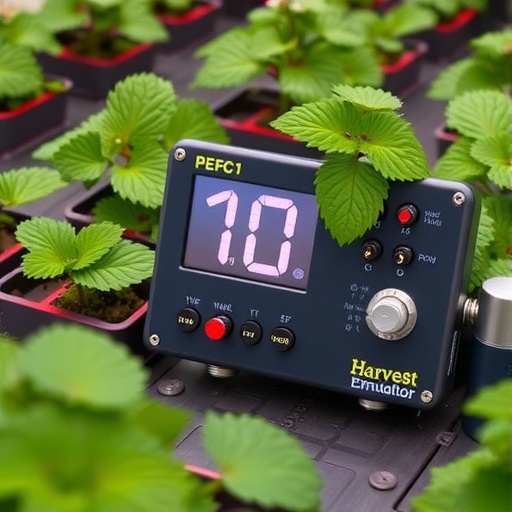
In an era where precision agriculture is increasingly becoming the linchpin of sustainable food production, a groundbreaking study out of Japan is turning heads in horticultural technology circles. Researchers led by Naito, Kawasaki, and Lee have unveiled a compelling proof-of-concept demonstrating harvest peak control in strawberry cultivation through the innovative use of a cultivation emulator paired with artificial weather chambers. This pioneering approach harnesses advanced environmental simulations to optimize growth cycles, effectively transforming how growers might soon manage crop yields on a commercial scale.
Strawberries, cherished worldwide for their flavor and nutritional value, present significant challenges to producers due to their sensitivity to environmental variables like temperature, light, and humidity. Traditional cultivation methods often rely on natural weather conditions and instinctive scheduling for planting and harvesting. However, this can lead to unpredictable yields and quality inconsistencies. The new research proposes an emulator-based system that can mimic and control the microclimatic parameters within artificial weather chambers, allowing for unprecedented precision in steering crop development toward a predetermined harvest peak.
What sets this study apart is its detailed integration of emulation technology with climate-controlled growth environments. The research team constructed a strawberry cultivation emulator that accurately models plant responses to varying weather conditions. This emulator was systematically linked with artificial weather chambers that reproduce these conditions in a highly controlled setting. By iteratively adjusting environmental inputs based on emulator predictions, the researchers achieved fine-tuned regulation of strawberry development stages, essentially programming the plants’ growth trajectories to reach harvest readiness at specifically targeted times.
Underlying this accomplishment is an intricate computational framework. The emulator utilizes vast datasets on strawberry physiological responses, including photoperiod sensitivity, temperature thresholds, and moisture requirements. Advanced algorithms process these parameters to forecast optimal environmental conditions conducive to the desired growth rate and fruit maturation. This dynamic simulation thereby offers a virtual blueprint for the precise manipulation of real-world growth environments inside the weather chambers.
The controlled environmental system itself represents a feat of engineering. Artificial weather chambers were custom-built with capabilities to modulate diverse climatic factors, ranging from temperature gradients and humidity levels to light intensity and spectral quality. These chambers enable continuous, real-time adjustments informed by emulator outputs. Combining physical control hardware with predictive digital models creates a closed-loop system optimized for maximizing strawberry yield and quality.
Importantly, the research transcends typical trial-and-error experimentation. The emulator-driven protocol minimizes guesswork and resource wastage, affording growers the ability to plan harvest schedules with scientific accuracy. This level of control could revolutionize strawberry production by stabilizing market supply and enhancing crop uniformity, potentially translating into economic benefits for farmers and improved availability for consumers.
Furthermore, the proof-of-concept results highlight the system’s robustness across variable growth scenarios. Even when subjected to simulated weather fluctuations mimicking unpredictable external conditions, the emulator and weather chambers successfully maintained trajectory toward intended harvest targets. This resilience suggests practical applicability in diverse geographical regions, where climate unpredictability poses a significant cultivation risk.
Beyond strawberries, the broader implications of this research are vast. The integration of crop growth emulators with artificial climate controls could be tailored to numerous high-value horticultural crops, from berries to leafy greens and specialty vegetables. Such technology aligns with global agricultural goals centered on sustainability, efficiency, and food security by enabling growers to adapt rapidly to changing environmental or economic circumstances.
This study also exemplifies the synergy between computational modeling and traditional agricultural practices. It underscores how precision agriculture is evolving through digitization and automation, blending biological insights with data science to produce tangible improvements. Future integrations might explore coupling this system with IoT sensors and AI-driven analytics to enhance real-time decision making further.
Importantly, the developments arise amid mounting pressures on the agricultural sector from climate change and population growth. With unpredictable weather patterns and increasing demand for fresh produce, controlled environment agriculture solutions like the one demonstrated by Naito and colleagues could play a key role in shaping resilient food systems. Their work not only provides a scientific foundation but also a practical roadmap for future innovations.
The research team emphasizes that while the proof-of-concept is promising, further experimentation in commercial-scale environments is necessary. Scaling the emulator-weather chamber interface and integrating economic considerations will be crucial steps toward broad deployment. Nonetheless, the foundational technology sets a new benchmark for harnessing environmental control to modulate plant phenology with exceptional precision.
In conclusion, the research by Naito, Kawasaki, Lee, and their collaborators opens a new frontier in agricultural science by illustrating how sophisticated environmental emulation can achieve precise harvest peak control. As commercial growers and agricultural technologists explore these findings, the potential to revolutionize not only strawberry cultivation but also broader crop management paradigms hints at a transformative era in food production technology.
This study is an inspiring demonstration of harnessing artificial environments and computational intelligence to fine-tune nature’s rhythms, bringing us closer to tailored, predictable agriculture. It underscores the exciting trajectory toward a future where crop cycles are not at the mercy of unpredictable weather but are strategically engineered for optimized yield, quality, and sustainability.
Subject of Research:
Strawberry cultivation and harvest timing control using artificial environmental simulation.
Article Title:
Proof-of-concept of harvest peak control using a strawberry cultivation emulator with artificial weather chambers.
Article References:
Naito, H., Kawasaki, Y., Lee, U. et al. Proof-of-concept of harvest peak control using a strawberry cultivation emulator with artificial weather chambers. Sci Rep (2026). https://doi.org/10.1038/s41598-026-46422-z
Image Credits: AI Generated
DOI: 10.1038/s41598-026-46422-z
Keywords:
Precision agriculture, strawberry cultivation, artificial weather chambers, growth emulator, harvest peak control, controlled environment agriculture, crop modeling, phenology management, sustainable agriculture.


