

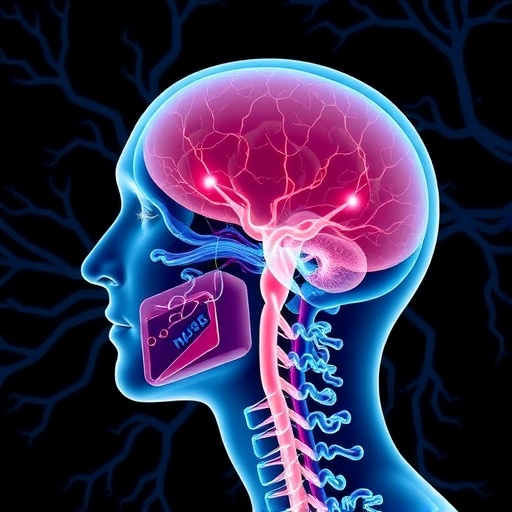
In a groundbreaking synthesis of vast and intricate research, scientists at the University of California, San Diego, have published a comprehensive review that elucidates the multifaceted mechanisms and therapeutic potential of vagus nerve stimulation (VNS). This revolutionary medical intervention, which the U.S. Food and Drug Administration (FDA) has approved across various devices and indications, showcases the profound breadth of vagus nerve modulation in treating a diverse array of conditions, from neurological disorders like epilepsy and depression to autoimmune diseases such as rheumatoid arthritis.
Vagus nerve modulation operates by delivering controlled external signals—most commonly gentle electrical pulses—targeted at the vagus nerve, a critical autonomic nerve running bilaterally from the brainstem down through the neck, thorax, and abdomen. Serving as a conduit of communication between the brain and multiple organ systems, the vagus nerve modulates central nervous system activity, inflammatory responses, and organ function. The emerging therapies under this umbrella harness these intrinsic pathways to alleviate symptoms and modify disease processes without relying solely on pharmacological interventions.
The extensive review, featured in the prestigious journal Comprehensive Physiology, compiles over 660 scholarly references to weave a unifying narrative that bridges multiple scientific domains surrounding VNS. The authors, led by Troy (Yifeng) Bu and senior author Imanuel Lerman, emphasize that despite a burgeoning body of mechanistic insights, the field has suffered from fragmentation, with research often siloed by condition or system. This paper dismantles those barriers, mapping out how vagus nerve stimulation orchestrates complex physiological responses from synaptic plasticity in the brain to immunomodulation and endocrine integration.
Particular attention is given to how VNS influences neural circuits and inflammatory pathways. Electrical stimulation of the vagus nerve activates afferent fibers terminating in the brainstem, which can modulate neurotransmitter release, alter neuronal excitability, and regulate autonomic tone. Simultaneously, the efferent fibers exert systemic control over inflammatory cytokines via the cholinergic anti-inflammatory pathway, a mechanism that has spurred interest in treating chronic inflammatory diseases non-invasively. The intricate interplay of these neural and immune processes underscores why vagus nerve modulation holds promise across such a wide spectrum of medical conditions.
However, the review also highlights significant hurdles in the clinical translation of VNS. A noteworthy challenge lies in the considerable variability among existing devices and stimulation parameters. Frequencies, waveforms, pulse durations, and target sites vary widely across studies and FDA-approved devices, making direct comparisons and standardized protocols elusive. The review cautions against assuming interchangeability among devices, noting that subtle differences in electrical signals can lead to divergent or even unintended physiological outcomes.
Moreover, patient heterogeneity presents a profound obstacle. Individual anatomical variations in vagus nerve composition, autonomic nervous system baseline setpoints, and comorbidities, such as chronic obstructive pulmonary disease or cardiovascular conditions, influence the therapeutic efficacy of VNS. There is increasing recognition that a one-size-fits-all approach is inadequate. Instead, future therapies must incorporate personalization strategies that account for biological and disease-specific differences to optimize outcomes.
The authors propose that closed-loop VNS systems represent a promising avenue for overcoming such challenges. These devices would integrate sensors to monitor physiological biomarkers in real time and dynamically adjust stimulation parameters accordingly. Such feedback-driven modulation could theoretically tailor therapies to the individual’s response, improving precision and minimizing side effects. This paradigm shift aligns with broader trends toward personalized and precision medicine using advanced technologies.
Artificial intelligence (AI) and machine learning algorithms also feature prominently in the roadmap for next-generation VNS therapies. AI-based models could analyze complex patient data, predict responders, and refine stimulation protocols by finding nuanced patterns invisible to human observers. Furthermore, advancements in selective fiber targeting within the vagus nerve may unlock the ability to stimulate only specific neural pathways responsible for desired therapeutic effects, minimizing off-target consequences.
From an engineering perspective, the review underlines the necessity for rigorous, multidisciplinary collaboration—melding neurobiology, bioelectronic engineering, and clinical sciences—to develop devices with optimized waveform characteristics, power efficiency, and biocompatibility. Innovations such as minimally invasive electrode designs and integration with wearable technology are anticipated to broaden accessibility and patient compliance.
This journal article is more than a mere catalog of research findings. It offers a conceptual framework envisaging vagus nerve stimulation as a modular biological system encompassing interacting neural and systemic components. By elucidating how this system might respond to different devices and stimulation paradigms, the paper aims to guide researchers and clinicians in designing tailored interventions addressing the right target organs with the right signals.
The work acknowledges early foundational support from agencies like DARPA and NIH’s SPARC initiative, which have propelled this field from nascent electrophysiology studies to robust therapeutic platforms. Yet, the authors remain prudently optimistic, cautioning against premature overgeneralizations and emphasizing the imperative to ground innovations in rigorous mechanistic understanding and patient-centered design.
The implications of this synthesis extend beyond therapeutic horizons. By unraveling vagus nerve’s multifaceted role in neuroimmune communication and systemic homeostasis, this field could illuminate fundamental biological processes relevant to disease pathogenesis and health maintenance. Altogether, the review marks a crucial milestone, setting the stage for transformative bioelectronic medicine that promises to redefine treatment paradigms across numerous chronic and acute conditions.
In summary, the UC San Diego-led comprehensive review embodies a pivotal advance in vagus nerve research, encapsulating both extraordinary opportunity and daunting complexity. This synthesis not only clarifies how vagus nerve stimulation exerts its diverse therapeutic effects but also charts a strategic course toward the personalized, evidence-based deployment of bioelectronic therapies, which may soon reshape clinical practice and patient outcomes worldwide.
Subject of Research: People
Article Title: A Review of Vagus Nerve Stimulation For Disease: Comprehensive Theory And Evidence For Mechanisms of Action
News Publication Date: 4-Mar-2026
References:
Bu, Y., Lerman, I., Liang, A., Hoffman, B., Gottfried-Blackmore, A., Mittal, R., Schiehser, D., Simmons, A., Klaming, R., Case, O., Puleo, C., & Lim, H. (2026). A Review of Vagus Nerve Stimulation For Disease: Comprehensive Theory And Evidence For Mechanisms of Action. Comprehensive Physiology. https://onlinelibrary.wiley.com/doi/10.1002/cph4.70109
Image Credits: Courtesy of Lerman Lab, UC San Diego Qualcomm Institute
Keywords
Vagus nerve stimulation, bioelectronic medicine, neuroimmune modulation, autonomic nervous system, personalized therapy, closed-loop systems, electrical neuromodulation, inflammatory diseases, epilepsy, depression, rheumatoid arthritis, FDA-approved devices, neural plasticity


