

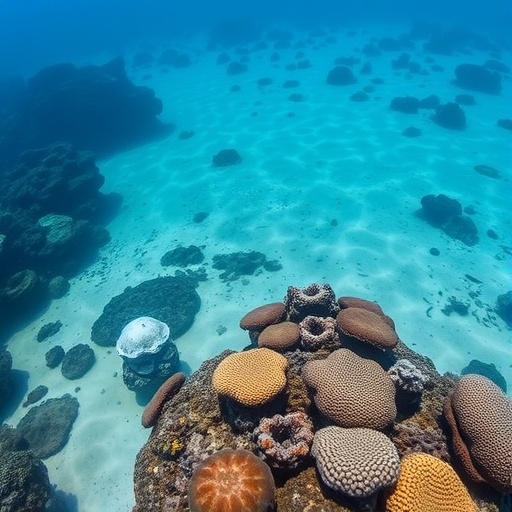
For the first time, an unprecedented international effort spearheaded by Smithsonian researchers has rigorously quantified the staggering extent of coral bleaching worldwide amid the 2014-2017 global marine heatwave. This multi-institutional study reveals that approximately half of the world’s coral reefs were severely impacted, marking the third global coral bleaching event as the most devastating on record. Moreover, the onset of an ongoing fourth heatwave in 2023 threatens to exacerbate the crisis, casting a dire shadow over global marine ecosystems and the countless communities they sustain.
Coral reefs are exceptionally productive ecosystems, delivering vital benefits to humanity, including fisheries, tourism, coastal protection, and pharmaceutical discoveries, with their estimated global value approaching $9.8 trillion annually. Their ecological vitality hinges on a symbiotic relationship between a microscopic animal—taxonomically linked to jellyfish—that builds the coral skeleton, and an equally minute algal partner residing within, which harnesses sunlight to produce essential energy via photosynthesis. Elevated ocean temperatures disrupt this delicate symbiosis, causing corals to expel their algae, lose coloration, and enter a state commonly known as bleaching. Prolonged or intense bleaching diminishes coral growth and reproduction, often culminating in widespread mortality.
The research team, drawing expertise from over 190 scientists across 143 institutions spanning 41 countries, integrated sophisticated satellite temperature datasets from the NOAA Coral Reef Watch system with extensive in situ reef assessments and aerial surveys. This holistic approach permitted the calibration of heat stress indicators against actual reef conditions, enabling extrapolation of bleaching severity to reefs globally, including those inaccessible for direct observation.
Findings from more than 15,000 reef surveys indicate that nearly 80 percent of coral reefs endured moderate or worse bleaching episodes, while approximately 35 percent faced significant mortality. These alarming statistics translate into an estimated 50 percent of reefs worldwide suffering severe bleaching, and 15 percent experiencing substantial reef death during the event from 2014 to 2017. Such degradation imperils the myriad ecosystem services reefs provide, jeopardizing economic and food security on local, regional, and global scales.
The team was compelled to define novel bleaching alert classifications due to the unprecedented severity of the thermal stress observed, signaling that conventional thresholds were insufficient amid intensifying ocean temperatures. This extension of monitoring capacity is crucial for understanding and forecasting reef responses under increasingly frequent and intense marine heatwaves, phenomena directly linked to anthropogenic climate change.
Professor Scott Heron of James Cook University emphasized the recurrent nature of the heat stress, noting that nearly half of the affected reef sites endured repeated bleaching-level conditions within this three-year timeframe, often with compounded detrimental effects. Notably, Australia’s Great Barrier Reef experienced back-to-back bleaching events during this interval, followed by three subsequent incidents, underlining a perilous trend of insufficient recovery time between acute stress episodes.
Over the past three decades, the Earth has witnessed a precipitous 50 percent decline in coral populations, largely due to oceanic heat uptake from fossil fuel emissions. Without this ocean heat absorption, surface air temperatures would soar to an inhospitable 50 degrees Celsius (122 degrees Fahrenheit), demonstrating the oceans’ role as a critical climate buffer, albeit at the expense of marine ecosystems. Current data confirms the onset of a fourth global coral bleaching event commencing in early 2023, compounding an already dire global conservation emergency.
The study’s senior scientist, Sean Connolly, characterized the 2014-2017 event as the most geographically extensive and severe bleaching episode ever documented, illuminating the fragility and vulnerability of coral reef ecosystems worldwide. The ongoing fourth event, surpassing prior heat stress magnitudes, presents a grim prognosis for reefs, many of which are displaying signs of chronic degradation and diminished resilience.
Joshua Tewksbury, director of the Smithsonian Tropical Research Institute, highlighted the critical necessity of coordinated, multidisciplinary endeavors to effectively monitor and understand these environmental crises. By leveraging a fusion of satellite remote sensing technology with rigorous ground-truth calibration, scientists can achieve an unprecedented scale of ecosystem assessment that informs conservation strategy and policy development at global and regional levels.
The implications of this research extend beyond ecological concerns, intersecting with economic stability and social well-being. Coral reef damage compromises fisheries that sustain millions of people, diminishes tourism revenue vital to many economies, and reduces coastal natural defenses, increasing community vulnerability to storms and erosion. Additionally, the loss of coral biodiversity restricts future opportunities for bioprospecting and pharmaceutical innovations, illustrating the profound interconnectedness of coral reef health with human progress.
As coral reef decline accelerates under mounting climate pressures, these findings underscore an urgent call to action for robust climate mitigation, enhanced reef management, and innovative adaptation strategies. Failure to curb greenhouse gas emissions and implement effective conservation initiatives will likely result in irreversible losses, threatening the complex marine ecosystems and human livelihoods intertwined with their existence.
Through this landmark study published in Nature Communications, scientists worldwide have amalgamated a comprehensive dataset and analytical framework that sets a new standard for coral reef monitoring. Their efforts pave the way for ongoing surveillance of reef health and provide critical information necessary for shaping resilient and sustainable marine policies amid a rapidly changing climate.
Subject of Research: Severe and widespread coral reef damage resulting from global marine heatwaves and coral bleaching events.
Article Title: Severe and widespread coral reef damage during the 2014-2017 Global Coral Bleaching Event
News Publication Date: 10-Feb-2026
Web References:
https://doi.org/10.1038/s41467-025-67506-w
Image Credits: Dave Burdick / University of Guam
Keywords: coral bleaching, global marine heatwave, coral reef damage, climate change, ocean warming, satellite monitoring, coral symbiosis, reef mortality, ecosystem services, NOAA Coral Reef Watch, Great Barrier Reef, coral conservation


