

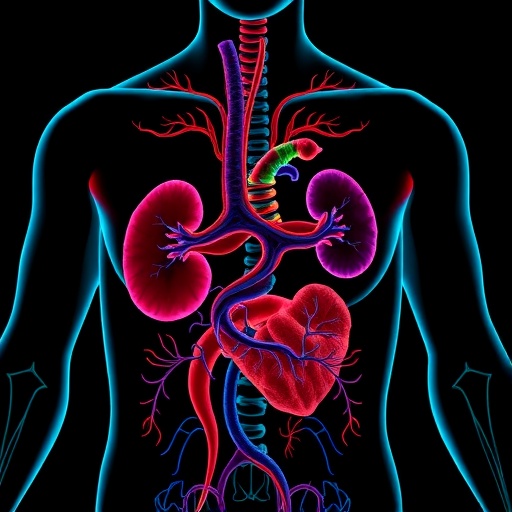
In an era where the complex interplay between human physiology and the microbiota residing within us increasingly captures scientific attention, a groundbreaking study has unveiled a profound connection linking the gut microbiome, kidney function, and heart health. This newly characterized axis—termed the gut microbiome-kidney-heart axis—not only sheds light on the underlying biological pathways influencing cardiovascular diseases (CVD) but also holds immense promise for predictive diagnostics and targeted therapeutics. Published in Nature Communications in 2026 by Chechi et al., this seminal research redefines our understanding of how microbial communities in the gut can directly and indirectly modulate critical organ systems implicated in cardiovascular pathology.
The human gut is host to trillions of microorganisms, including bacteria, archaea, viruses, and fungi, collectively known as the gut microbiome. These microorganisms execute vital functions such as nutrient metabolism, immune regulation, and maintenance of intestinal barrier integrity. However, their influence extends beyond the gastrointestinal tract through the production of metabolites and signaling molecules that affect distant organs, including the kidneys and heart. This study harnesses multi-omics approaches alongside longitudinal clinical data to decode this elaborate communication network and identify specific microbial signatures predictive of cardiovascular risk.
Central to the findings is the identification of distinct microbial taxa and their metabolites that appear to drive pathogenic pathways by modulating renal function, subsequently influencing cardiac health. Traditionally, the kidneys and heart have been viewed through a cardiorenal lens, where dysfunction in one organ exacerbates injury in the other. Chechi and colleagues expand this paradigm by incorporating the gut microbiome as a critical upstream regulator. Their analysis reveals that dysbiosis—microbial community imbalance—increases generation of uremic toxins and pro-inflammatory metabolites which impair glomerular filtration and promote vascular endothelial dysfunction.
Mechanistically, the study elucidates how microbial metabolites like trimethylamine-N-oxide (TMAO), indoxyl sulfate, and p-cresyl sulfate act as mediators in this axis. Elevated levels of these metabolites, frequently produced by gut bacteria metabolizing dietary choline and protein, enter systemic circulation, where they exacerbate oxidative stress, inflammation, and fibrosis within renal tissues. The resulting kidney impairment perturbs fluid and electrolyte homeostasis, which in turn places significant hemodynamic strain on the myocardium, fostering heart failure and arrhythmogenesis.
Importantly, the authors demonstrate that longitudinal profiling of gut microbial composition combined with plasma metabolomics can accurately stratify patients at risk for future cardiovascular events even before overt clinical manifestations. This predictive capacity, backed by rigorous machine learning models trained on high-dimensional datasets, offers a potential paradigm shift in preventive cardiology. By integrating microbiome analyses into routine diagnostics, clinicians could preemptively identify high-risk individuals, enabling early intervention strategies and personalized treatment plans.
The study further dissects the immune-modulatory roles of the gut microbiome within this axis, highlighting its influence on systemic inflammation—a recognized driver of atherosclerosis and myocardial injury. Alterations in the gut microbial population were correlated with shifts in circulating cytokine profiles, including increased levels of interleukin-6 (IL-6) and tumor necrosis factor-alpha (TNF-α). Such pro-inflammatory states intensify endothelial dysfunction and plaque instability, underpinning the increased susceptibility to ischemic events observed in the study cohort.
Chechi et al.’s work also underscores the kidney’s role as both a filter and a responder to microbiome-derived metabolites, showcasing how renal clearance of these compounds determines their systemic concentrations and consequent cardiovascular impact. Their analysis detailed renal transcriptomic changes induced by elevated microbial metabolites, highlighting the activation of profibrotic pathways such as transforming growth factor-beta (TGF-β) signaling, which promote glomerulosclerosis and chronic kidney disease progression.
Clinically, this research calls for a reassessment of therapeutic strategies targeting cardiovascular risk. Current treatments focusing on blood pressure and lipid control could be augmented by interventions modulating the gut microbiome—such as probiotics, prebiotics, dietary modifications, and even targeted bacteriophage therapy. By restoring microbial balance and reducing the load of toxic metabolites, it may be possible to ameliorate kidney impairment and thereby safeguard cardiac function.
Furthermore, the study ventures into the potential of personalized microbiome-based therapies, emphasizing the interindividual variability in microbial composition and metabolite production. This variability necessitates patient-specific microbial profiling to tailor interventions effectively. The prospect of developing microbial metabolite inhibitors or adsorbents to reduce systemic toxin levels emerges as a promising avenue for future drug development.
Technological advances underpinning this research were pivotal. The integration of shotgun metagenomics with high-throughput metabolomics and single-cell RNA sequencing enabled a comprehensive assessment of functional microbiome-host interactions. Coupled with sophisticated bioinformatics pipelines and robust statistical modeling, these tools allowed the authors to distill complex datasets into actionable biological insights.
While the study presents compelling evidence linking the gut microbiome-kidney-heart axis to cardiovascular disease risk, it also opens new questions. The directionality and causality of these interrelationships warrant further exploration through interventional trials. Additionally, the environmental and lifestyle factors influencing microbial composition and metabolite production in the context of this axis remain an area ripe for investigation.
In a global health landscape where cardiovascular diseases remain the leading cause of mortality, this research offers a beacon of hope. It illuminates previously underappreciated molecular conduits connecting gut microbes, renal function, and cardiac health, underscoring the systemic nature of cardiovascular pathology. By advancing our grasp of these intricate biological networks, it paves the way for transformative advances in prevention, diagnosis, and therapeutics.
The implications extend beyond cardiology into nephrology and gastroenterology, advocating for a multidisciplinary approach to patient care. Healthcare practitioners are encouraged to recognize the gut microbiome as a dynamic organ influencing systemic health. This recognition advocates for integrating microbiome assessments into routine clinical evaluation and designing multifaceted treatment regimens addressing microbial dysbiosis alongside traditional risk factors.
In conclusion, the study by Chechi et al. marks a paradigm shift, positioning the gut microbiome not merely as a bystander but as a key orchestrator in the pathophysiology of cardiovascular diseases via a novel kidney-heart axis. This intricate crosstalk offers unprecedented opportunities for early detection and intervention, reshaping future cardiovascular medicine into a more holistic, systems-biology oriented discipline. Harnessing the full potential of this axis will undoubtedly require continued collaborative research, technological innovation, and clinical translation, but the pathway illuminated by this work is poised to redefine our battle against cardiovascular disease.
Subject of Research: The gut microbiome’s role in modulating kidney function and heart health, with implications for predicting future cardiovascular diseases.
Article Title: A gut microbiome-kidney-heart axis predictive of future cardiovascular diseases
Article References:
Chechi, K., Chakaroun, R., Myridakis, A. et al. A gut microbiome-kidney-heart axis predictive of future cardiovascular diseases. Nat Commun (2026). https://doi.org/10.1038/s41467-026-69405-0
Image Credits: AI Generated


