

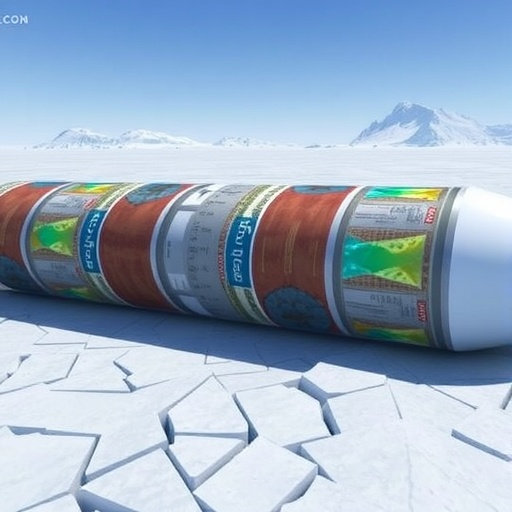
Deep beneath the formidable expanse of the West Antarctic Ice Sheet, a team of international scientists has accomplished an extraordinary feat that promises to reshape our understanding of climate history and ice sheet dynamics. Situated approximately 700 kilometers from the nearest Antarctic research facilities, experts successfully drilled through an astonishing 523 meters of ice at Crary Ice Rise, extracting a sediment core of unprecedented length—228 meters. This achievement marks a pivotal advancement in polar science, offering an unmatched geological archive that chronicles environmental conditions spanning millions of years, with profound implications for predicting the future behavior of Antarctic ice in a warming world.
The sediment core recovered from this remote ice dome stands as the longest ever retrieved beneath an ice sheet, far surpassing previous efforts where cores seldom exceeded ten meters. The core is a stratified record composed of various sediments including fine muds, firmer gravels, and embedded rocks, each layer representing a distinct period in Earth’s climatic past. These sediments provide a direct window into past warm intervals, revealing episodes when global temperatures considerably exceeded pre-industrial levels by more than two degrees Celsius—a critical threshold in contemporary climate discussions.
Understanding how the West Antarctic Ice Sheet responded during these warmer epochs is essential because a complete melting of this colossal ice mass would propel sea levels to rise by an estimated four to five meters globally, potentially displacing millions and reshaping coastal landscapes. Yet, until now, scientific models have heavily depended on indirect satellite data and records collected at ice edges or floating ice shelves, lacking in-depth insights from the ice sheet’s interior where the processes governing its stability truly unfold.
The SWAIS2C project—Sensitivity of the West Antarctic Ice Sheet to 2°C—was conceived to address this knowledge gap. By targeting Crary Ice Rise, an ice dome grounded at the Ross Ice Shelf’s inner margin, researchers directly accessed sediment layers that faithfully record past ice sheet margin behaviors. Preliminary analyses suggest that the sediment layers span an impressive 23 million years, encompassing multiple warm periods marked by substantial ice retreat and ecological transformation, as indicated by fossilized microfauna within the core.
One of the most compelling discoveries within the core is the presence of sediment types and marine organism remains indicative of open ocean conditions beneath what is today thick, solid ice. Shell fragments and fossils that require sunlight confirm that at times in Earth’s history, the Ross Ice Shelf once retreated, exposing open waters and facilitating iceberg calving. However, pinpointing the exact timing and environmental triggers of these episodes has remained elusive, making the ongoing chronological refinement of these sediments a scientific priority with the potential to unlock vital clues about ice sheet sensitivity to warming.
The technical challenges in obtaining this record were monumental. The multidisciplinary team of 29 scientists, drillers, engineers, and polar experts had to innovate beyond previous methodologies. They first employed hot-water drilling to melt the pronounced ice column—a formidable task in itself—and then deployed an extensive riser and drill string assembly stretching over 1,300 meters deep. The operation required round-the-clock shifts under extreme weather conditions, underscoring the logistical complexity of polar frontier science.
The retrieval and subsequent examination of sediment cores involved meticulous documentation through photography, X-raying, and sampling, allowing researchers to characterize the sedimentological sequences and microfossil contents comprehensively. Early field-based dating work utilized biostratigraphy, relying on microfossil identification to estimate core age, while ongoing laboratory analyses will improve temporal resolution and environmental reconstructions.
Success on this third drilling attempt, after two previous setbacks due to technical difficulties, speaks to the resilience and ingenuity of the team. Their accomplishment not only expands the scientific frontier but also sets a new benchmark for sub-ice sediment recovery, opening avenues for further high-resolution paleoclimate investigations. These endeavors are crucial as the West Antarctic Ice Sheet’s fate remains a pivotal unknown in global climate projections.
Looking forward, the SWAIS2C collaboration plans to build upon this success by continuing its multi-disciplinary exploration of ice sheet dynamics. Detailed paleoenvironmental reconstructions drawn from the sediment core will refine climate models, enabling predictions of ice margin retreat rates and mechanisms under various warming scenarios. These insights are vital for policymakers and scientists aiming to mitigate and adapt to the consequences of accelerating climate change.
Ultimately, the recovery of the Crary Ice Rise sediment core is more than a scientific milestone—it is a beacon illuminating the past behaviors of one of Earth’s most vulnerable and impactful ice reservoirs. By peering into billions of years of preserved climate memory, researchers gain not only historical perspective but also critical foresight necessary to navigate the coming challenges of global warming.
Subject of Research:
The sensitivity and historical behavior of the West Antarctic Ice Sheet during past warm periods, with a focus on sediment records from Crary Ice Rise.
Article Title:
Record-Breaking Antarctic Sediment Core Sheds Light on Ice Sheet Retreat and Climate Sensitivity
News Publication Date:
Information not provided.
Web References:
https://swais2c.aq/
https://www.earthsciences.nz/news/behind-the-scenes-of-swais2cs-hunt-for-climate-clues-at-the-antarctic-frontier
Image Credits:
Ana Tovey / SWAIS2C
Keywords:
West Antarctic Ice Sheet, sediment core, climate history, ice sheet retreat, Crary Ice Rise, paleoenvironment, sub-ice geology, Antarctic drilling, climate sensitivity, sea level rise, Ross Ice Shelf, SWAIS2C project.


