

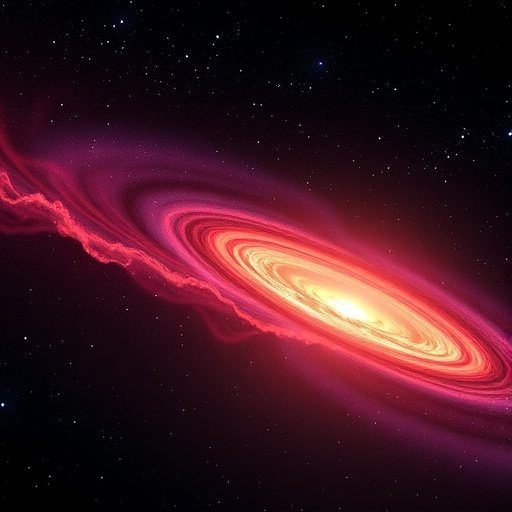
The cosmos is alive with echoes from its most cataclysmic events, as revealed by the latest release from the LIGO-Virgo-KAGRA (LVK) Collaboration: the Gravitational-Wave Transient Catalog 4.0 (GWTC-4). This monumental compilation captures the waveforms of gravitational disturbances arriving at Earth from vast distances and time spans—signals birthed by the violent mergers of black holes, neutron stars, or hybrids of these extreme objects. Between May 2023 and January 2024, the global network of gravitational-wave observatories has detected an unprecedented number of these cosmic ripples, deepening humanity’s insight into the workings of the universe.
Gravitational waves represent tiny distortions in the fabric of spacetime, generated when some of the universe’s densest and most massive objects collide and coalesce. Traveling across billions of light-years, these waves arrive at Earth minutely altering space itself, detectable only by the most exquisitely sensitive instruments ever built. The LVK network, combining the US-based LIGO detectors, Italy’s Virgo, and Japan’s KAGRA observatories, listens intently to this faint cosmic choir. Their advanced interferometers split laser beams across multi-kilometer arms, measuring infinitesimal changes caused by passing gravitational waves to reveal the dynamic processes of celestial compact objects.
The newly published GWTC-4 catalog more than doubles the number of gravitational-wave candidates previously recorded, boasting 128 new detections from the latest observing run alone. These entries represent just a portion of approximately 300 mergers spotted during this period, but each candidate enriches our understanding of the range and nature of astrophysical objects in the cosmos. By analyzing these signals, scientists can reconstruct the masses, spins, and distances of the collisions, gaining unprecedented clarity on the evolutionary history of black holes and neutron stars.
At the heart of this progression is the remarkable improvement in the sensitivity and data processing capabilities of gravitational-wave detectors. Upgrades to LIGO’s interferometers now enable searches for signals from binary neutron stars as far as one billion light-years away, while heavier black holes can be observed at even greater distances. The delicate interplay of enhanced hardware and sophisticated computational algorithms is propelling gravitational-wave astronomy from its infancy into a mature, data-rich discipline providing rigorous tests of fundamental physics and astronomical phenomena.
These advancements have uncovered a remarkably diverse spectrum of merging compact objects. Not only do the new data reaffirm the predominance of binary black holes—pairs of black holes orbiting and eventually merging—but they also reveal extraordinary features: the heaviest black hole binaries ever detected, systems where component black holes spin at breathtaking fractions of the speed of light, and binaries with markedly unequal masses. Additionally, there are clear detections of collisions between black holes and neutron stars, expanding the catalog beyond “bread-and-butter” binary mergers and signaling a diversity of cosmic progenitors and evolutionary pathways.
Of particular note is the signal labeled GW231123_135430, originating from the merger of two remarkably massive black holes, each approximately 130 solar masses. This mass scale is significantly higher than that observed in most previous detections, challenging existing models of stellar collapse and black hole formation. The prevailing interpretation is that these black holes may themselves be products of previous mergers, a cosmic chain reaction amplifying their mass and spin properties. Such observations push the boundaries of theoretical astrophysics and hint at complex dynamical environments, such as dense star clusters, where repeated mergers may be commonplace.
On another front, the detection GW231028_153006 showcases unusually high spins in both black holes, with rotational velocities nearing 40% that of light speed. These rapid spins point toward formation scenarios involving previous binary mergers, where angular momentum is accrued through coalescence. Spin measurements are not mere curiosities—they provide crucial diagnostics for distinguishing between isolated stellar evolution and dynamic assembly in dense environments, offering clues about the population synthesis of compact objects.
The LIGO and Virgo detectors employ laser interferometry with unprecedented precision to discern gravitational-wave signals from a noisy background. Minute disturbances on the order of a thousandth the diameter of a proton are teased out, requiring exquisite calibration, data analysis, and cross-verification across multiple detectors. The stochastic nature of these signals means detection rates vary dramatically, with some days yielding multiple events and others none. This randomness reflects the turbulent and episodic nature of astrophysical compact object mergers across the universe.
Beyond identifying individual mergers, the expanding catalog permits population-level studies of black holes and neutron stars, improving statistical confidence in cosmological and astrophysical parameters. For instance, there is mounting evidence that black holes merging earlier in the universe’s history tend to possess higher spins than their more contemporary counterparts. This temporal evolution poses fascinating questions about the astrophysical conditions in the early universe, such as metallicity, stellar dynamics, and the role of environmental factors in black hole spin-up mechanisms.
Moreover, gravitational-wave detections form a novel means of probing the fundamental nature of gravity itself. The general theory of relativity posits gravity as a geometric property of spacetime, predicting specific waveforms for merging black holes’ gravitational-wave emissions. The LVK collaboration’s loudest signals, like GW230814_230901, have undergone rigorous scrutiny for deviations from theoretical predictions. Thus far, Einstein’s formulation has weathered these tests admirably, although improving sensitivity necessitates ever more refined modeling. Observational gravitational-wave astrophysics is thus becoming a critical arena where classical gravity is tested under its most extreme, nonlinear regimes.
The catalog’s insights also enrich cosmology by offering independent measurements of the Hubble constant, the rate at which the universe expands today. By accurately gauging the luminosity distance to merging black hole binaries purely from gravitational-wave signals and combining this with redshift information—when available—astronomers derive key parameters governing cosmic expansion. Although still in early stages, results suggest a Hubble constant of about 76 kilometers per second per megaparsec, a figure that contributes to the ongoing debate between different cosmological probes and measurements.
In essence, each gravitational-wave detection recorded in the GWTC-4 catalog opens a new window into the universe’s most profound mysteries. As the sensitivity of detectors improves and the catalog grows, what started as a handful of detections a decade ago has blossomed into a flood of information challenging and refining our understanding of black holes, neutron stars, cosmology, and fundamental physics alike. Future observing runs promise yet greater discoveries, possibly revealing new classes of objects or unforeseen phenomena that could reshape astrophysics.
This scientific voyage is a testament to the convergence of innovation across experimental physics, computational science, and astrophysics. Enhanced data pipelines, machine learning algorithms, and global collaborations ensure that gravitational-wave astronomy remains at the forefront of discovery, providing a lens onto the violent, dynamic cosmos that no other method can offer. As the universe continues to churn out these cosmic ripples, humanity stands ready to listen, decode, and comprehend the grand celestial narrative encoded in waves traveling through spacetime itself.
Written by Jennifer Chu, MIT News
Subject of Research: Gravitational waves from compact object mergers, population properties of black holes and neutron stars, tests of general relativity, cosmological implications
Article Title: “GWTC-4.0: An Introduction to Version 4.0 of the Gravitational-Wave Transient Catalog”
Web References: http://dx.doi.org/10.3847/2041-8213/ae0c06
References: DOI 10.3847/2041-8213/ae0c06 (GWTC-4.0 Publication)
Image Credits: Ryan Nowicki / Bill Smith / Karan Jani
Keywords
Gravitational waves, Astrophysics, Black holes, Neutron stars, General relativity, Cosmic mergers, LIGO, Virgo, KAGRA, Hubble constant, Cosmology, Compact binaries


