

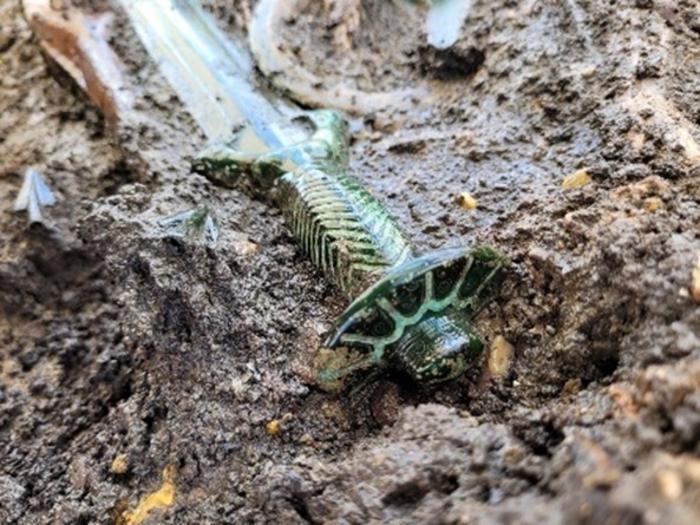
An extraordinary journey into the distant past has been unveiled through advanced scientific inquiry, as researchers meticulously examined a 3,400-year-old Bronze Age sword using an array of state-of-the-art, non-destructive techniques. This ancient artifact offers a unique glimpse into metallurgical practices and societal complexity during the Bronze Age, elucidating technological advancements that shaped early human civilization. Thanks to cutting-edge facilities at the Helmholtz-Zentrum Berlin (HZB) and BESSY II synchrotron radiation source, scientists have harnessed an innovative combination of methods to scrutinize the sword’s composition, structure, and mechanical properties without compromising its pristine condition.
At the heart of this investigation lies the integration of three sophisticated analytical procedures: high-resolution imaging, advanced spectroscopy, and structural analysis. These methodologies collectively facilitate a multidimensional characterization of the artifact, enabling researchers to map elemental distributions, identify metallurgical phases, and reveal internal stresses within the metal matrix. Such insights deepen our understanding of Bronze Age metalworking techniques, pointing toward a level of craftsmanship and resource knowledge previously unappreciated. The interdisciplinary approach bridges archaeology, materials science, and engineering to transform cultural heritage into a scientific treasure trove.
The imaging techniques deployed include high-resolution X-ray computed tomography (CT), which allows the scientific team to visualize internal structures and potential manufacturing defects embedded within the sword’s alloy. This precise imaging yields three-dimensional reconstructions highlighting stratigraphic layering and forging marks, suggesting sequential thermal and mechanical treatments during the sword’s fabrication. By identifying subtle variations in density and microstructure, researchers can infer the forging temperatures and quenching protocols applied, shedding light on the technological prowess of Bronze Age smiths.
Spectroscopic methods, particularly X-ray fluorescence (XRF) and X-ray absorption spectroscopy (XAS), complement the imaging by providing detailed elemental and chemical composition data. These techniques exploit synchrotron radiation to excite atoms within the metal, eliciting characteristic emissions that serve as elemental fingerprints. The analysis reveals the sword’s primary constituents—copper and tin—as well as trace elements such as arsenic and lead, which inform on alloying practices and ore sources. Notably, variations in tin concentration across the blade hint at intentional modulation of mechanical properties, balancing hardness and flexibility critical for combat effectiveness.
Structural analysis methods employed at BESSY II further enhance the study through micro-beam diffraction and stress mapping. These approaches detect crystallographic orientations and residual stresses induced by forging and use. The data illuminate the sword’s metallurgical history, including cold working and annealing stages, which contribute to its durability and resilience. By non-invasively mapping mechanical stress distributions, scientists assess wear patterns and potential micro-cracks, offering new perspectives on how such weapons were utilized and maintained by Bronze Age warriors.
The significance of this research extends beyond artifact preservation; it underlines the transformative power of contemporary materials science in archaeology. Applying these advanced techniques to center-stage cultural heritage objects enables the extraction of otherwise inaccessible information, enriching historical narratives with empirical evidence. This study exemplifies how non-destructive examination preserves the integrity of invaluable relics while extending their educational and scientific potential for future generations.
Furthermore, the project’s success underscores the intrinsic value of interdisciplinary collaboration between archaeologists, engineers, physicists, and materials scientists. This synergy optimizes the analytical strategy and contextualizes the findings within broader anthropological frameworks. Unraveling the craftsmanship behind the sword contributes not only to our understanding of ancient societies’ technological capabilities but also to the evolution of human innovation and adaptation.
Looking ahead, the methodologies perfected in this research present a blueprint for examining a myriad of metal artifacts across different eras and regions. The fusion of imaging, spectroscopy, and structural characterization stands as a universal approach to decode the hidden histories locked within metallic cultural patrimony. Increasingly sophisticated instrumentation promises enhanced resolution and sensitivity, paving the way for discoveries that can rewrite chapters of human technological history.
Ultimately, the 3,400-year-old Bronze Age sword emerges as both a relic and a science frontier, embodying the intersection of past and present technologies. This meticulous non-destructive examination showcases how science can breathe new life into ancient artifacts, bridging millennia with photons and electrons to narrate stories of craftsmanship, conflict, and cultural evolution. It is a vibrant testament to the enduring human endeavor to understand our origins through innovation and inquiry.
This study also highlights the vital role of synchrotron radiation facilities like BESSY II in cultural heritage science. The intense, tunable X-ray beams enable precision analyses not feasible with conventional laboratory instruments. Such accessibility transforms museums and archaeological collections into dynamic research hubs where scientific discovery enhances both academic and public engagement with history.
In conclusion, examining the Bronze Age sword with tri-modal, non-destructive techniques has set a new standard in archaeological materials analysis. Through synergistic application of high-resolution imaging, spectroscopy, and stress mapping, researchers have illuminated the metallurgical sophistication of Bronze Age artisans. This breakthrough enriches our understanding of ancient technology and underscores the indispensable role of modern science in preserving and interpreting humanity’s tangible heritage.
Subject of Research: Examination of a 3,400-year-old Bronze Age sword using non-destructive scientific techniques.
Article Title: (Not provided)
News Publication Date: (Not provided)
Web References: HZB Video Link
Image Credits: HZB
Keywords: Archaeology, Bronze Age, Structural analysis, Mechanical stress, Spectroscopy, Imaging


