

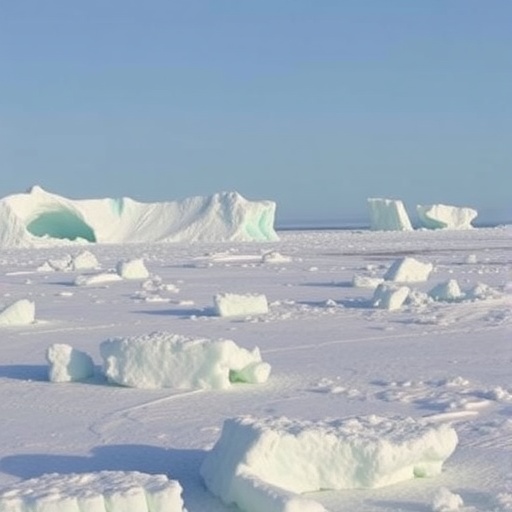
Deep beneath the seemingly inert expanse of the Greenland ice sheet lies a breathtaking secret: swirling, plume-like structures that defy the traditional understanding of ice as a rigid, solid entity. For years, these enigmatic formations have intrigued and puzzled scientists worldwide. Recent groundbreaking research from the University of Bergen (UiB), in collaboration with prominent institutions such as NASA Goddard Space Flight Center, the University of Oxford, and ETH Zurich, sheds new light on this phenomenon. Their findings reveal that these giant plumes are not abnormalities but rather manifestations of thermal convection within the ice—a process akin to the churning seen in the Earth’s mantle, albeit at a vastly different scale and environment.
Thermal convection, traditionally understood as the slow, buoyancy-driven movement in the semi-molten mantle beneath the Earth’s crust, occurs due to temperature gradients that cause material to rise and fall. The same mathematics that helps explain continental drift has been successfully applied by these researchers to the Greenland ice sheet to rationalize the presence of the plume-like structures observed deep inside the ice. This discovery challenges conventional wisdom, which has long treated the ice sheet as a monolithic solid mass. Instead, it points towards a dynamic internal system where temperature-driven flows subtly but persistently stir the ice over millennia.
At first glance, ice appears too rigid for convection currents to form. However, the researchers explain that the immense pressure and the unique thermal conditions inside the Greenland ice sheet allow the ice to behave in a ductile manner. It becomes softer and more malleable under extreme conditions, comparable in flow characteristics to materials found in the Earth’s mantle, albeit millions of times softer. This astonishingly soft ice permits the slow but powerful buoyancy-driven motions that define thermal convection, transforming what was once thought of as static ice into a quietly dynamic system.
Dr. Robert Law, a postdoctoral fellow at ETH Zurich’s Laboratory of Hydraulics, Hydrology and Glaciology, and the study’s lead author, describes this discovery as a “freak of nature.” According to Law, the softness of the ice found deep inside northern Greenland is roughly ten times greater than what was formerly believed—a revelation with profound implications for our understanding of ice sheet dynamics. This softness affects not only the physical structure but also the internal heat transfer, stress distribution, and potentially the rate of deformation and flow within the ice sheet.
The significance of these findings extends beyond pure scientific curiosity. The paper, recently published in The Cryosphere and selected as a ‘highlight paper’ by its editors, underscores how understanding thermal convection processes inside ice sheets can refine predictive models of ice sheet behavior under climate change scenarios. Professor Andreas Born of the University of Bergen, a co-author, stresses that although softer ice does not inherently lead to more rapid melting, it fundamentally alters how the ice sheet moves and deforms. This, in turn, influences how ice sheets discharge mass to the ocean—a critical factor driving future sea-level rise.
Incorporating these mechanical and thermal properties into ice sheet models represents a significant advancement. Traditional models often employ simplified assumptions about ice viscosity and softness, potentially underestimating the complexity and variability within the ice. Enhanced models that account for convection-induced softness will provide more accurate forecasts of how ice sheets respond to both natural internal dynamics and external climate forces, a vital step toward reducing uncertainties in sea-level rise predictions.
Equally captivating is the conceptual similarity between the deep ice convection and mantle convection processes, despite the vast differences in material properties and timescales. This analogy offers an elegant illustration of how fundamental physical principles transcend specific materials and scales, linking the seemingly disparate fields of glaciology and geodynamics. It reaffirms the universality of convection driven by thermal gradients and provides a new framework for interpreting ice sheet internal structures and their movement patterns.
While the findings paint a more vibrant picture of Greenland’s internal ice sheet activity, they also highlight the need for further study. The research team emphasizes that the discovery of convection and softer ice doesn’t automatically mean accelerated melting or increased contributions to sea-level rise. Instead, it calls for nuanced investigations to understand the complex interplay between internal ice dynamics and surface melting processes, ensuring comprehensive risk assessments as global temperatures continue to rise.
Greenland’s ice sheet occupies a special place not only scientifically but also culturally and geopolitically. It is the largest ice mass in the Northern Hemisphere, home to unique ecosystems and human communities who have adapted to its margins for thousands of years. The newfound understanding of its internal dynamics enriches our appreciation of this remarkable environment, revealing hidden processes that have shaped its evolution over centuries and will influence its future trajectory.
This research also prompts reconsideration of how we interpret remote sensing data and geophysical measurements from Greenland. The presence of convection-driven plumes could affect the readings of ice temperature, density, and flow speed typically used to calibrate models. Recognizing these features allows researchers to better match observed data with theoretical models, bridging gaps between observation and simulation, and enhancing predictive capabilities.
The collaborative effort behind this study underscores the importance of international and interdisciplinary partnerships in tackling complex Earth system questions. By bringing together expertise from glaciology, geodynamics, remote sensing, and climate science, the team could integrate diverse perspectives and methodologies to unravel the multifaceted nature of ice sheet behavior.
In conclusion, this pioneering study into the thermal convection processes within the Greenland ice sheet is a vivid reminder of the dynamic nature hidden beneath the seemingly static ice surface. It challenges preexisting paradigms, enhances our understanding of ice physics, and ultimately contributes vital knowledge to the global effort in predicting and mitigating climate change impacts. The ice sheet’s intricate dances of warmth and flow, like an immense pot of boiling pasta, reveal the delicate balance of forces shaping our planet’s cryosphere.
Subject of Research: Thermal convection processes within the Greenland Ice Sheet and their implications for ice sheet softness and dynamics.
Article Title: Exploring the conditions conducive to convection within the Greenland Ice Sheet.
News Publication Date: 13-Feb-2026.
Web References: http://dx.doi.org/10.5194/tc-20-1071-2026
References:
Law, R., Born, A., Voigt, P., MacGregor, J. A., & Guimond, C. M. (2025). Exploring the conditions conducive to convection within the Greenland Ice Sheet. The Cryosphere.
Image Credits: ETH Zurich.
Keywords: Greenland Ice Sheet, thermal convection, ice softness, ice dynamics, mantle convection analogy, ice sheet modeling, sea level rise prediction, glaciology, ice physics.


