

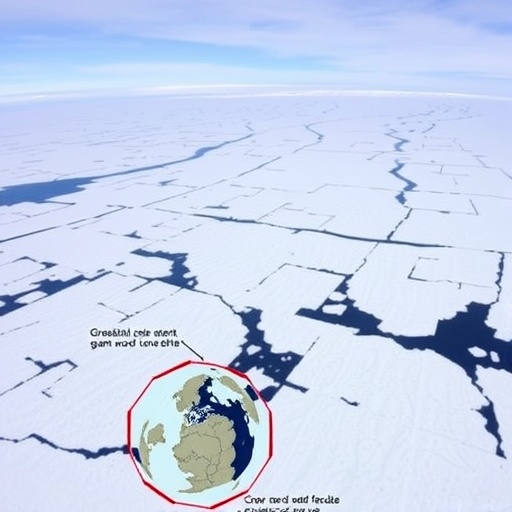
The Greenland ice sheet, a colossal expanse of frozen freshwater, has long been a critical component of Earth’s climate system. Recent studies published by Bonsoms, González-Herrero, Fettweis, and colleagues in Nature Communications (2026) reveal unprecedented melt events that surpass all previously recorded extremes. These findings not only deepen our understanding of the ice sheet’s vulnerability under current climatic conditions but also paint a sobering picture of future scenarios driven by ongoing global warming.
Greenland’s ice sheet is a monumental feature, covering approximately 1.7 million square kilometers and containing enough ice to raise global sea levels by over seven meters if fully melted. Until now, melt events have occurred seasonally, with an overall increasing trend exacerbated by anthropogenic climate change. The new research brings to light the magnitude and frequency of these melt events, underscoring how recent years have shattered prior records in terms of melt intensity, duration, and spatial extent.
At the heart of this investigation lies a meticulous fusion of remote sensing data, climate models, and on-the-ground observations. Over the last two decades, satellite missions like NASA’s MODIS and the European Space Agency’s Sentinel constellations have offered an unprecedented temporal and spatial resolution in detecting ice sheet changes. The authors leveraged these Earth observation datasets alongside state-of-the-art regional climate models to examine how melt patterns have evolved with atmospheric and oceanic warming.
One of the compelling revelations from the study is the acceleration of melt durations, with several summer seasons in the 2010s and 2020s exhibiting melting episodes that began earlier and ended later than historical norms. This extension of the melt season intensifies the overall mass loss, making recovery periods insufficient for ice refreezing. The researchers highlight surface albedo feedbacks as a critical mechanism—darker melt areas absorb more solar radiation, further perpetuating melting in a vicious cycle.
A detailed analysis of meteorological conditions identified persistent high-pressure anomalies over the Arctic as principal drivers of these record-breaking melt events. These anticyclonic systems facilitate the advection of warm air masses over Greenland, suppress cloud cover, and amplify solar radiation. This meteorological setup has been increasingly observed in recent decades, suggesting a link between large-scale atmospheric circulation changes and ice sheet mass balance alterations.
Beyond atmospheric drivers, the interplay with ocean temperatures reveals another layer of complexity. The study draws attention to the role of warmer Atlantic waters impinging on Greenland’s marine-terminating glaciers. Subsurface warming flags a critical destabilization mechanism where increased basal melting induces glacier retreat, thereby accelerating ice discharge into the ocean. Coupled with surface melt, these processes combine to exponentially raise Greenland’s contribution to observed global sea level rise.
Future climate projections incorporated in the study utilize high-resolution regional climate models downscaled from global climate simulations under various greenhouse gas emission pathways. Under moderate-to-high emissions scenarios, the simulations predict an upsurge in frequency and magnitude of melt events. By mid-century, such record-breaking episodes are expected to become the new norm, challenging existing assumptions about the ice sheet’s resilience and tipping points.
The implications of these findings extend far beyond climatological curiosity. Greenland’s accelerated mass loss contributes directly to sea level rise, posing severe risks to coastal communities worldwide. The study quantifies that recent melt accelerations have increased Greenland’s sea level contribution by an estimated 0.5 millimeters per year, a figure projected to climb substantially, threatening global infrastructure, economies, and ecosystems.
In addition, the meltwater flux into the North Atlantic influences ocean circulation patterns, particularly the Atlantic Meridional Overturning Circulation (AMOC). This vital current system regulates heat distribution across the Northern Hemisphere. Increased freshwater input can weaken this circulation, potentially triggering broader climatic disruptions including shifts in precipitation patterns and extreme weather events that reverberate across continents.
The research also underlines the urgency of advancing observational networks in Greenland, emphasizing the need for sustained satellite monitoring complemented by in situ measurements. Refinements in ice sheet modeling are necessary to capture complex feedbacks and regional variability. Current models still face challenges such as parameterizing subglacial hydrology and representing cloud-radiation interactions, but progress is rapidly closing these gaps.
Furthermore, the study broadens the discourse on climate mitigation and adaptation strategies. It highlights that timely reductions in greenhouse gas emissions could alleviate some of the pressure on the Greenland ice sheet, potentially averting the most extreme melt outcomes. Conversely, delayed action risks unleashing irreversible ice loss and exacerbating sea level rise beyond manageable limits.
From a scientific viewpoint, Bonsoms and colleagues illustrate how integrating multidisciplinary data and advanced climate modeling produces compelling evidence on the evolving state of Greenland’s ice mass under anthropogenic influence. Their work serves as both a warning and a benchmark for the global climate science community, inspiring enhanced collaboration and innovation in polar research.
In essence, the record-breaking melt events documented are harbingers of a transformed Arctic, where historic limits have been surpassed due to the profound imprint of human-driven climate change. The Greenland ice sheet’s future is not set in stone but hinges on the decisions society makes today. This study meticulously quantifies these melting dynamics, providing a critical tool for policymakers, oceanographers, glaciologists, and climate advocates aiming to navigate the uncertain waters ahead.
As the planet warms, the Greenland ice sheet stands as one of the most visible and powerful indicators of change—a vast frozen archive steadily melting away, reshaping not only the physical landscape but the global climate system itself. The new evidence of record-breaking melt events impels urgent scientific inquiry, global awareness, and concerted action to safeguard our collective future from the cascading consequences of polar warming.
By elucidating the mechanisms behind Greenland’s unprecedented melt episodes, this research paints a comprehensive portrait of climate change’s tangible effects on Earth’s cryosphere. The findings represent a clarion call to intensify efforts to decarbonize economies, enhance climate resilience, and embrace sustainable practices that can curb the accelerating loss of one of Earth’s most vital natural archives.
Ultimately, Bonsoms et al. chart a compelling narrative: the Greenland ice sheet is no longer a static relic of the past but a dynamic frontline in the global climate crisis. This study’s insights will resonate across disciplines and societies, galvanizing action and fostering a deeper understanding of the intricate feedbacks that define our changing planet.
Subject of Research: Greenland ice sheet melt events and climate change impacts
Article Title: Record-breaking Greenland ice sheet melt events under recent and future climate
Article References:
Bonsoms, J., González-Herrero, S., Fettweis, X. et al. Record-breaking Greenland ice sheet melt events under recent and future climate. Nat Commun (2026). https://doi.org/10.1038/s41467-026-69543-5
Image Credits: AI Generated


