

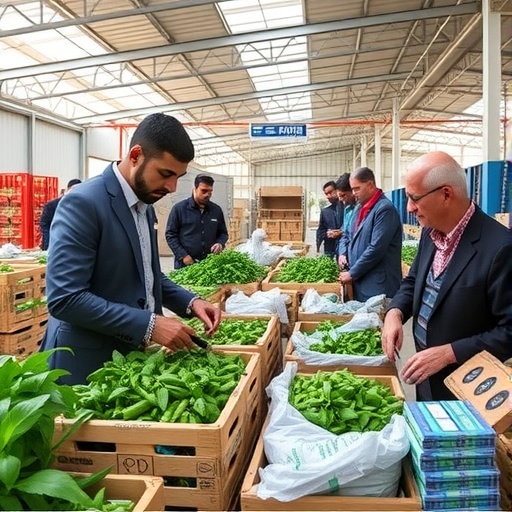
In recent years, the significance of green supply chain practices has gained momentum, particularly in developing economies. Examining this pivotal shift, a groundbreaking study titled “The effects of green supply chain practices on sustainable development in the Palestinian Islamic Development Company” by S.M.W. Salameh has unveiled critical insights into how environmental responsibility can integrate seamlessly with economic viability. This study, published in the journal Discover Sustainability, provides a comprehensive overview of the interconnections between sustainable practices and their implications for corporate performance in the context of Palestine.
Green supply chain management (GSCM) is increasingly recognized as a vital component in fostering sustainable business operations. By focusing on ecological principles throughout the supply chain, companies are not only mitigating environmental impacts but also enhancing their competitive advantage. Salameh’s research highlights that the Palestinian Islamic Development Company serves as a case study for understanding these dynamics within a region where economic challenges intertwine with environmental issues. Addressing the dual need for economic growth and environmental stewardship, the study stresses the importance of adopting green practices that resonate with local and global sustainability goals.
The findings of this study reveal that organizations that implement GSCM practices can significantly enhance their operational efficiency. These practices encompass various strategies, including waste reduction, energy efficiency, and the sustainable sourcing of materials. Salameh meticulously outlines how these strategies have led to reduced operational costs within the Palestinian Islamic Development Company. By minimizing waste and enhancing resource utilization, companies can not only improve their bottom lines but also contribute to broader environmental sustainability goals.
Moreover, the research delves into the intricate relationship between GSCM and corporate social responsibility (CSR). Salameh posits that firms embracing green supply chain practices often find that their commitment to sustainability enhances their overall brand image and fosters customer loyalty. In regions like Palestine, where public perception plays a crucial role in business success, aligning corporate strategy with environmental responsibility can yield significant long-term benefits. Companies are increasingly viewed as trustworthy partners when they prioritize ecological concerns alongside profit motives.
Salameh’s analysis highlights an essential aspect of green supply chain management: collaboration. The study encourages businesses to engage with suppliers and customers in redefining standards for sustainable practices. By creating a network of stakeholders committed to gscm, firms can amplify their impact on sustainable development. This cooperative model allows companies within the Palestinian Islamic Development Company to leverage expert insights and innovations from partners, fostering a culture of sustainability that extends beyond individual organizations.
The implications of GSCM extend into the realm of regulatory compliance as well. Salameh notes that as global standards for environmental practices tighten, companies in developing regions must adapt swiftly to avoid potential sanctions. By proactively integrating green practices into their operations, firms can ensure they remain ahead of regulatory trends, thereby securing their market position and fostering a resilient business model amidst shifting legislative landscapes.
Salameh’s research underscores the importance of employee engagement in implementing green supply chain initiatives. It emphasizes that a well-informed workforce is essential for successfully executing sustainable practices. Training and workshops focused on sustainability empower employees, transforming them into ambassadors of green initiatives. Companies that invest in their human capital not only cultivate an environmentally conscious workplace culture but also optimize their operational processes by harnessing insights from staff engaged in day-to-day activities.
Furthermore, the study draws connections between green supply chain practices and access to new markets. With increasing consumer preferences leaning toward sustainable products, businesses that adopt environmentally friendly practices can tap into growing segments of the market that prioritize ethics over mere pricing. Salameh elucidates how the Palestinian Islamic Development Company, through GSCM, can find competitive niches both locally and globally, appealing to consumers who align their purchasing decisions with sustainability values.
The research also touches on the potential for innovative technologies to bolster green supply chain practices. Emerging technologies, such as blockchain for traceability and artificial intelligence for optimizing logistics, have transformative potential when integrated into supply chain operations. Salameh suggests that investing in these technologies can streamline processes, reduce inefficiencies, and promote transparent and responsible sourcing practices within the Palestinian context.
A notable takeaway from Salameh’s study is the alignment of economic growth with sustainable practices. The research proposes that companies in developing regions do not have to choose between economic viability and environmental stewardship. Instead, through the adoption of green supply chain practices, firms can simultaneously address economic needs while fostering a healthier planet.
Additionally, the study emphasizes the role of global partnerships in fostering sustainability. Collaborative initiatives between local firms and international organizations can facilitate knowledge transfer and access to resources necessary for implementing GSCM. Such partnerships can also pave the way for funding opportunities, enhancing the capacity for innovation and growth in sustainable practices.
The research serves as a clarion call for policymakers to support GSCM initiatives actively. By providing incentives and frameworks that facilitate the transition towards greener practices, governments can play a crucial role in shaping sustainable industries. Salameh advocates for legislation that not only promotes green practices but also supports companies committed to sustainability, thereby creating a favorable business environment.
In conclusion, Salameh’s exploration of green supply chain practices within the Palestinian Islamic Development Company provides a robust framework for understanding the synthesis of environmental responsibility and business strategy. By illustrating the multifaceted benefits of GSCM, the study offers valuable insights for businesses navigating the complexities of sustainable development. As industries globally move toward greener methods, the lessons drawn from Palestine may hold significant implications for broader discussions on corporate sustainability.
An imperative emerges from this examination: the commitment to sustainability must be a collective effort. As organizations recognize the interdependence of economic and environmental objectives, they simultaneously build a more sustainable future — one where corporations act not only as profit-driven entities but also as stewards of the planet.
Subject of Research: The impact of green supply chain practices on sustainable development in the Palestinian context.
Article Title: The effects of green supply chain practices on sustainable development in the Palestinian Islamic Development Company.
Article References:
Salameh, S.M.W. The effects of green supply chain practices on sustainable development in the Palestinian Islamic Development Company.
Discov Sustain (2026). https://doi.org/10.1007/s43621-025-02536-4
Image Credits: AI Generated
DOI: 10.1007/s43621-025-02536-4
Keywords: Green Supply Chain Management, Sustainable Development, Corporate Social Responsibility, Palestine, Economic Viability, Environmental Stewardship.


