

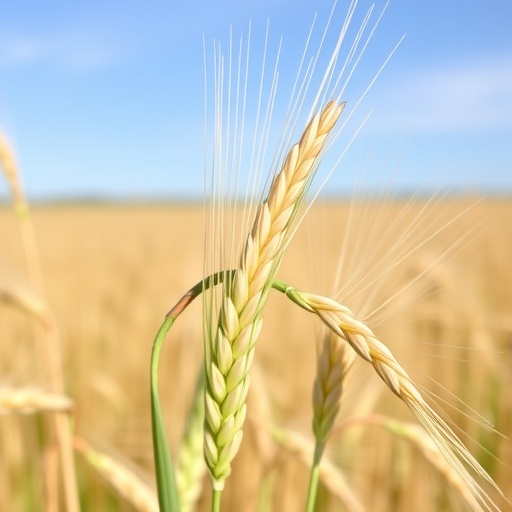
In a groundbreaking advance that could reshape the future of global agriculture, scientists have unlocked the intricate developmental dynamics that sculpt grass inflorescence architecture. This pioneering research, focused on bread wheat and rice, delves deep into the morphodynamic processes that underpin the formation of grass inflorescences—complex floral structures critical for grain production and ultimately, crop yield. Through a sophisticated blend of developmental biology, computational modeling, and genetic analysis, the study offers unprecedented insight into how variations in early inflorescence development translate into the remarkable morphological diversity seen across grass species. This understanding paves the way for targeted yield improvements that could enhance food security worldwide.
The team embarked on their investigation by closely examining the early stages of inflorescence development in two seminal cereal crops: bread wheat (Triticum aestivum) and rice (Oryza sativa). These species represent contrasting inflorescence architectures, with wheat displaying a multitiered spikelet arrangement and rice exhibiting a panicle-type inflorescence. Researchers meticulously charted the timelines and spatial patterns of meristem fate transitions—the pivotal switching points dictating the fate of plant stem cells from vegetative to reproductive roles. By capturing the morphogenetic events underpinning primordium initiation and differentiation, the study establishes a developmental chronology crucial to deciphering inflorescence complexity.
Harnessing powerful computational modeling, the researchers simulated the dynamic processes governing meristem fate transitions and primordium initiation patterns. This approach enabled the team to recreate the morphogenetic landscapes that lead to the observed architectural differences between wheat and rice inflorescences. The model revealed that the interplay between when meristems transition to flowering phases and how new floret primordia initiate spatially and temporally collectively shapes species-specific inflorescence patterns. These insights underscore the intricate choreography of cellular decision-making during floral organogenesis and highlight key developmental checkpoints ripe for genetic manipulation.
Perhaps one of the most captivating findings is the elucidation of the developmental underpinnings for “supernumerary spikelets”—additional floral branches arising in wheat that deviate from the canonical spikelet formation. The model predicted two autonomous developmental pathways contributing to the formation of paired spikelets, a fascinating example of inflorescence branching unique to wheat. This revelation not only deepens our fundamental understanding of grass developmental plasticity but also identifies novel morphological traits that could be harnessed for crop yield improvement. Such spikelet proliferation holds the promise of augmenting grain number without compromising plant robustness.
In an exciting translational leap, the research also uncovered a mutant allele termed duo2, which accelerates the developmental timeline of wheat inflorescence formation. Plants harboring duo2 displayed markedly earlier floral transitions, leading to significant yield improvements in field trials. This discovery offers tangible evidence that modulating developmental dynamics can directly enhance agronomic performance. The duo2 mutation essentially primes plants for quicker reproductive development, enabling a more efficient allocation of resources towards grain production—a trait especially valuable in the context of changing climates and the need for crop resilience.
At the molecular level, the duo2 phenotype traces back to alterations in the RA2-D gene, an orthologue of the maize RAMOSA2 (RA2) gene renowned for its role in floral branching and meristem specification. The study demonstrates that RA2-D acts as a critical regulator of floral transition in wheat, essentially governing the timing and progression of inflorescence development through genetic control of meristem fate. This characterization adds a vital node to the genetic network orchestrating grass inflorescence architecture and offers a promising molecular target for precision breeding strategies aimed at optimizing crop yields.
The integration of detailed morphodynamic analysis with genetic dissection represents a significant methodological leap. This multidisciplinary approach shines a spotlight on how perturbations in developmental timing and primordium initiation modes ripple through the plant’s architecture, culminating in diverse inflorescence phenotypes. Such developmental plasticity is a hallmark of grasses, whose evolutionary success hinges on the fine-tuning of reproductive structures to environmental cues and selection pressures. By demystifying these processes, the research lays the groundwork for engineering crops that better align with modern agricultural demands.
A salient feature of the computational model lies in its predictive power, enabling scientists to hypothesize how changes at the meristematic level translate into emergent morphological traits. This capability allows researchers to simulate the effects of gene perturbations—such as RA2-D mutations—before committing to laborious and time-intensive breeding experiments. The model thus acts as a virtual testing platform, accelerating the discovery-to-application pipeline in crop improvement programs. It also facilitates cross-species comparisons, broadening the implications of the findings beyond wheat and rice to other economically vital grasses.
The discovery of supernumerary and paired spikelet formation pathways illuminates the developmental plasticity that enables grasses to diversify inflorescence structures. From an evolutionary perspective, this plasticity provides a substrate for natural and artificial selection to mold traits that maximize reproductive success. The ability to manipulate these pathways genetically offers exciting opportunities for breeders to customize inflorescence architecture, potentially unlocking yield potentials that were previously inaccessible due to developmental constraints or trade-offs inherent in traditional morphologies.
Field experiments corroborating the benefits of the duo2 mutant allele underscore the real-world applicability of developmental biology discoveries. In managed agricultural environments, the adoption of genotypes with accelerated meristem transition, such as duo2, could result in earlier harvests and increased grain production without necessitating additional inputs. Such advancements are particularly urgent as global agriculture faces mounting challenges from climate change, land scarcity, and population growth. This study’s translational success heralds a new era where developmental genomics informs and expedites the generation of elite crop varieties.
The research also raises intriguing questions about the broader regulatory networks modulating inflorescence morphodynamics. RA2-D’s role as a master regulator hints at a complex interplay of signaling pathways, transcription factors, and hormonal gradients orchestrating meristem fate decisions. Future studies could explore how environmental factors modulate these genetic circuits, potentially revealing adaptive mechanisms that fine-tune flowering time and spikelet production in response to stress or seasonal cues. Such knowledge could refine predictive models and inform climate-resilient breeding strategies.
Moreover, the comparative framework established between wheat and rice highlights the value of cross-species studies for elucidating fundamental developmental principles. Despite their evolutionary divergence, shared and distinct mechanisms governing inflorescence patterning emerge, allowing researchers to disentangle universal themes from species-specific innovations. This synthesis of developmental and evolutionary biology holds promise for identifying conserved genetic modules amenable to manipulation across diverse grass crops, boosting food security on multiple fronts.
The detailed focus on early inflorescence development stages fills a critical knowledge gap. While mature inflorescence morphology has been extensively characterized, the morphogenetic processes establishing initial patterns have remained elusive. By illuminating this obscure developmental window, the study empowers breeders with knowledge of the earliest formative events that set the trajectory for final architecture and yield outcomes. This refined spatiotemporal understanding enhances the precision of gene editing and breeding interventions targeting inflorescence traits.
In summary, this visionary work elucidates how developmental morphodynamics orchestrate the vast diversity of grass inflorescence forms, linking molecular genetics with macroscopic plant architecture in a predictive and actionable framework. The identification of pivotal genetic players such as RA2-D and the duo2 mutant offers practical pathways to accelerate breeding of higher-yielding wheat varieties. By bridging fundamental developmental biology with translational crop science, the research represents a landmark contribution poised to reshape the future of cereal crop improvement, ensuring sustainable food production in an era of unprecedented global challenges.
Subject of Research: The study focuses on developmental morphodynamics of grass inflorescence architecture in bread wheat and rice, examining how meristem fate transitions and primordium initiation collectively influence morphological diversity and crop yield.
Article Title: Grass inflorescence morphodynamics guides yield improvement in wheat.
Article References:
Wang, Y., Cui, B., Du, F. et al. Grass inflorescence morphodynamics guides yield improvement in wheat. Nat. Plants (2026). https://doi.org/10.1038/s41477-026-02246-3
Image Credits: AI Generated


