

In a groundbreaking advancement poised to redefine the scope of atomic-scale imaging in liquid environments, researchers at The University of Manchester have unveiled the first technique capable of achieving atomic-resolution visualization of atomic dynamics at solid–liquid interfaces within a broad spectrum of non-aqueous, organic solvents. This pioneering work, published in the prestigious journal Science, marks a decisive shift from traditional high-resolution imaging methods, which have been predominantly confined to aqueous solutions. By overcoming the formidable technical barriers that have long restricted electron microscopy studies to vacuum or solid states, this innovation opens transformative pathways for in-situ exploration of chemical phenomena fundamental to emerging green technologies.
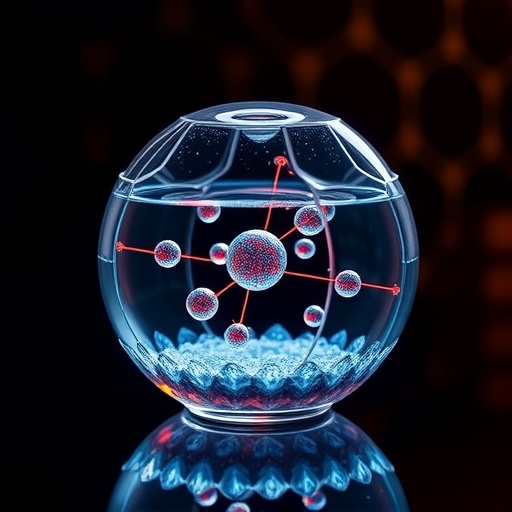
Historically, Transmission Electron Microscopy (TEM) has stood as a unique tool for directly imaging individual atoms by harnessing a meticulously concentrated electron beam to interrogate the innermost structure of materials. Despite its extraordinary spatial resolution, TEM’s dependency on ultra-high vacuum environments had imposed an insurmountable limitation for observing liquid-phase reactions. Liquids evaporate under vacuum, disrupting the sample’s integrity and rendering live observations of liquid-mediated atomic behavior effectively impossible. The Manchester team’s bold approach circumvents this challenge through the fabrication of “nano-aquariums”: innovative nanoscale liquid reservoirs encapsulated within atomically thin graphene windows. These graphene enclosures—approximately a few atomic layers thick—are not only mechanically robust enough to isolate the contained solvent from the vacuum but also minimally interactive with electron beams, ensuring exceptional imaging clarity.
Each nano-aquarium contains minuscule quantities of test liquids, as minuscule as 100 attolitres, highlighting a feat of meticulous engineering in sample preparation. This scale is one billion times smaller than a raindrop, underscoring the exquisite precision required for such studies. The team employed the advanced facilities at the electron Physical Science Imaging Centre (ePSIC), the UK’s national electron microscopy center dedicated to physical science research, to capture real-time videos showcasing the behavior of gold atoms adhering to the graphene-liquid interface. These captured atomistic movies illuminate atomic phenomena including site-to-site hopping, the dynamic clustering of atoms into dimers and trimers, and their agglomeration into larger nanoscale particles. Strikingly, these atomic motions and cluster formations exhibited pronounced variations contingent on the chemical nature of the organic solvent utilized.
A defining strength of this investigation is its integration of artificial intelligence (AI) to process and analyze the extensive data sets generated. Through an AI-enabled automated tracking pipeline, the researchers were able to monitor more than one million individual gold atoms across five distinct solvents. This scale of atom tracking marks a significant departure from the norms of atomic-resolution studies—which typically rely on datasets comprising just dozens or hundreds of atoms—thereby providing statistically robust insights rather than anecdotal snapshots. Such comprehensive datasets allow for a granular understanding of how subtle variations in solvent composition and physicochemical properties influence the fundamental atomic interactions at interfaces.
Notably, the clarity of the images offers unprecedented resolution not only of the mobile gold atoms themselves but also of the underlying graphene lattice. This dual observation capability permits researchers to decipher the interplay between atomic motion and substrate interactions, elucidating why certain configurations—such as atom pairing—arise during stochastic diffusion. This mechanistic understanding elevates the field beyond phenomenological descriptions, enabling more predictive models of atomic self-assembly and catalyst behavior in liquid environments.
A revolutionary aspect of the methodology is the sealing process for the graphene liquid cells, innovatively performed while fully submerged in liquid employing a delicately controlled ceramic cantilever. This underwater sealing technique mitigates solvent evaporation during sample preparation—a notorious problem in previous efforts—thus maintaining stable solute concentrations and facilitating direct, controlled comparison between various solvents. Professor Roman Gorbachev, architect of the fabrication technique, emphasizes that this approach ensures sample fidelity for nearly any solvent, breaking free from the constraints of aqueous exclusivity.
The implications of this work resonate profoundly in the domain of catalysis, where isolated gold atoms act as highly selective and efficient sites for green chemistry applications. Preventing these atoms from aggregating into inactive larger clusters has been a persistent challenge. By leveraging their novel platform, the team revealed that solvent choice exerts powerful control over catalyst morphology: the low polarity, low boiling point, and low surface tension of acetone favor the stabilization of dispersed gold atoms both during liquid-phase reaction conditions and subsequent drying. Contrastingly, solvents with higher boiling points or aqueous environments tended to promote particle growth. Collaborative catalyst testing with Cardiff University’s Catalysis Institute validated these structural insights, confirming the practical catalytic performance benefits aligned with the nano-imaging discoveries.
Beyond catalysis, this revolutionary imaging technique holds the potential to illuminate atomic-scale mechanisms across diverse fields where solid–liquid interfaces govern critical functionality. From the electrochemical processes powering fuel cells and advanced batteries, to filtration systems and precious metal reclamation from electronic waste, the ability to watch individual atoms interacting within liquids offers an unprecedented lens for scientific exploration. Historically, researchers have largely depended on ensemble averaging methods that obscure nanoscale heterogeneity; this direct, atom-by-atom observational capability promises to upend longstanding assumptions and enable more rational design strategies.
Professor Sarah Haigh, who led this transformative research, reflected on the profound knowledge gaps that have persisted despite decades of study: “It’s remarkable how much we still don’t understand about how atoms behave at solid–liquid interfaces, given how fundamental these processes are to modern technology. Now we can watch what’s actually happening, understand why, and use that insight to design better materials and processes.” This statement encapsulates the core value of in-situ atomic microscopy, bridging the persistence of mysteries in interfacial science with newfound clarity.
The success of this endeavor was propelled by an interdisciplinary coalition involving expertise in electron microscopy, two-dimensional materials engineering, catalytic science, and computational modeling. The collaboration spanned leading institutions including The University of Manchester, Cardiff University, Sheffield University, and the national microscopy facility ePSIC at Diamond Light Source, illustrating the power of multidisciplinary synergy in addressing complex scientific challenges. With this platform firmly established, ongoing research efforts are already applying these real-time atomic observations to critical questions in sustainable energy conversion and the circular economy of metal recovery from electronic waste.
This breakthrough heralds a new era in quantitative, dynamic materials characterization, shifting away from static ensembles to vivid, high-resolution movies of atoms in motion—transforming our ability to decode, control, and optimize interfacial chemistry central to the green energy transition and beyond. As research progresses, the insights harvested from watching atoms “dance” on graphene windows in organic liquids will doubtless catalyze innovations across a spectrum of critical technologies, signaling a vibrant future for atomic-scale science and engineering.
Subject of Research: Atomic-resolution imaging of gold atoms at organic liquid–solid interfaces using graphene liquid cells in Transmission Electron Microscopy.
Article Title: Atomic-resolution imaging of gold species at organic liquid-solid interfaces.
News Publication Date: 2-Apr-2026.
Web References: DOI Link
Keywords
Physics, Materials Engineering, Condensed Matter Physics, Electron Microscopy, Graphene, Catalysis, Solid–Liquid Interfaces, Atomic-resolution Imaging, Non-Aqueous Solvents, Nanoparticles, Green Chemistry, AI-Enabled Analysis


