

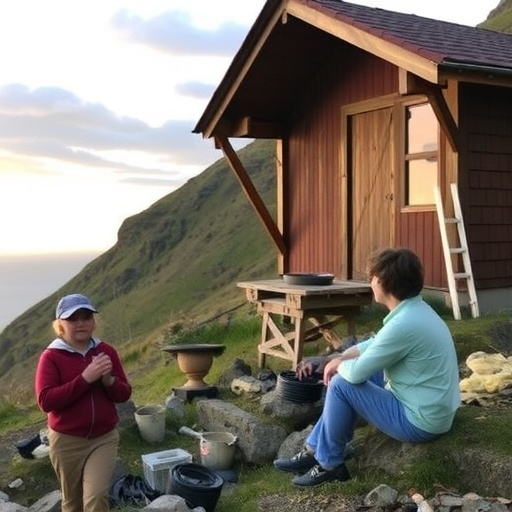
The GRACE initiative, officially launched in October 2025, marks a significant advancement within Europe’s evolving strategy to combat the pressing effects of climate change on remote rural territories. Operating under the auspices of the Horizon Europe Programme and the EU Mission Adaptation to Climate Change, this ambitious four-year collaboration unites 26 specialized partners from 15 different countries. Coordinated by the Fondazione Centro Euro-Mediterraneo sui Cambiamenti Climatici (CMCC) in Italy, GRACE aims to fundamentally transform how vulnerable rural areas adapt to their diverse climate challenges through community-led processes emphasizing local innovation and capacity building.
This multinational consortium is structured around a pragmatic approach that integrates scientific research, stakeholder governance, and technological innovation. Dedicated to addressing the complex intersection of climate hazards and socio-economic vulnerabilities, GRACE directly engages ten rural regions spread across Europe. Among these, five “Demonstrator Regions” located in Portugal, Italy, Austria, Denmark, and Sweden serve as laboratories where nature-based solutions, cutting-edge digital tools, and governance reforms are co-developed and rigorously field-tested. These pilot experiences are critically disseminated to five “Replicator Regions” in Greece, Slovakia, Ireland, Latvia, and Ukraine, which are positioned to adapt and implement the proven approaches within their own distinct contexts.
The project’s introductory phase featured a pivotal kick-off meeting held in Venice, Italy, complemented by a field study in the coastal municipality of Cavallino-Treporti, one of the Demonstrator Regions. This visit provided participants with direct exposure to the acute climate risks in coastal ecosystems, particularly those associated with sea-level rise, storm surges, and saltwater intrusion. Insights gained reinforced the necessity of integrating localized climate science with grassroots participation to devise resilient strategies that are both ecologically sound and socially equitable.
What sets GRACE apart is its concentrated focus on remote rural areas where adaptation capacity is often decentralized, and vulnerabilities are layered. These regions exemplify the multifaceted nature of climate-induced hazards: Southern Portugal battles persistent drought and water scarcity; the Venetian Lagoon contends with complex coastal erosion; mountainous zones in Austria face heavy rainfall and landslides, while Denmark’s low-lying landscapes are increasingly flood-prone. Northern Sweden, meanwhile, confronts unpredictable shifts in snow and ice dynamics. The Replicator Regions face analogous hazards compounded by socio-political challenges, with Ukraine experiencing conflict-driven vulnerabilities overlaying climatic stresses.
Ecologically and socioeconomically diverse, these territories encompass five major European biogeographical zones—Mediterranean, Continental, Atlantic, Alpine, and Boreal—offering critical variation that ensures solutions developed remain robust and adaptable across a spectrum of climatic and governance conditions. By involving regional authorities, civil society, and local populations, GRACE emphasizes participatory co-creation processes that embed solutions into the cultural, political, and environmental framework of each area, enhancing long-term viability.
A distinctive feature of GRACE lies in its tri-pillar operational methodology, which optimizes the interface between governance, technology, and social empowerment. The first pillar, Community-Driven Governance and Adaptation Pathways, prioritizes the formation of Rural Climate Resilience Groups (RCRGs). These forums convene local stakeholders—municipal officials, researchers, businesses, and citizens—to collaboratively identify clustered climate risks and prioritize adaptive actions. Employing the Collaborative Systems Mapping of Sustainable Pathways (CoSMoS), communities articulate their own adaptive trajectories, ensuring responsiveness and contextual relevance.
Complementing this, the second pillar harnesses AI-powered digital tools to elevate evidence-based decision-making. The development of an innovative digital dashboard synthesizing climate, environmental, and socioeconomic datasets allows planners and local authorities to visualize vulnerabilities, assess adaptation scenarios, and monitor implementation progress systematically. This tool enhances transparency and consistency between Demonstrator and Replicator Regions, facilitating cross-territorial learning and scalable adaptation frameworks.
Recognizing that technological and governance innovation must be underpinned by human capital, GRACE’s third pillar focuses on Capacity Building and Social Empowerment. Tailored training modules are designed for over 500 regional stakeholders, complemented by citizen engagement initiatives reaching upwards of 14,000 residents. These efforts foster local expertise, nurture leadership in adaptation practices, and enable communities to sustain and evolve resilience strategies autonomously, thus bridging the often-cited divide between policy and practice.
Ultimately, GRACE acknowledges the dual identity of rural communities as both vulnerable to climate change and potent agents of adaptation leadership. By centering community voices, the project leverages inherent local knowledge and social cohesion to co-create adaptive solutions that are practical, inclusive, and rooted in lived experience. This human-centric approach enhances the legitimacy of adaptation interventions and aligns with broader European ambitions for an equitable green transition.
Projected outcomes over the project’s lifespan articulate an impactful trajectory aligned with the European Green Deal, the EU Strategy on Adaptation to Climate Change, and the EU Rural Pact. GRACE aims to validate adaptation interventions that mitigate nine principal climate risks across five biogeographical contexts. Strengthening governance frameworks and social readiness, at least 15 public authorities are expected to internalize GRACE methodologies, thereby institutionalizing adaptive capacity within policy domains.
Moreover, the initiative anticipates generating emergent opportunities for green employment, bioeconomic endeavors, and nature-based tourism, contributing to diversified rural economies. The integration and deployment of advanced digital infrastructure serve to democratize access to climate intelligence, particularly enhancing rural digital literacy and equitable participation in climate services, a historically underserved sector.
By synthesizing rigorous scientific research, innovative digital solutions, and robust community engagement, GRACE is poised to embed adaptive resilience at the core of Europe’s rural development agenda. Its participatory governance model and knowledge transfer mechanisms ensure not only immediate climate risk reduction but also foster an enduring adaptive culture, empowering remote communities to become proactive stewards of their environmental futures amid unfolding climate uncertainties.
This milestone project exemplifies how multi-disciplinary collaboration across countries, sectors, and communities can create scalable, transferable models for rural adaptation, setting a precedent for global efforts in similar contexts. As climate impacts intensify, GRACE’s integrative approach, grounded in both cutting-edge technology and local empowerment, offers a blueprint for resilient adaptation that resonates far beyond Europe’s borders.
Subject of Research:
Article Title:
News Publication Date:
Web References:
References:
Image Credits: European Science Communication Institute gGmbH
Keywords: climate adaptation, rural resilience, community-led governance, nature-based solutions, digital tools, capacity building, European Green Deal, climate change mitigation, climate risk management, AI in climate adaptation


