

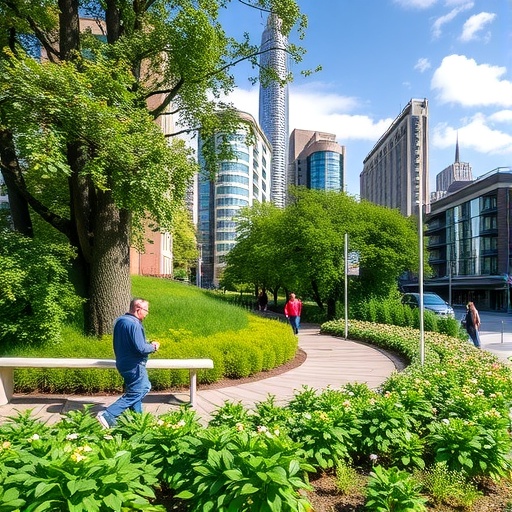
As cities around the world grapple with the escalating challenges of climate change, air pollution, and urban sprawl, the role of urban green spaces has taken on unprecedented significance. In a groundbreaking comparative study between South Korea and Germany, researchers Son, Martin, Linnerooth-Bayer, and their colleagues have unveiled critical insights into the governance mechanisms that enable urban green spaces to function effectively as nature-based solutions (NBS). Published in npj Urban Sustainability in 2026, this research unpacks how two distinct socio-political landscapes manage and integrate green infrastructure to mitigate environmental stressors and enhance urban resilience.
Urban green spaces—parks, community gardens, green roofs, and wetlands—are not merely aesthetic amenities but are increasingly recognized as vital components of sustainable city planning. They perform an array of ecosystem services including carbon sequestration, temperature regulation, stormwater management, and biodiversity conservation. The study brings to light the multifaceted governance structures that influence the planning, implementation, and maintenance of these green spaces, revealing how institutional frameworks shape their effectiveness and innovation in NBS.
In Korea, urban green governance is heavily influenced by top-down policymaking within a centralized administrative system. Here, governmental agencies spearhead green space projects as components of larger urban development initiatives. This approach frequently emphasizes technological integration and rapid implementation to respond to acute urban problems such as air quality degradation and heat islands. The researchers highlight Korea’s Green Infrastructure Plan as a flagship initiative showcasing the government’s commitment to embedding nature-based solutions within metropolitan planning. However, the study also notes challenges related to public participation and coordination across overlapping municipal departments, which sometimes hamper long-term sustainability.
Conversely, the German model demonstrates a more decentralized and participatory approach to urban green space governance. Germany’s environmental policies typically promote collaborative frameworks involving municipal governments, local communities, non-governmental organizations, and private stakeholders. This pluralistic governance ensures that green infrastructure projects are co-designed with input from diverse actors, fostering social acceptance and ecological awareness. The research underscores Germany’s strong legal frameworks that mandate sustainable urban development and nature conservation, ensuring that urban green spaces serve multifunctional roles within the cityscape.
One of the pivotal findings of the study concerns the integration of scientific knowledge and traditional ecological practices into governance models. In both Korea and Germany, adaptive management practices are increasingly employed to respond to dynamic environmental conditions and urban demands. Korea’s urban planners are incorporating cutting-edge geospatial technologies and remote sensing tools to optimize green space placement and monitor ecosystem health. Meanwhile, Germany leverages a long history of ecological landscape management, engaging citizen scientists and local environmental groups to promote biodiversity-friendly practices and public stewardship.
The comparative analysis unearths the interplay between governance capacity and institutional trust. In Korea, the centralized approach can elicit swift responses to crises but may struggle with fostering trust and ownership from grassroots organizations. Germany’s decentralized governance, while slower in execution, often yields stronger social cohesion and shared responsibility for green space outcomes. These socio-political dynamics serve as critical determinants of the sustainability and resilience of urban nature-based solutions, suggesting that effective governance requires balancing efficiency with inclusivity.
Moreover, both countries face common challenges related to urban densification and competing land use interests. The study notes that spatial constraints in rapidly growing cities pressurize green spaces, threatening their ecological functions and social value. Innovative governance practices—such as multi-use zoning, green corridors, and vertical greening—are emerging to reconcile development imperatives with environmental conservation. These approaches underscore the necessity of incorporating flexibility and foresight in urban planning instruments to safeguard green infrastructure.
Financial mechanisms also feature prominently in the governance discourse. Korea’s model predicates substantial state investment and public-private partnerships to fund green infrastructure initiatives. Such funding strategies have enabled large-scale NBS projects like urban forest restoration and wetland rehabilitation. Germany, on the other hand, utilizes a diverse array of financing, including federal grants, municipal budgets, and community-driven fundraising. The study highlights the effectiveness of sustained financial incentives and subsidy programs in promoting innovative green infrastructure solutions in both contexts.
Another layer of complexity arises with the governance of ecosystem services provided by urban green spaces. The researchers emphasize the need for comprehensive valuation frameworks that quantify benefits such as air purification, climate regulation, and mental health improvements. While Korea has begun integrating ecosystem service valuation into urban policy assessments, Germany’s environmental accounting systems more thoroughly incorporate these metrics. This difference influences priority-setting and resource allocation, illuminating the role of scientific rigor in enhancing governance transparency and effectiveness.
Importantly, the research addresses the role of social equity and inclusion in green space governance. Both Korea and Germany recognize that equitable access to urban green spaces is essential for maximizing societal benefits. However, disparities persist in terms of distribution and quality of green areas, often reflecting socioeconomic divides. The study stresses the importance of integrating equity considerations into governance frameworks to ensure that marginalized communities also reap the health and well-being advantages of nature-based solutions, thereby fostering environmental justice.
Cross-cultural exchange and international cooperation emerge as promising avenues for advancing urban green governance. The authors advocate for enhanced dialogue and knowledge transfer between Korea and Germany, allowing each to learn from the other’s strengths and challenges. Such exchanges can stimulate policy innovation, capacity-building, and the harmonization of standards for urban sustainability. They also highlight the potential for joint research initiatives and pilot projects that test governance models in diverse urban settings.
A key technical component of the study involves the application of network analysis tools to map governance actors and their interactions. This methodological innovation illuminates complex relationships among governmental entities, civil society, and private sector participants. Understanding these networks reveals leverage points for intervention and collaboration, enhancing coordination and reducing fragmentation in green space management. Such insights are vital for refining governance architectures that underpin resilient nature-based solutions.
The study also explores the interaction between regulatory frameworks and technological innovation. In Korea, advanced digital platforms facilitate real-time monitoring and citizen engagement, enabling rapid response to environmental changes and public feedback. Germany’s regulatory environment encourages experimentation with low-impact development techniques and nature-positive designs. Balancing regulatory oversight with innovation flexibility emerges as a crucial governance consideration to foster adaptive and scalable urban green infrastructure.
Furthermore, the research underscores the importance of long-term monitoring and evaluation mechanisms within governance systems. Regular assessment of ecological performance and social outcomes helps ensure that green infrastructure projects maintain intended benefits over time. Both Korea and Germany are developing standardized indicators and reporting procedures, yet challenges remain in data harmonization and stakeholder participation. Strengthening these feedback loops will be instrumental in embedding learning and continuous improvement in urban NBS governance.
In conclusion, this comparative study offers profound insights into how governance models shape the success and sustainability of urban green spaces as nature-based solutions. While Korea’s centralized efficiency contrasts with Germany’s participatory inclusiveness, both approaches reveal pathways to integrating ecological, social, and technological dimensions within urban planning. The findings stress that effective governance is multidimensional, requiring institutional capacity, cross-sector collaboration, equitable access, and adaptive management to meet the complex demands of sustainable urban futures. As cities globally confront mounting environmental crises, these lessons from Korea and Germany provide a valuable blueprint for amplifying the role of green infrastructure in fostering resilient, livable, and just urban environments.
Subject of Research: Governance mechanisms of urban green spaces as nature-based solutions in Korea and Germany.
Article Title: Governance of urban green spaces as nature-based solutions in Korea and Germany.
Article References:
Son, J., Martin, J., Linnerooth-Bayer, J. et al. Governance of urban green spaces as nature-based solutions in Korea and Germany. npj Urban Sustain (2026). https://doi.org/10.1038/s42949-026-00340-1
Image Credits: AI Generated


