

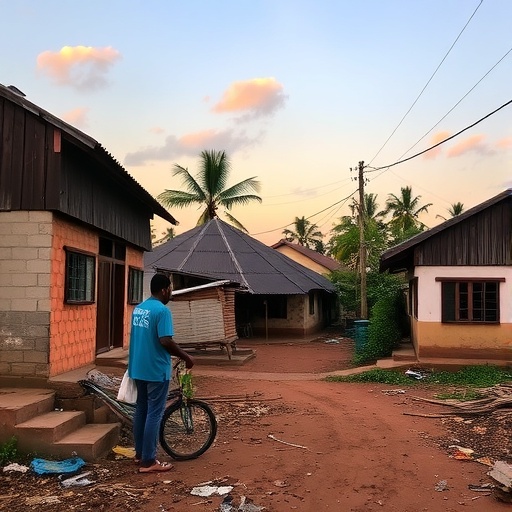
In an alarming new study published in Nature Climate Change, researchers have unveiled the stark and quantifiable consequences of global warming on poverty and inequality at subnational levels. Utilizing a blend of advanced climate models and economic analyses, the investigation offers the most detailed forecast yet of how rising temperatures could exacerbate poverty and widen the gulf of inequality across diverse regions by 2030. The findings not only deepen concerns about environmental degradation but also underscore the urgent socioeconomic risks embedded within climate dynamics worldwide.
Central to the study is the integration of temperature projections from the Coupled Model Intercomparison Project Phase 6 (CMIP6) with historical climate data derived from the European Centre for Medium-Range Weather Forecasts Reanalysis 5 (ERA-5). By comparing projected future temperatures with baseline averages spanning from 1979 to 2022, the research team was able to calculate precise forecasts of temperature change on a granular level. This method facilitated an unprecedented examination of how incremental temperature increases influence poverty metrics and income inequality across countries and within their subnational regions.
Crucially, the researchers applied baseline poverty and inequality estimates drawn from prior high-resolution econometric models to these temperature changes, thereby translating shifts in climate variables directly into socioeconomic outcomes. The cornerstone data included in Supplementary Tables 2 and 3 of the study allowed for a meticulous quantification of temperature-driven variations in poverty rates across various defined thresholds, most notably the US$2.15 daily poverty line — a stringent measure of extreme poverty as defined by the World Bank’s latest standards.
By 2030, the study projects average temperature enhancements in the countries sampled to fall between 1.2 and 1.9 degrees Celsius compared with the 1979–2022 historical baseline. The implications for poverty levels are profound: these temperature increases correlate with an additional 0.75 to 1.2 percentage points rise in poverty, equating to roughly a 10 to 15.9 percent increase in the extreme poor population. This translates into an additional 62.3 to 98.7 million people worldwide who would be living under severe poverty conditions purely attributable to global warming’s temperature effects, assuming other socioeconomic factors remain constant.
The projected increase in extreme poverty represents a staggering setback in global poverty reduction efforts and paints a sobering picture for global development targets. According to the World Bank’s recent estimates, approximately 622 million people will be living in extreme poverty by 2030 globally. From this baseline, warming-induced poverty rise means nearly 10 to 16 percent more individuals could face critical deprivation directly linked to climate change. This undermines decades of progress and challenges policymakers and development agencies to reckon with climate dynamics as a fundamental driver of inequality.
The study’s projections also fall within ranges previously reported but fine-tune the estimates with robust subnational data and refined models. Where earlier simulations offered optimistic and pessimistic scenarios predicting 32.2–67.7 million and 42.0–131.5 million people falling into poverty due to warming respectively, this new research situates the expected impacts solidly in between. It corroborates the concern that climate change is not a distant threat, but an immediate and escalating crisis with tangible human costs across socioeconomically vulnerable populations.
Beyond poverty incidence, the research also reveals unsettling trends regarding income inequality as measured by the Gini index — a standard gauge of income distribution disparity. The warming projection from 1979–2022 temperature baselines corresponds with an increase in the Gini coefficient by about 0.56 to 0.88 percentage points. While these seemingly modest increments in the Gini index may appear numerically subtle, they represent relative increases of 1.6% to 2.5% in inequality, indicative of a widening economic divide intensified by climate stressors.
Such inequality enhancements suggest that the poorest and most marginalized populations will disproportionately bear the brunt of climate impacts, exacerbating existing conceptual and material divides within nations. This runs counter to commitments embedded in global sustainable development goals aimed explicitly at reducing inequality. The linkage of rising temperature to inequality deepens the conversation around climate justice — highlighting the need for adaptation measures that prioritize equitable protections and opportunities for at-risk groups.
Among the most disquieting projections is the scenario analysis based on greenhouse gas emissions pathways. The study emphasizes that higher emissions scenarios correlate with the most severe poverty and inequality spikes. This underscores the critical importance of global mitigation efforts to curb carbon outputs and restrict temperature rises. Without aggressive climate policies, the direct socioeconomic repercussions on poverty infrastructure, labor productivity, and vulnerable households could compound, embedding systemic cycles of deprivation.
Methodologically, the study exemplifies an integrated approach combining climatological data with socioeconomic modeling to produce actionable insights. By leveraging ERA-5 historical reanalysis data for robust baseline temperature distributions and contrasting those with state-of-the-art CMIP6 future climate projections, researchers overcome uncertainties that often challenge long-term impact assessments. Such hybrid modeling frameworks represent a forward leap in precision, enabling more tailored policy recommendations grounded in regional and subnational realities.
The research also draws on a growing body of evidence linking temperature fluctuations with economic outcomes at micro and macro levels. Elevated temperatures have been documented to adversely influence labor capacity, agricultural yields, and health outcomes — all critical drivers of poverty dynamics. By quantifying these relationships through the prism of future climate trajectories, the study adds empirical weight to calls for integrated climate-economy strategies.
Moreover, this study’s spatial granularity, analyzing poverty and inequality at subnational scales, allows for nuanced understanding of vulnerability hotspots. Policymakers armed with such data can identify regions where climate stresses may most intensively worsen poverty, enabling targeted adaptation investments and social safety nets. This contrasts with coarser national level analyses that often mask significant internal disparities.
While spotlighting the challenges, the study also implicitly highlights opportunities. Proactive climate action combined with poverty alleviation and inequality reduction programs can potentially offset predicted adverse outcomes. Strategic infrastructure upgrades, climate-resilient agriculture, social protections, and inclusive development policies could mitigate the impacts forecasted here. However, time windows for effective intervention are narrowing rapidly as projected warming trajectories advance.
In sum, the study by Dang, Hallegatte, Nguyen, and colleagues presents a rigorous and compelling narrative: global warming is poised to intensify poverty and inequality significantly by the near-term horizon of 2030. These impacts are not mere statistical abstractions but represent millions of human lives whose socio-economic conditions will deteriorate unless climate action is ramped up aggressively. By elucidating the intersecting dynamics of climate and development, this research advances both scientific understanding and the urgency of integrated policy solutions in the face of a warming world.
As the international community prepares for upcoming climate summits and debates, findings like these serve as clarion calls. They remind us that the climate crisis is inseparable from the poverty and inequality crisis — intertwined threads demanding coordinated, informed, and ambitious responses. Addressing these intertwined challenges effectively means recognizing that mitigating global temperature rises is fundamentally a battle against deepening social inequities, not only an environmental imperative.
Subject of Research: Impacts of global warming on subnational poverty and inequality
Article Title: Impacts of global warming on subnational poverty and inequality
Article References: Dang, HA.H., Hallegatte, S., Nguyen, M.C. et al. Impacts of global warming on subnational poverty and inequality. Nat. Clim. Chang. (2025). https://doi.org/10.1038/s41558-025-02516-6
Image Credits: AI Generated


