

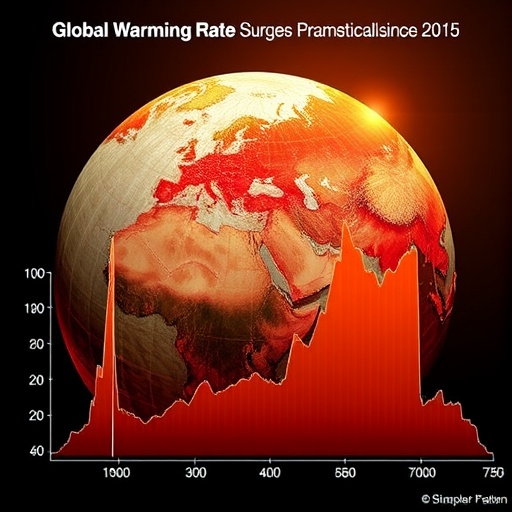
In a groundbreaking analysis published in the reputable journal Geophysical Research Letters, researchers from the Potsdam Institute for Climate Impact Research (PIK) have presented compelling evidence that global warming has not only persisted but significantly accelerated since 2015. This advance in understanding results from meticulous statistical treatment of extensive temperature data spanning over a century. By isolating and filtering out natural variability, the team brought to light a robust acceleration in global temperature trends, marking a pivotal moment in climate science.
The cornerstone of this new research is the application of sophisticated statistical methods to five major global temperature datasets—originating from NASA, NOAA, HadCRUT, Berkeley Earth, and ERA5. These datasets, known for their reliability and comprehensive coverage, provide instrumental temperature records dating back to 1880. The innovative approach applied by the PIK team involved filtering out short-term natural perturbations such as El Niño events, volcanic activities, and solar cycle fluctuations to reveal the underlying long-term warming signal more clearly.
What is especially striking about the findings is the quantifiable increase in the warming rate over the past decade. Whereas the average rate of global temperature increase from 1970 to 2015 hovered slightly under 0.2°C per decade, the rate from 2015 onwards has surged to approximately 0.35°C per decade. This rate stands as the highest recorded rate of warming since the commencement of instrumental records well over a century ago. The statistical significance of this acceleration was confirmed with a confidence level exceeding 98%, establishing a near-certain basis for this phenomenon.
Two robust statistical frameworks were employed in the study to analyze the trend. The quadratic trend analysis allowed the team to investigate nonlinear changes in warming rates, while the piecewise linear model pinpointed precise inflection points where the warming rate shifted dramatically. Both methodologies converged on a consistent message: global warming acceleration began manifesting notably around 2013 or 2014, reinforcing the reliability of the findings.
A critical aspect of this study was the careful removal of confounding natural climate drivers. El Niño, a recurring climate phenomenon characterized by warming or cooling in the equatorial Pacific Ocean, often skews short-term global temperature estimations. Similarly, solar maxima—periods of peak solar activity—and volcanic aerosols introduce variability into the climate record. Adjusting for these factors is essential to distinguish the anthropogenic trend from natural fluctuations, and the PIK team’s ability to achieve this with precision underscores the strength of their conclusions.
The study does not delve into the causative mechanisms underlying this acceleration, although it acknowledges that climate models are capable of replicating increasing warming rates under current greenhouse gas emission scenarios. This suggests that the observed acceleration aligns with broader scientific expectations concerning the impact of continued CO₂ emissions and other anthropogenic forcings on Earth’s climate system.
The implications of such acceleration are profoundly concerning in the context of international climate objectives. The findings indicate that if this heightened warming trend continues unabated, the Earth is likely to surpass the Paris Agreement’s 1.5°C threshold decades earlier than originally projected—potentially before 2030. This underlines the urgency for rapid and substantial reductions in fossil fuel emissions to mitigate further escalation of global temperatures.
The research team, led by PIK climate scientist Stefan Rahmstorf and statistical expert Grant Foster, emphasized the clarity gained by reducing climate ‘noise’ in the data. Foster noted that by removing natural variability, the underlying warming signal stands out with unprecedented discernibility. Rahmstorf echoed this sentiment, stressing the vital interplay between innovative statistical methods and global climate monitoring in unveiling climate dynamics that were previously obscured.
This study heralds a critical advancement in climate science by addressing the statistical challenges that have historically complicated the detection of changes in warming rates. Until now, short-term natural variation concealed the acceleration amid baseline variability. By filtering these elements, the research offers a clearer trajectory of climate trends, enhancing policymakers’ and the scientific community’s ability to make informed decisions.
Furthermore, the consistency of results across all examined datasets and analytic approaches adds robustness to the conclusion. This cross-validation reduces the likelihood that the observed acceleration is an artifact of methodological bias or dataset anomalies. Instead, the acceleration appears as a genuine, global-scale climatic signal with far-reaching consequences.
Intriguingly, the years 2023 and 2024, both categorized among the warmest on record, become somewhat moderated in adjusted temperature estimates when accounting for natural drivers. Nonetheless, they remain the hottest years since temperature instrumentation began, underscoring the persistent upward trajectory despite short-term corrections. The early 2010s emerged as a tipping point, highlighting a gradual but decisive shift toward accelerated warming.
In conclusion, this statistical verification of accelerated global warming deepens our understanding of the climate system’s response to anthropogenic influences. It compels a reevaluation of emission targets and climate projections, pressing for immediate action to curtail further warming. As the world confronts this accelerated trend, the importance of integrating advanced analytical tools with climate science becomes ever more apparent, bridging data insights with urgent policy needs.
Subject of Research: Statistical Analysis of Accelerated Global Warming Trends
Article Title: Global warming has accelerated significantly.
News Publication Date: 6-Mar-2026
Web References: http://dx.doi.org/10.1029/2025GL118804
References: Foster G., Rahmstorf S. (2026). Global warming has accelerated significantly. Geophysical Research Letters. DOI: 10.1029/2025GL118804
Keywords: Climate change, Global warming acceleration, Statistical analysis, Temperature datasets, El Niño adjustment, Climate modeling, Paris Agreement


