

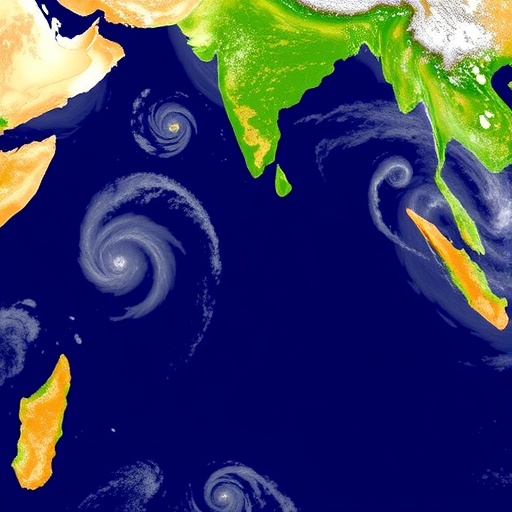
In recent years, the intensification of tropical cyclone activity has become an increasingly alarming phenomenon globally. A groundbreaking new study by Shan, Song, Lin, and colleagues, published in Nature Communications in 2026, has unveiled a direct link between global warming and the rise in pre-monsoon tropical cyclone occurrences over the North Indian Ocean. This research sheds light on the climatic changes influencing the dynamics of cyclonic storms before the onset of the monsoon season, a period traditionally marked by relative atmospheric stability in the region.
Tropical cyclones in the North Indian Ocean primarily develop during two distinct seasons: the pre-monsoon period, spanning March to May, and the post-monsoon period from October to December. The new findings indicate a conspicuous increase in cyclone frequency and intensity in the pre-monsoon months, correlating strongly with rising sea surface temperatures (SSTs) attributed to anthropogenic global warming. The study’s comprehensive data analysis reveals that this unexpected surge poses a significant alteration in the climatological patterns governing the region’s weather extremes.
One of the pivotal factors driving this increased cyclone activity is the elevated SSTs in the Arabian Sea and the Bay of Bengal, the two main sub-basins that constitute the North Indian Ocean. As greenhouse gas emissions trap more heat in the atmosphere, ocean waters absorb a significant portion, thereby raising the thermal energy available to fuel cyclones. Warmer waters facilitate enhanced evaporation rates, which, in turn, provide more moisture and latent heat energy – essential ingredients for cyclone intensification and genesis.
The research team employed advanced climate models and observational datasets spanning multiple decades to dissect the evolving cyclone behavior. Their results highlight that the pre-monsoon period is becoming more energetically favorable for tropical cyclone formation due to subtle but impactful shifts in atmospheric circulation patterns and thermodynamic variables. These shifts include changes in vertical wind shear, mid-level humidity, and low-level vorticity, all modulated by rising temperatures and altered jet stream positions.
Moreover, this increasing cyclone activity during the pre-monsoon phase bears critical implications for the densely populated coastal regions of India, Pakistan, Bangladesh, and Myanmar. These areas have traditionally been less prepared for severe storms in the earlier months of the year, as monsoon onset typically marks the active tropical storm period. The newfound surge complicates disaster preparedness, burdening local infrastructure and communities with augmented risks outside the expected cyclone season.
The study also underscores the role of anthropogenic factors versus natural climate variability. By isolating the human-induced warming signal from natural ocean-atmosphere oscillations such as the Indian Ocean Dipole and El Niño-Southern Oscillation, the researchers provide compelling evidence that the recent changes in cyclone activity are predominantly driven by global warming. This attribution is critical in focusing mitigation and adaptation strategies within regional and international climate policy frameworks.
In addition to climatological observations, the team analyzed the storm intensity metrics and trajectories, revealing that the intensification rates of pre-monsoon cyclones have accelerated concurrently with warming trends. These storms tend to exhibit more robust wind fields and greater precipitation rates, escalating their capacity to inflict damage. The enhanced storm strength adds a new dimension of urgency to understanding and forecasting cyclogenesis in this vulnerable region.
Hydrological consequences also come into focus given this shift in cyclone dynamics. The pre-monsoon tropical cyclones bring heavy rains that can trigger flash floods, landslides, and significant sediment transport, affecting river basins and coastal ecosystems before the stabilizing influence of the monsoon. The disruption of normal hydrological cycles threatens agriculture, water supply, and biodiversity, creating complex challenges for environmental management and food security.
The researchers emphasize that monitoring and modeling efforts must prioritize the evolving threat posed by pre-monsoon cyclones. Current early warning systems, infrastructure design codes, and community preparedness programs are aligned mostly with the traditional storm seasons and may lag in responsiveness to the new risk periods. Strengthening observational networks and incorporating the latest climate projections into policy planning become imperative goals.
This pivotal study also highlights the interconnectedness of global climate phenomena. The intensification of North Indian Ocean cyclones echoes similar upward trends reported in other oceanic basins worldwide, such as the Atlantic and Western Pacific. However, the North Indian Ocean’s unique geography, socioeconomic factors, and monsoon dynamics demand tailored strategies to address the localized impacts effectively.
The authors propose that ongoing and future research should focus on refining regional climate models to resolve finer-scale interactions between ocean warming, atmospheric processes, and cyclone genesis. Such improvements will enhance the predictive capacity and support actionable intelligence for stakeholders, from government authorities to coastal communities.
Furthermore, the findings advance the discourse on climate justice, as vulnerable populations in the Indian subcontinent disproportionately bear the brunt of increasing storm hazards while contributing minimally to global emissions. This situation calls for integrated approaches combining climate adaptation, emission reduction efforts, and international cooperation to build resilience.
In summary, the study by Shan et al. unequivocally documents that ongoing global warming is catalyzing a notable increase in pre-monsoon tropical cyclone activity over the North Indian Ocean, a region of high demographic and ecological sensitivity. The implications of this research extend beyond scientific understanding, acting as a clarion call for urgent and informed action to mitigate emerging climate risks and safeguard millions.
This landmark contribution not only deepens our grasp of how climate change alters cyclone behavior in lesser-studied domains but also underscores the pressing need to evolve disaster management paradigms and climate policies in harmony with emerging realities.
By elucidating the mechanistic pathways through which ocean warming intensifies pre-monsoon cyclones, the study provides critical knowledge essential for forecasting and proactive response strategies. As the world confronts an era of escalating climate extremes, such insights form the foundation for resilient futures.
Subject of Research:
The study investigates the influence of anthropogenic global warming on the increase in pre-monsoon tropical cyclone activity over the North Indian Ocean, exploring ocean-atmosphere interactions and climatic drivers of observed changes.
Article Title:
Global warming drives an increase in pre-monsoon tropical cyclone activity over the North Indian Ocean.
Article References:
Shan, K., Song, F., Lin, Y. et al. Global warming drives an increase in pre-monsoon tropical cyclone activity over the North Indian Ocean. Nat Commun (2026). https://doi.org/10.1038/s41467-026-69818-x
Image Credits: AI Generated


