

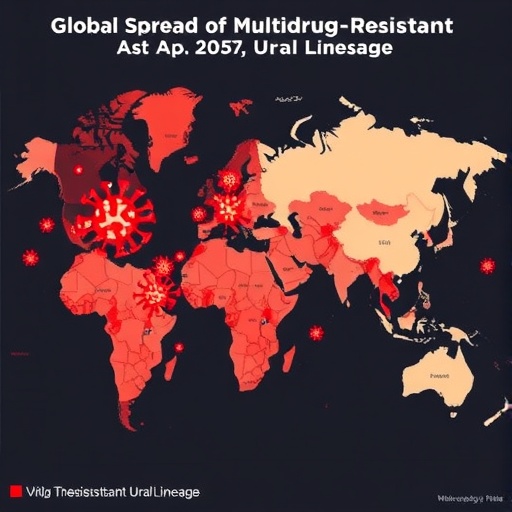
The relentless spread of multidrug-resistant tuberculosis (MDR-TB) continues to pose a formidable challenge to global public health, demanding an urgent reevaluation of our strategies for containment and treatment. In a groundbreaking study published in Nature Communications, Chitwood, Rancu, Song, and colleagues unveil the intricate global phylogeography of the Ural lineage 4.2 of Mycobacterium tuberculosis, a strain notorious for its rapid expansion and multidrug resistance. This research not only pinpoints the evolutionary trajectories of this lineage but also unravels its alarming dissemination patterns, reshaping our understanding of how tuberculosis adapts and thrives under therapeutic pressure.
Tuberculosis remains one of the deadliest infectious diseases worldwide, claiming over a million lives annually. The emergence and proliferation of MDR strains exacerbate this public health crisis, rendering conventional antibiotics ineffective. The Ural lineage 4.2 has recently drawn scientific scrutiny due to its remarkable ability to evade multidrug regimens, often outperforming other lineages in terms of transmission and resistance. This study leverages high-throughput whole-genome sequencing and sophisticated phylogenetic analyses to map the skyline of this lineage’s evolution and dispersion on a global scale.
By sequencing hundreds of clinical isolates collected across diverse geographic regions, the research team constructed a comprehensive phylogenetic tree, illuminating the microevolutionary steps that have propelled Ural lineage 4.2 into a worldwide threat. Their approach involved the integration of genomic data with epidemiological and demographic information, allowing for the reconstruction of temporal and spatial migration models. The results reveal a pattern of rapid clonal expansion punctuated by the acquisition of resistance-conferring mutations, underscoring the adaptive prowess of this pathogen.
A key revelation from this study is the identification of multiple independent resistance events, suggesting that the Ural lineage 4.2 does not merely inherit resistance from a single ancestor but repeatedly evolves under drug pressure. This complexity impedes straightforward diagnostic and therapeutic interventions, as heterogeneity within the strain can mask resistance profiles. Additionally, the lineage exhibits genetic markers linked to enhanced transmissibility, a feature that could explain its swift global dissemination despite ongoing control efforts.
The geographical distribution unveiled by the phylogeographic reconstruction points to Eastern Europe as a likely epicenter for the early diversification of Ural lineage 4.2. From this nexus, the strain exhibits a discernible migration trajectory towards Central Asia, the Middle East, and increasingly, pockets in Western Europe and beyond. This pattern aligns with both historical migration routes and contemporary patterns of urbanization and international travel, suggesting that human sociocultural dynamics play a pivotal role in fungal epidemiology.
Intriguingly, the study also highlights the influence of host-pathogen interactions and environmental factors in shaping the evolutionary landscape of this lineage. Variability in immune pressures and antimicrobial usage across regions creates a fertile ground for the selection of drug-resistant variants. Genomic evidence indicates selective sweeps around genes implicated in antibiotic resistance, such as mutations in the rpoB and katG genes, which are critical for rifampicin and isoniazid resistance respectively, the frontline drugs in TB treatment.
Advanced computational modeling applied in this research sheds light on the temporal dynamics of the lineage’s expansion. Estimates derived from molecular clock analyses suggest that the key multidrug resistance mutations appeared relatively recently, within the last two decades, coinciding with intensified antimicrobial use and suboptimal treatment adherence observed globally. This timing underscores the urgent need for improved stewardship of existing therapies and the rapid deployment of novel interventions.
The pathogenic success of the Ural lineage 4.2 cannot be fully appreciated without considering its genomic plasticity. Beyond resistance mutations, the lineage harbors genetic elements linked to virulence factors, metabolic versatility, and stress responses, enabling it to persist and replicate within diverse host environments. This adaptability likely contributes to prolonged infectious periods and higher transmission risks, further complicating control measures.
Public health implications derived from this study are profound. Current diagnostic algorithms may fail to detect the full spectrum of resistance mutations within this lineage, leading to inappropriate treatment regimens that perpetuate resistance cycles. The authors advocate for the integration of whole-genome sequencing into routine surveillance programs to capture emergent resistance patterns in real-time, thereby informing targeted therapeutic interventions and policy decisions.
Furthermore, the international spread detailed in this research calls for a coordinated, multisectoral response transcending national boundaries. Enhanced screening protocols, particularly in migratory hotspots and healthcare settings, coupled with patient-centered care models emphasizing adherence, are imperative to curb the propagation of this resilient pathogen. Investment in vaccine development tailored against the unique antigenic profiles of lineage 4.2 could also be transformative.
This study serves as a clarion call to the scientific community and global health agencies, emphasizing that the battle against tuberculosis is entering a new phase marked by rapid bacterial evolution and globalization-driven spread. It exemplifies how integrative approaches combining genomics, epidemiology, and computational biology can unravel complex infectious disease challenges, enabling proactive rather than reactive public health strategies.
As the world grapples with emerging and re-emerging infectious diseases, understanding the molecular and ecological underpinnings of MDR tuberculosis offers a critical template for tackling antimicrobial resistance at large. The insights garnered from the global phylogeography of Ural lineage 4.2 underscore the pathogen’s capacity to outpace conventional interventions, necessitating innovative diagnostics, therapies, and surveillance frameworks grounded in genomic intelligence.
In conclusion, the expansive research by Chitwood and colleagues heralds a paradigm shift in tuberculosis control, emphasizing precision medicine and international collaboration as the cornerstones of future success. The detailed portrait of the Ural 4.2 lineage’s genetic journey not only enriches our scientific knowledge but also provides actionable pathways to impede its spread. Combatting this multidrug-resistant foe demands vigilance, agility, and an unwavering commitment to deploying cutting-edge science in the service of global health.
Subject of Research: The global phylogeography and multidrug resistance mechanisms of Ural lineage 4.2 Mycobacterium tuberculosis
Article Title: The global phylogeography of rapidly expanding multidrug resistant Ural lineage 4.2 Mycobacterium tuberculosis
Article References:
Chitwood, M.H., Rancu, I., Song, Y. et al. The global phylogeography of rapidly expanding multidrug resistant Ural lineage 4.2 Mycobacterium tuberculosis. Nat Commun (2026). https://doi.org/10.1038/s41467-026-71193-6
Image Credits: AI Generated


