

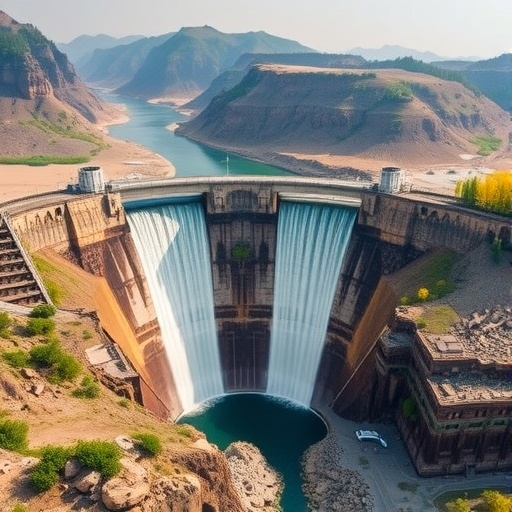
In recent years, the growing impact of climate change has amplified the frequency and severity of drought events worldwide, placing substantial stress on water resources and associated energy systems. Among the sectors most vulnerable to these hydrological disruptions is hydropower, a renewable energy source that fundamentally depends on the availability of water to generate electricity. A new breakthrough study conducted by researchers R.I. Cuppari, T.M. Pavelsky, and G.W. Characklis has now shed light on a promising strategy to mitigate the financial risks that drought imposes on countries whose energy portfolios heavily rely on hydropower. Published in Nature Communications in 2026, their study explores the concept of global risk pooling as an innovative approach to safeguard and stabilize hydropower-dependent nations against the economic volatility caused by prolonged dry spells.
Hydropower’s dependence on consistent river flows inherently ties its productivity to climate and weather variability. Droughts, characterized by abnormally low precipitation and reduced river inflows, can drastically curtail hydropower generation, leading to significant revenue losses and potential energy shortages. The economic consequences ripple through national economies, impacting energy prices, industrial productivity, and even social welfare. Traditional risk management strategies, such as localized energy diversification or governmental emergency funds, often fall short in cushioning the extensive and systemic fiscal impacts of droughts. This inadequacy prompted Cuppari and colleagues to rethink financial risk management by analyzing the benefits of risk sharing on a global scale.
Global risk pooling refers to the aggregation and distribution of financial risks across multiple countries or regions, effectively spreading potential losses and gains. This mechanism is inspired by principles of insurance and reinsurance, where risks are diversified to reduce the burden on any single participant. Utilizing sophisticated climate and economic models, the researchers quantified the financial risks drought poses to hydropower systems in various countries worldwide and simulated how pooling these risks can mitigate economic volatility. Their approach integrated hydrological data, energy market forecasts, and macroeconomic indicators to create a comprehensive framework for evaluating risk transfer benefits.
The findings of the study are both enlightening and encouraging. By creating a global hydropower drought risk pool, countries can significantly lower the variance of their energy revenue losses compared to managing risks independently. This stabilizing effect arises because drought occurrences are often spatially and temporally uncorrelated across regions; when one country suffers from a dry spell, others may experience average or above-average water flows, enabling cross-border compensation. In practical terms, this means a country facing hydropower revenue shortfalls during a drought can be financially supported by collective resources generated from less-affected countries, smoothing out the financial turbulence caused by climatic extremes.
Highlighting specific regions, the study demonstrates that nations in South America and Africa, which rely heavily on hydropower, stand to gain substantial economic resilience through risk pooling. For instance, Brazil and Zambia, both hydropower-dependent but with distinct climatic regimes, show complementary drought cycles, making them ideal partners in a cooperative risk-sharing arrangement. This transnational financial cooperation could be facilitated via international climate finance mechanisms or newly designed financial instruments tailored for hydropower risk management.
Beyond financial stabilization, risk pooling can also incentivize more sustainable water resource management. Knowing that drought risks are collectively managed and compensated can encourage countries to invest in long-term infrastructure improvements, such as reservoir expansions and integrated water-energy planning, without fear of incurring catastrophic financial losses. Moreover, the interconnected financial safety net may enhance investments in hydropower by reducing the perceived investment risk, thereby supporting global renewable energy transitions aligned with climate mitigation goals.
Nevertheless, implementing a global risk pool for hydropower drought risk is not without challenges. Coordinating among sovereign countries involves complex negotiations on equity, contribution assessments, governance structures, and regulatory harmonization. Trust-building and transparent data sharing are critical elements for such a system’s success, requiring international frameworks and possibly third-party oversight institutions. The study emphasizes the importance of designing flexible, adaptive policies that can evolve in response to changing climate dynamics and economic conditions.
From a technical perspective, the models employed by the researchers hinged on a suite of advanced statistical and computational tools, such as stochastic hydrological simulations, portfolio optimization algorithms, and machine learning-based climate predictions. This integration allowed the team to capture the nonlinear dynamics of hydropower production and drought impacts under uncertainty, providing robust insights into the potential financial benefits of coordinated risk management. Their methodology sets a new standard for interdisciplinary climate risk assessment, blending hydrology, economics, and policy analysis.
Looking ahead, the implications of this research extend beyond hydropower. The concept of global risk pooling could be adapted to other climate-sensitive sectors, such as agriculture, insurance, and public health, wherever distributed risk sharing holds the promise of improved resilience to extreme environmental events. Furthermore, it aligns with ongoing international efforts aimed at climate adaptation financing, underlining the increasingly interconnected nature of climate risks and the need for cooperative, systemic solutions.
In summary, the study by Cuppari, Pavelsky, and Characklis marks a pivotal advance in understanding and managing the multifaceted risks posed by drought to hydropower-dependent countries. By proposing and rigorously evaluating the mechanism of global risk pooling, they provide a scientifically grounded, economically viable framework for shielding nations from the pronounced financial shocks induced by climate variability. This approach not only promises to enhance energy security but also fosters international collaboration crucial for addressing the global challenges of climate change.
As the world grapples with accelerating climatic shifts, innovation in financial and policy instruments such as global risk pooling becomes indispensable. The research highlights how solidarity and shared responsibility among countries can transform a pressing vulnerability into an opportunity for resilience and sustainability. Given the vital role of hydropower in the clean energy matrix, protecting it through such novel frameworks supports broader climate goals while cushioning vulnerable economies from environmental disruptions.
To realize the potential of global risk pooling fully, further research and pilot projects are needed to translate theoretical models into actionable programs. This includes developing legal frameworks that address cross-border financial flows, standardizing risk assessment methodologies, and fostering capacity-building initiatives for participating countries. The new paradigm suggested by this study underscores the necessity of anticipatory and cooperative governance to effectively confront the intertwined challenges of hydrological uncertainty, energy security, and economic stability.
In conclusion, the breakthrough insights from this landmark study represent a beacon of hope and a call to action. By embracing global risk pooling mechanisms, hydropower-dependent nations can better navigate the unpredictable realities shaped by climate change, ensuring that renewable energy systems remain reliable pillars of sustainable development. The research illustrates the power of interdisciplinary collaboration and innovative thinking in crafting solutions that transcend borders and safeguard the common good in an era of climate crisis.
Subject of Research: Financial risk mitigation of drought impacts in hydropower-dependent countries through global risk pooling mechanisms.
Article Title: Global risk pooling mitigates financial risk from drought in hydropower-dependent countries.
Article References:
Cuppari, R.I., Pavelsky, T.M. & Characklis, G.W. Global risk pooling mitigates financial risk from drought in hydropower-dependent countries. Nat Commun (2026). https://doi.org/10.1038/s41467-025-67082-z
Image Credits: AI Generated


