

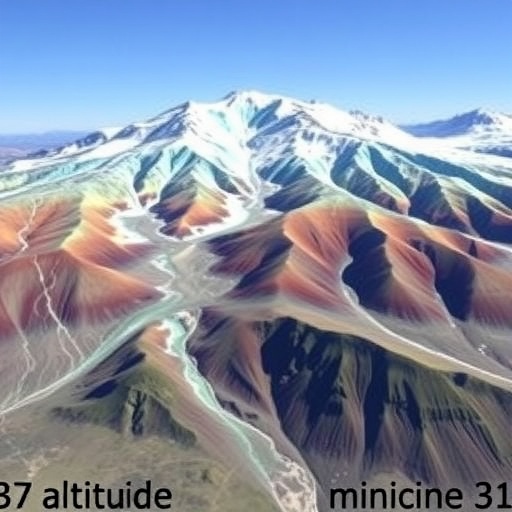
A groundbreaking study has emerged from a team of international researchers, offering revolutionary insights into the relationship between glacier equilibrium-line altitudes (ELAs) and the Earth’s paleoclimate. Published in Communications Earth & Environment, this research enhances our ability to reconstruct past climates by providing refined global estimates of glacier ELA ratios. The implications of this work extend beyond glaciology, touching on climate modeling, historical environmental assessments, and future climate prediction methods.
At its core, the study focuses on glacier equilibrium-line altitudes—the altitudinal threshold on a glacier where accumulation and ablation are balanced. This line marks the boundary separating zones where snow and ice gain mass from those where they lose mass. Historically, understanding ELA changes has been essential for interpreting glacial responses to climate variations. However, prior estimates have suffered from significant regional inconsistencies and scaling uncertainties, impacting the precision of paleoclimate reconstructions.
By compiling an unprecedented global dataset and integrating advanced statistical modeling techniques, the researchers developed robust estimates for ELA ratios, accounting for regional variability and glacier morphology. Their comprehensive approach synthesizes data from various continents, glacier types, and climatic zones, enabling a more harmonized framework for interpreting glaciological indicators in paleoenvironmental contexts. This refinement provides a universal standard applicable to diverse glacial settings worldwide.
Technically, the study leverages remote sensing data, ground-truth observations, and ice core analyses to model glacier mass balance dynamics with extraordinary accuracy. The authors employ a multi-parametric regression model calibrated with empirical data, which quantifies the shifts in ELA in response to temperature fluctuations and precipitation patterns over millennia. This methodology surpasses previous heuristic models by incorporating higher-dimensional variables such as aspect, slope, and local topographic shading, all of which critically influence local glacier mass balance.
One of the most striking outcomes of this research lies in its improved temporal resolution. By precisely pinpointing ELA shifts across different time scales, from the mid-Holocene to the Last Glacial Maximum, the study enhances our capacity to correlate glacier responses with specific paleoclimatic episodes. This temporal specificity allows scientists to discern nuanced climate oscillations that might otherwise be obscured in broader historical climate reconstructions, thereby refining global climate models’ sensitivity.
Furthermore, the global scope of the analysis sets a new benchmark in the field. Prior ELA studies were often region-specific, limiting their extrapolation power. This study’s integration of data from large ice masses in polar regions, mid-latitude mountain glaciers, and tropical glaciers reveals universal patterns and heterogeneities in glacial response. This comprehensive perspective uncovers previously unrecognized systemic behaviors in glacier-climate interactions, challenging some long-held assumptions in glaciology.
The implications extend to predicting future glacier behavior under ongoing anthropogenic climate change. Understanding past glacier responses with newfound resolution enables the calibration of predictive models that anticipate future mass balance trends. This capability is critical for anticipating water resource availability in glacier-fed river basins, informing policy decisions related to flood risks, hydropower generation, and ecosystem conservation.
A particularly innovative aspect of this research is its application in paleoclimate reconstructions beyond traditional proxy evidence like ice cores and sedimentary deposits. Glacier ELA ratios emerge as a quantifiable proxy, blending physical glaciology with climatology and geomorphology. This fusion allows a non-biased and direct climate signal extraction, thereby reducing ambiguities commonly associated with indirect proxies and enhancing confidence in paleoclimate datasets.
The study’s authors also highlight the potential of machine learning to further refine these models. Future iterations could incorporate high-resolution topographic data and real-time climate inputs to dynamically update ELA estimates. This forward-thinking integration signifies a pivotal moment where big data analytics and earth science converge to unlock the planet’s climatic history in unprecedented detail.
By exploring regional anomalies in ELA ratios—where certain glaciers responded paradoxically to climate drivers—the team sheds light on complex feedback mechanisms within cryospheric systems. These insights offer new explanations for why some glaciers advanced or retreated asynchronously relative to global temperature trends, emphasizing the importance of localized factors in climate-glacier dynamics.
This advance in understanding is timely, considering the accelerating pace of glacier retreat worldwide. As glaciers vanish, preserving their climatic histories becomes crucial. The refined global ELA ratio benchmarks can help identify extinct glaciers’ past extents and conditions, offering a window into long-gone climatic regimes and improving future scenario projections for glaciated regions.
The interdisciplinary collaboration underpinning the research—spanning glaciologists, climatologists, geospatial analysts, and statisticians—demonstrates the synergy needed to tackle broad scientific questions. Their collective expertise ensured methodological rigor and cross-validation across multiple independent datasets, strengthening the reliability of derived conclusions.
Critically, the authors have made their comprehensive database publicly accessible, providing a valuable resource for the global scientific community. This openness not only facilitates independent verification but also stimulates further research building upon their foundation, accelerating the pace of discovery in cryospheric science.
Ultimately, the study elevates glacier ELA ratios from an often underutilized parameter to a cornerstone metric in paleoclimatology. By establishing consistent global benchmarks, it empowers researchers to unravel Earth’s climatic past with newfound precision, laying a foundation for improved future climate projections and mitigation strategies.
As the climate crisis intensifies, insights like these underscore the importance of deep-time climate understanding. Holistically capturing glacier responses to ancient climate shifts equips humanity with the knowledge needed to navigate contemporary environmental challenges. This research marks a transformative step toward that goal.
Subject of Research: Glacier equilibrium-line altitude ratios and their applications in paleoclimate reconstructions.
Article Title: Global estimates of glacier equilibrium-line altitude ratios for enhanced paleoclimate reconstructions.
Article References:
Yang, W., Mackintosh, A.N., Cooper, E.L., et al. Global estimates of glacier equilibrium-line altitude ratios for enhanced paleoclimate reconstructions. Communications Earth & Environment (2026). https://doi.org/10.1038/s43247-026-03391-5
Image Credits: AI Generated


