

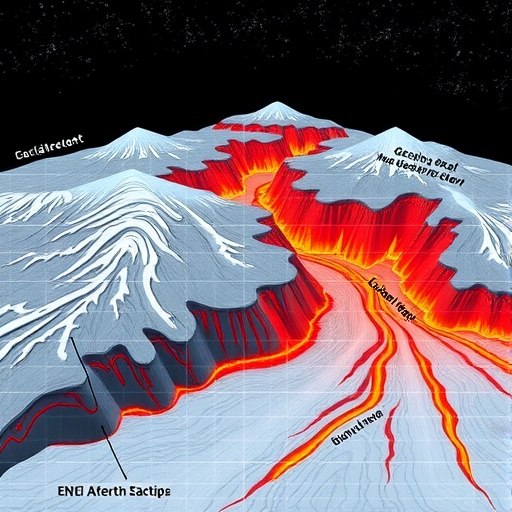
In a groundbreaking new study published in Nature Communications, researchers have unveiled a critical link between glacial loading and the dynamic behavior of magma beneath continental volcanic arcs. This pioneering work fundamentally advances our understanding of how surface processes such as glaciation influence deep Earth phenomena, specifically the ascent and storage of magma—a process that ultimately leads to volcanic eruptions. By integrating geophysical modeling with geological observations, the team has illustrated how the stress exerted by massive ice sheets can create “stress pinch points” that modulate the pathways through which magma ascends and accumulates in the crust, potentially altering volcanic activity in regions with extensive glaciation histories.
Volcanic arcs are complex systems typically formed above subduction zones, where one tectonic plate drives beneath another, generating magma that rises through the Earth’s crust to feed volcanoes. The traditional view holds that magma ascent is largely governed by tectonics and mantle melting processes. However, this new research introduces an additional and often overlooked variable: the effect of glacial loading on the mechanical stress regime of the crust. When large ice masses accumulate, their immense weight deforms the underlying rock, inducing localized stress changes that can open or close pathways for magma flow. Conversely, the melting and retreat of these ice masses reduce loading, triggering further stress adjustments. This interplay appears to create dynamic windows of enhanced or impeded magma movement.
At the core of this investigation are sophisticated numerical models that simulate the stress fields induced by changing glacial masses on continental arcs. By layering these models with magma dynamics simulations, the researchers have shed light on how an evolving stress landscape controls the “pinch points” — narrow zones of concentrated stress — where magma is either bottlenecked or allowed to pass freely. These stress pinch points act as crucial control points for magma storage, delimiting where magma chambers form and evolve over time. Such chambers are the reservoirs that sustain volcanic eruptions, meaning glacial processes far from the volcanic vents themselves could influence eruption frequency and magnitude.
One of the striking revelations from this study is that glacial loading does not just exert a uniform compressive force; instead, it causes heterogeneous stress distributions in the crust. These uneven stress fields foster spatial variations in the mechanical strength and permeability of the host rocks, thereby guiding magma ascent along preferred structural domains. Areas beneath thick, stagnant ice sheets may experience compressed rock that impedes magma ascent, while zones near ice margins or during rapid deglaciation may undergo tensile stress regimes that facilitate magma migration. This nuanced view challenges prior assumptions about magma pathways and highlights the importance of integrating surface ice dynamics with subsurface geodynamic processes.
Furthermore, this research provides critical temporal insight by linking glacial cycles spanning tens of thousands of years with episodic volcanic activity. As glaciers wax and wane through ice ages, the resulting modulations in crustal stress and magma dynamics could create pulses of volcanic eruptions or quiescence synchronized with orbital and climatic shifts. Put simply, the waxing and waning of ice sheets may not only reshape landscapes through erosion and deposition but also dictate when and how volcanoes erupt. This conceptual breakthrough unites disparate Earth systems—climatology, glaciology, and volcanology—under a comprehensive framework.
Importantly, the study’s findings have broad implications for volcanic hazard assessment in regions currently experiencing or recovering from glaciation. For example, volcanic arcs in the Pacific Northwest, parts of the Andes, and Iceland—all regions with histories of extensive ice cover—may be subject to stress field variations influencing magma behavior. Reactivation of dormant volcanoes or increased magma storage could follow ice retreat that alters subsurface stress pinch points. Such insight equips volcanologists and emergency planners with new tools to anticipate volcanic unrest in a changing climate.
Technically, the research team employed state-of-the-art finite element modeling to resolve stress distributions in the crust in response to glacial load changes. These models were carefully calibrated with seismic tomography data and surface geology to validate their realism. Additionally, magmatic ascent was described using fluid dynamics equations, incorporating pressure gradients, viscous resistance, and rock fracturing mechanics. The integration of these multidisciplinary approaches is a key strength, enabling a robust depiction of coupled stress-magma interactions rarely achieved in previous studies.
The data underpinning these models derive from multiple geological and geophysical sources: ice sheet reconstructions from remote sensing and ice core records, rock mechanical properties from laboratory experiments, and magma compositions from volcanic deposits. By correlating these datasets spatially and temporally, the study elucidates not only where magma accumulates but also the timing of its mobilization relative to glacial cycles. This comprehensive approach ensures that the conclusions extend beyond theoretical speculation toward a practical understanding of Earth’s volcanic systems influenced by cryospheric dynamics.
Beyond the continental arcs, these findings may also have relevance for volcanic centers influenced by smaller-scale glaciers or seasonal snowpacks. Localized stress pinch points could transiently affect magma ascent even in less glaciated terrains, potentially explaining enigmatic volcanic unrest episodes observed in certain mountain ranges. The broad applicability of the stress pinch point concept across scales posits it as a fundamental mechanism in the Earth’s endogenous system.
Moreover, the research underscores the intricate feedback loops between surface climate and deep Earth processes. Glacial loading and unloading do not merely respond to climate but actively reshape volcanic systems that can, in turn, emit greenhouse gases influencing climate trajectories. This bi-directional interplay emphasizes that understanding volcanic hazards requires a holistic perspective encompassing climatic drivers, glaciation patterns, and mantle-crust interactions.
As the scientific community grapples with predicting volcanic hazards in a warming world, this new paradigm emphasizes that glacier retreat may activate previously quiescent magma bodies through mechanical stress modulation. Such mechanistic insights are crucial for forecasting eruption likelihood and magnitude, and for designing monitoring strategies that integrate geodetic measurements of surface deformation with deep volcanic system assessments.
Finally, the research also invites further exploration of the nuances governing magma storage beneath volcanoes and how these processes vary with crustal composition, geothermal gradients, and tectonic setting in glaciated arcs. As models evolve with better computational power and data resolution, future studies will refine the parameters controlling stress pinch points and magma dynamics, propelling volcanic science into a new era of integrated Earth systems understanding.
In conclusion, this landmark study represents a paradigm shift in Earth sciences, highlighting glacial loading as a potent modulator of magma ascent and storage in continental volcanic arcs. Through a sophisticated interplay of geophysical modeling and geological evidence, Townsend, Moreno-Yaeger, Harp, and collaborators have mapped how subsurface stress pinch points arising from ice sheet dynamics sculpt volcanic plumbing systems, ultimately influencing eruption behavior. This nexus of cryosphere-geosphere interactions not only transforms volcanic hazard prediction but also enriches our grasp of the Earth’s interconnected systems amid a rapidly changing climate.
Subject of Research: The influence of glacial loading on magma ascent and storage dynamics in continental volcanic arcs.
Article Title: Stress pinch points from glacial loading modulate magma ascent and storage in continental arcs.
Article References: Townsend, M., Moreno-Yaeger, P., Harp, A. et al. Stress pinch points from glacial loading modulate magma ascent and storage in continental arcs. Nat Commun (2026). https://doi.org/10.1038/s41467-026-69485-y
Image Credits: AI Generated


