

In an age where environmental awareness is at the forefront of public discourse, the implications of water quality on health and wellbeing remain profound. Recent research conducted by Ahmed, Mazhar, and Hussain has brought to light the critical issue of haloacetic acids (HAAs) in drinking water, particularly focusing on a case study conducted in Jamia Nagar, New Delhi. The study, which utilizes Geographic Information Systems (GIS) for spatial monitoring and analysis, provides vital insights into the presence and distribution of these potentially harmful compounds in metropolitan drinking water supplies.
Haloacetic acids are a group of disinfection byproducts formed when chlorine used in water treatment interacts with organic matter. Although chlorination is essential to ensure that drinking water is free from pathogens, the unintended consequence of this process can lead to the formation of HAAs, which have been associated with various health risks, including cancer. Despite their significance, there has been a notable gap in research addressing the spatial distribution of HAAs within urban drinking water systems. This is where the current study fills a crucial void, utilizing advanced GIS methodologies to present a comprehensive assessment.
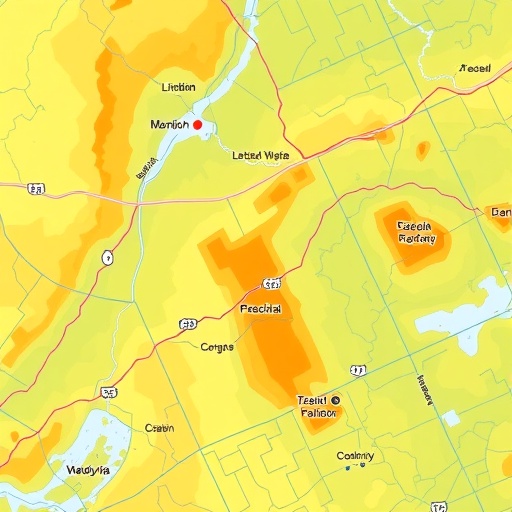
The findings from Jamia Nagar highlight the varying concentrations of HAAs across the region, revealing troubling peaks in certain localities. The researchers conducted field sampling over a designated period, analyzing water samples from different sources to quantify HAA levels. This detailed sampling approach was not only instrumental in identifying problem areas but also provided a clear visual representation of contamination pools through GIS mapping. Such visualization enables concerned stakeholders—ranging from local government bodies to health organizations—to target interventions more effectively.
The GIS framework employed in this study allowed for the integration of diverse data sets, including hydrological information, demographic distributions, and urban infrastructure layouts, creating a multifaceted platform for analysis. By layering these datasets, the researchers could extract patterns and correlations that would otherwise remain obscured. This innovative application of GIS demonstrates its practical utility in environmental monitoring and public health assessment, showcasing how technology can intersect meaningfully with ecological science.
Moreover, the study emphasizes the importance of proactive measures in managing water quality issues. If left unchecked, the harmful effects of HAAs can exacerbate public health crises, particularly in regions with already stressed healthcare systems. As cities around the world continue to grow, the demand for safe drinking water becomes ever more pressing. The findings serve as a clarion call for local authorities, urging them to implement more robust water treatment procedures, including advanced filtration techniques that can significantly reduce HAA concentrations.
Public awareness and education are also pivotal in addressing water quality concerns. The authors advocate for increased transparency in reporting water quality data to the public, allowing residents to understand the potential risks they may face with their drinking water. By promoting community engagement and awareness, residents can make informed decisions about their water usage and advocate for cleaner local policies. Citizen involvement can often serve as a catalyst for change, pressing authorities to prioritize environmental health and public safety.
In assessing the implications of this research, one can’t help but consider the broader urban planning challenges presented. As populations rise and urban sprawl continues, the encroachment into natural ecosystems is likely to intensify. The presence of organic material contributing to HAA formation in treated water can be viewed as a reflection of broader environmental degradation. Sustainable urban planning practices must intersect with robust monitoring systems to ensure that both human health and biodiversity are safeguarded.
Following this study, future research avenues are ripe for exploration. Investigating the effects of climate change on the formation of HAAs and the efficacy of different water treatment methods in mitigating their presence could prove essential. As weather patterns evolve, understanding how they affect water quality will be crucial in developing adaptive strategies to address future challenges. Such research will require interdisciplinary collaboration among environmental scientists, chemists, urban planners, and public health officials.
In light of the study’s outcomes, it is evident that policies surrounding water treatment need to evolve to incorporate findings from contemporary research. The integration of ongoing monitoring and assessment protocols can help establish a baseline of water quality that reflects real-time conditions. More importantly, these protocols must be accompanied by a framework for responding to emergent data, ensuring that risks are addressed without delay.
In conclusion, the spatial monitoring and analysis of haloacetic acids through GIS methodologies represent a pivotal advancement in the ongoing battle for safe drinking water. The cumulative knowledge gleaned from the Jamia Nagar case study underlines the significance of adaptable, data-driven approaches to public health safeguarding. As further research unfolds, the momentum generated by this groundbreaking study can foster a renewed commitment to ensuring clean and healthy water for all.
The subject of research is not just a scientific curiosity; it is of paramount importance to the living conditions of millions in urban environments. The implications of haloacetic acids in drinking water stretch beyond simple chemical analysis, inviting a holistic reevaluation of environmental health practices. As the dialogue around water quality continues to evolve, let us remain vigilant and proactive in our pursuit of solutions, inspired by the findings of Ahmed, Mazhar, and Hussain.
Subject of Research: Analysis of haloacetic acids in drinking water
Article Title: Spatial monitoring and analysis of haloacetic acids in drinking water using GIS: a case study of Jamia Nagar, New Delhi
Article References:
Ahmed, S., Mazhar, M.A. & Hussain, W. Spatial monitoring and analysis of haloacetic acids in drinking water using GIS: a case study of Jamia Nagar, New Delhi.
Environ Monit Assess 198, 46 (2026). https://doi.org/10.1007/s10661-025-14783-z
Image Credits: AI Generated
DOI: https://doi.org/10.1007/s10661-025-14783-z
Keywords: haloacetic acids, drinking water quality, GIS, public health, environmental monitoring


